One of our neighbours from one of our previous addresses has provided me with stamps over a number or years. These have been mainly from Greece but last week she brought me a stamp that has become the oldest in my collections.
Great Britain - 1841
The One Penny Red was first issued in 1841 - the second stamp issued. The original was unperforated. Several different versions were issued - perforated and with different letters in the bottom corners. This has O - A.
As you can see the stamp is a bit tired but that's not surprising for something around 180 years old. I still have to establish exactly what year this was issued.
The theme today on Sunday Stamps is transportation. My old stamp has transported me back even if it's not on theme.
It's a long time since I last appeared on Sepia Saturday but when I saw that you had reached 'M' in the alphabet series I just knew I had to take part.
I may not be able to show you machines or a lady working with them.
However I came across a gentleman not known, or traced by me. There is no doubt about the photographer -
Hayman Selig Mendelssohn (1847 -1908) had studios in London and Newcastle and was also photographer to Her Majesty Queen Victoria and the Royal Family.
This portrait found on a market stall in the North East of England contains interesting information on the back.
It is most frustration that I cannot read the signature but it appears to have been written in December (?) 1888.
And the number of photographic medals also fit nicely into our theme for 'M'.
For other 'M' related posts please visit the links at Sepia Saturday 545
At this stage of the Challenge it's time to mind my Ps and Qs. In East Devon when a visit by Queen Victoria was planned the names of some places where changed to '_____puddle', presumably to save her blushes. In Dorset next to a church at Alton Pancras a small stream has its source.
River Piddle at Alton Pancras
Piddle in Old English simply means 'marsh' of 'fen".
The course of the Piddle takes it south/south east to Wareham where together with the River Frome it exits into Poole Harbour.
Afpuddle is one of thesmall villages in East Dorset, situated in the heart of " Hardy's country " and on the banks of the little River Piddle, from which it derives its name.
Afpuddle on the River Piddle
An advert called Paradise for Sale inspired Ogden Nash to write this poem.
The village of Piddletrenthide is mentioned in the Domesday Book as an estate on the River Piddle assessed at thirty (trent) hides.
If you are a movie buff I'll bet you didn't know that the African Queen was shot in part on the River Piddle when they used the reeds at the river mouth for where Bogart pulled the Queen along.
The river passes next to the garden of a pub at Piddletrenthide just the place to stop at - no comment needed.
Photo attributions:
River Piddle at Alton Pancras: 30 December 2008 ex geograph.org.uk by Nigel Mykura - CC BY-SA 2.0 licence
Afpuddle on the River Piddle: c1903 Newberry Publications, published by Raphael Tuck & Sons - Public Domain
Sign for the Piddle Inn: 4 October 2008 ex geograph.org.uk by Trish Steel - CC BY-SA 2.0 licence
O - Osborne House "It's impossible to imagine a prettier spot." That's what Queen Victoria said of Osborne House on the Isle of Wight.
North face of Osborne House, IOW (CC BY-SA 3.0)
The Osborne estate was in the hands of the Blachford family from 1705. Robert Pope Blachford adapted an existing house there in the period 1774 to 1781.
Queen Victoria and Prince Albert initially leased that house from the Blachford family before buying it in 1845. As it was too small for them Albert commissioned the master builder and developer, Thomas Cubitt to advise him.
Work on a new house began in 1846, the old house was demolished in 1848 and the new Osborne House's main wing was completed in 1851.
Prince Albert died of typhoid in 1861 and Victoria never really recovered from his death. She was to die at Osborne in 1901.
Neither Edward VII nor any other royal family member wanted the upkeep of the house and estate so , in 1902, he gave Osborne to the nation.
The house and Victoria and Albert's private rooms were sealed on Edward's orders but have been open to the public, with Queen Elizabeth's permission, since 1954.
English Heritage became responsible for management of Osborne in 1986. Since then other parts have accessible to the public as well, including the beach where Victoria used to bathe.
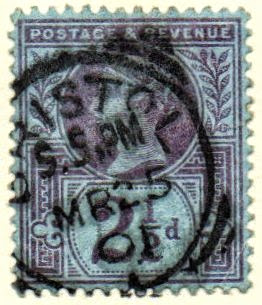
Colours are not always what they seem to be. The earliest 'yellow' in my collection is the Golden Jubilee issue for Queen Victoria of January 1,1887.
Great Britain
The Stanley Gibbons catalogue describes this as purple 0n yellow.
On May 5, 1937 the first 15 definitives for George VI were issued and included a 2d orange stamp.
6 February, 1952 saw the issue of the Wilding definitives for Queen Elizabeth II. The lowest denomination of 1/2d is described as orange-red.
I had to wait until 25 February 1976 for a Machin derivative in a colour to meet the theme - 10.1/2p yellow.
The capital of Gambia was founded by the British in 1816, before the reign of Queen Victoria began and of course well before the first postage stamps. Founded as a trade post or base to suppress the slave trade it was named after the Secretary of State for War and the Colonies, the 3rd Earl of Bathurst. In 1966 (on 24th June) a set of stamps commemorated the founding of Bathurst.
Gambia
Bathurst was renamed Banjul in 1973.
This is an orange or yellow post for Sunday-Stamps-II-93. Don't forget to check the links there for other contributions.
The Albert Memorial was one of a set of stamps of London Landmarks issued on 6 May 1980.
Great Britain
The memorial, designed by Sir George Gilbert Scott, is situated in Kensington Gardens. It was commissioned by Queen Victoria to commemorated her husband, Prince Albert, who died of typhoid in 1861.
My next two stamps have a French connection although they are both from the USA.
USA - 28.8.1945 - US soldiers passing the Arc du Triomphe
The Statue of Liberty appears on many stamps, the one I have chosen to show is the oldest in my collection.
USA - 20.8.47
A Lockheed Constellation flies over the Statue and the New York skyline - pity the franking has obscured so much.
I am also spoilt for choice from other countries. Here's a look at royalty in Sweden. The man who was to become Gustav VI in 1950 was alive when our Queen Victoria was on the throne.
Sweden - Gustav VI
In 1973 he was succeeded by his son.
Sweden - Carl XVI
Carl XVI and Queen Sylvia
This brings us full circle as their eldest child is Crown Princess Victoria.
For royalty from elsewhere and I suspect more mention of Victoria check out the links at Sunday-Stamps-ii-23.
The prompt this week shows Archduke Franz Ferdinand and his wife leaving the town hall in Sarajevo eight minutes before he was assassinated on 26 June 1914.
This week people are commemorating the 50th anniversary of the assassination of President Kennedy of the USA. Unfortunately I cannot recall where I was or what I was doing on that day. My wife says she was feeding our month-old son.
I have chosen therefore to look at other assassinations and assassination attempts from history starting with:
Death of Caesar, 15 March 44 BC (Oil on canvas - Jean-Léon Gérôme - Walters Art Museum, Baltimore)
The painting depicts the aftermath of the incident where Caesar is stabbed to death, with Brutus striking the final blow - immortalised by Shakespeare's "Et tu, Brute." Shortly after Shakespeare has Cassius encouraging people to proclaim, "Liberty, freedom and enfranchisement."
That seems to me to be a natural link to the cry arising during the French Revolution - "Liberté, egalité, fraternité" - and the republican assassinated in his bath by a 24 year-old gentlewoman.
Assassination of Jean-Paul Marat by Charlotte Corday, 13 July, 1793 (Painting by Jean=Joseph Weerts)
Charlotte did not attempt to escape and lost her head to the guillotine. [You may read about her here ]
On 18 May 1912 John Bellingham lost his life at the end of a rope. Convicted by a jury who took only ten minutes to find him guilty just 4 days after the bankrupt and embittered business man had become an assassin.
Assassination of Spencer Perceval the British Prime Minister by John Bellingham at the Palace of Westminster in 1812
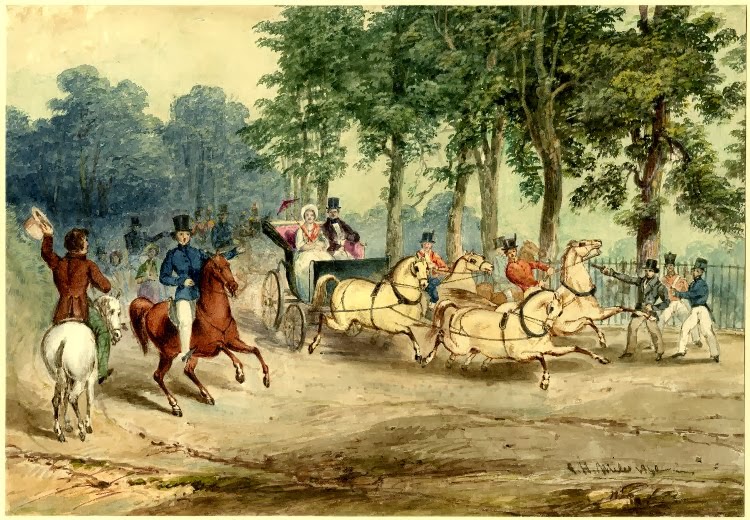
Edward Oxford was more fortunate; his assassination attempt failed.
Edward Oxford shoots at Queen Victoria - June 18, 1840
This water colour painting by G H Miles, now in the British Museum, shows the Queen and the Prince Consort driving in a phaeton towards Constitution Hill; a policeman runs towards Oxford as he fires.
Oxford, a discharged barman, was treated as a madman and confined in Bedlam, before eventually being sent to Broadmoor. Released on his promise to go to Australia, he was reported to be working there as a house painter as late as 1882. By that time two American Presidents had been killed by bullets from assassins. Lincoln by John Wilkes Booth in 1865 and James A Garfield by Charles J Guiteau in 1881
Engraving of Garfield's assassination (July 2, 1881)
The caption to the picture of the engraving, published in Frank Leslie's Illustrated Newspaper, reads: Scene in the ladies room of the Baltimore & Ohio Railroad Depot - the arrest of the assassin. - ... - The assassin Charles Guiteau is being restrained by members of the crowd. Guiteau, a preacher, writer and lawyer, was convicted and hanged. I looked for videos to back up this post and came across the Stephen Sondheim musical "Assassins" which included actors representing Booth, Guiteau, Leon Czolgosz (killer of President McKinley) and Lee Harvey Oswald. That brings us back to Kennedy again and enough exposure of assassins in an age when states can kill by remotely controlled drones. For hopefully less morbid memories cross over to Sepia-Saturday-204.
The theme this week is drink up, celebrating any form of consumable liquid, and a theme that can be interpreted in many different ways.
This summer in the UK has not given us many chances to sit out and celebrate in the sun so there has only been the odd day like this.
A Half Empty Glass
Or is it half full?
One of my favourite books begins with the line, "It was a cold grey day in November." - the day that Daphne du Maurier's heroine, Mary Yellan, arrived here.
Cornwall's Jamaica Inn
For one reason or another it's several years since I had an alcoholic drink but not so long ago as when this source of water was in everyday use.
Stocks Hill monument, Ketton
The monument at Ketton, the village where I grew up, was erected including the cold water tap to commemorate the Diamond Jubilee of Queen Victoria in 1897. Forty years later I was born in a house a stone's throw from Stocks Hills. The only water available twenty years after that was still from a cold water tap on the outside of the house.
Many years later with two children as well the opportunity came to drink up something stronger abroad.
Who's been in the sun
You should be able to date this pair in the process of drinking up from the size of those shoulder pads.
Eat your heart out, Sue Ellen
Just occasionally I managed to get in on the act too, when home from Norway for Christmas.
Brandy, Sir?
They say you can take a horse to water but you can't make it drink - not true in this case at least.
HRH The Princess Beatrice was the fifth daughter and
youngest child of Queen Victoria who edited the journals and diaries of Queen Victoria after her death.
From her marriage in 1885 until 1917 she was known as Princess Henry of
Battenberg.
Princess Beatrice in her wedding dress 1885
(coloured bookplate)
There is no link to Victoria or the Royal Family in my next picture, it's from just over a hundred years after the wedding of Victoria and Albert.
Cutting the cake - 1958
It reminds me that it is our wedding anniversary next week. I wonder what happened to that hair!
Princess Beatrice's full name was Beatrice Mary Victoria Feodore. The present Princess Beatrice of York is Beatrice Elizabeth Mary and she is not married yet,
Princess Beatrice of York - 2005
(At an equestrian event)
In Sweden in 2010 a Crown Princess was married.
Crown Princess Victoria and Daniel Westling
(Cortège at Slottsbaken 19 June 2010 - Author Holger Motzkau 2010; cc-by-sa 3.0)
Before you go to check our other wedding related posts at SS-140 you might like to walk down the aisle with our last Royal bride.
Incidentally Princess Beatrice of York wore an infamous hat at this wedding, not at all like that held by the groom on
The use of postage stamps started in Great Britain with the famous Penny Black in 1840.
Penny Black (reproduction)
As the stamps were only for internal use the country's name was not included on the stamps; later it was agreed internationally that British stamps did not need the name but all should contain the sovereign's head. In fact there has only been one stamp that has included the name Britain - the stamp commemorating the Festival of Britain in 1951.
Use of the Penny Black was discontinued when it was replaced due to the black colour not showing postmarks clearly. The Penny Red took its place.
I have only one stamp showing Queen Victoria who reigned from 1837-1901 and I have shown this before.
Queen Victoria 1851
There is another stamp of the same value and colour as this. The difference between lies in the design; the stamp I've shown has 16 dots around each corner, the other only 14.
After Victoria Great Britain had four Kings as shown on these stamps from my collection.
Edward VII (1901-1910)
I've shown a reproduction here as my Edward VII stamps are so heavily postmarked.
George V (1910-1936)
Edward VIII (1936)
These are the only four stamps issued for Edward VII before his abdication.
George VI (1936-1952)
These early stamps from George VI's reign include the commemorative for his coronation.
Our present Queen came to the throne in 1952 and is to celebrate her Diamond Jubilee this year.
Elizabeth II
The first stamps issued became known as the Wilding issues as they were based on a portrait of Queen
Elizabeth II by photographer Dorothy Wilding. Variations on this theme were used until 1967, when the Machin issues were introduced. The Machin design is a profile of the queen on a solid back ground.
Machin issue
In 1971 the currency was decimalised so the stamps changed again for the new values.
Decimal currency
To save stamps from Great Britain you have always needed to recognise different water marks. In addition technical improvements in printing mean you also need to be able to identify graphite lines on the back of the stamp, phosphor bands (all over, single or double), position and design of the demonination value.There are literally hundreds of varieties.
With the advent of first and second class postage rates the demonination has been removed and in my opinion the design has been ruined by unsightly postage class numbering.
First and Second Class Postage.
As you can see there is also a different stamp and charge for large envelopes. Postage rates have gone up by over 4000% since Queen Victoria''s days. She would not have been amused.