Pages

Showing posts with label Lincoln. Show all posts

Saturday, 23 November 2013

Et tu ...? - Sepia Saturday

The prompt this week shows Archduke Franz Ferdinand and his wife leaving the town hall in Sarajevo eight minutes before he was assassinated on 26 June 1914.


This week people are commemorating the 50th anniversary of the assassination of President Kennedy of the USA. Unfortunately I cannot recall where I was or what I was doing on that day. My wife says she was feeding our month-old son.

I have chosen therefore to look at other assassinations and assassination attempts from history starting with:

Death of Caesar, 15 March 44 BC
(Oil on canvas - Jean-Léon Gér
ôme - Walters Art Museum, Baltimore)
The painting depicts the aftermath of the incident where Caesar is stabbed to death, with Brutus striking the final blow - immortalised by Shakespeare's "Et tu, Brute." 

Shortly after Shakespeare has Cassius encouraging people to proclaim, "Liberty, freedom and enfranchisement."

That seems to me to be a natural link to the cry arising during the French Revolution - "Liberté, egalité, fraternité" - and the republican assassinated in his bath by a 24 year-old gentlewoman.

Assassination of Jean-Paul Marat by Charlotte Corday,
13 July, 1793
(Painting by Jean=Joseph Weerts)
Charlotte did not attempt to escape and lost her head to the guillotine. [You may read about her here ]

On 18 May 1912 John Bellingham lost his life at the end of a rope. Convicted by a jury who took only ten minutes to find him guilty just 4 days after the bankrupt and embittered business man had become an assassin.

Assassination of Spencer Perceval the British Prime Minister by John Bellingham at the Palace of Westminster in 1812
Edward Oxford was more fortunate; his assassination attempt failed.
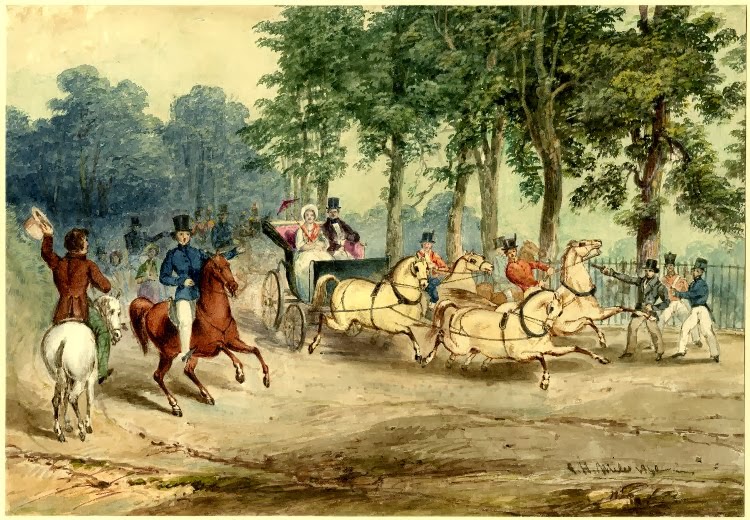
Edward Oxford shoots at Queen Victoria - June 18, 1840
This water colour painting by G H Miles, now in the British Museum, shows the Queen and the Prince Consort driving in a phaeton towards Constitution Hill; a policeman runs towards Oxford as he fires.

Oxford, a discharged barman, was treated as a madman and confined in Bedlam, before eventually being sent to Broadmoor. Released on his promise to go to Australia,  he was reported to be working there as a house painter as late as 1882.

By that time two American Presidents had been killed by bullets from assassins. Lincoln by John Wilkes Booth in 1865 and James A Garfield by Charles J Guiteau in 1881

Engraving of Garfield's assassination (July 2, 1881)
The caption to the picture of the engraving, published in Frank Leslie's Illustrated Newspaper, reads:

Scene in the ladies room of the Baltimore & Ohio Railroad Depot - the arrest of the assassin. - ... - The assassin Charles Guiteau is being restrained by members of the crowd.

Guiteau, a preacher, writer and lawyer, was convicted and hanged.

I looked for videos to back up this post and came across the Stephen Sondheim musical "Assassins" which included actors representing Booth, Guiteau, Leon Czolgosz (killer of President McKinley) and Lee Harvey Oswald.

That brings us back to Kennedy again and enough exposure of assassins in an age when states can kill by remotely controlled drones.

For hopefully less morbid memories cross over to Sepia-Saturday-204.

Friday, 11 May 2012

Victorian Kitchens - Sepia Saturday

I try to keep out of the kitchen as every time I go in there I'm either given a job to do or I'm told I'm in the way. Nevertheless I've found a couple of kitchens that I hope will interest you.

The Victorian Kitchen, Dalgarven Mill, Ayrshire
The house where I was born had a Victorian kitchen; we had a black leaded grate similar to this and we still have a mixing bowl like the one on the table. However the floor was made of stone slabs which didn't exactly generate a warm feeling.

My second kitchen is located in Lincolnshire where I went to school.

Replica of a Victorian Kitchen at the Museum of Lincolnshire Life, Lincoln 2011
We had a chair just like that but our tin bath was kept and used in an outhouse with a coal-fired copper to heat the water. We didn't have the luxury of a water pumped into the kitchen like in this replica.. Our stone flag floors were soften by rugs like the one shown here made by pegging scraps of cloth to canvas sacking,

These two pictures brought memories back to me as did the video below. It runs for 30 minutes but I've hope you have the time to view it as the old pictures it contains are worth looking at. When you've watched it perhaps those of you who think 'those were the days' will have changed your minds.


This is the first of a series of videos about Victoria Kitchens of You tube)

For more kitchen utensils don't forget to check Sepia Saturday 125


Attributions:

  • The Victorian Kitchen, Dalgarven Mill, 2008; author Rosser1958 - Roger Griffith
  • Replica of a Victorian Kitchen, Museum of Lincolnshire Life 2011; author Green Lane; Creative Commons Attribution-Share Alike  3.0 unported, 2.5. 2.0 and 1.0 Generic licenses.

Thursday, 8 September 2011

Presidential Sepia Saturday

I've chosen a Presidential theme this week based on Alan's photo of President Wilson on a train.
President-elect Obama with former Presidents Bush, Carter and Clinton and the then current President Bush at the White House on Jan 7, 2009
(by Pete Souza - Creative Commons 2.0 Generic License)

How did Obama get to Washington DC later in the month? By train of course.
Barack Obama on the end of the Georgia 300 train car as it rolls through Claymont, Delaware on the way to Washington DC (17 January 2009)
(by ajac - CC Attribution 2.0 Generic License)

But look closely at the first photo again. Another old President is in the room - President Lincoln in the picture on the wall. After his assassination by John Wilkes Booth in April 1865 Lincoln's last ride was on a funeral train.
The engine that drew Lincoln's Funeral Train from Washington to Springfield
Presidents travelling by train is a well established tradition as shown by President Wilson. Pictures exist of other Presidents and presidential candidates on the stomp including this from 1920.
Informal photograph of Governor James M. Cox of Ohio, a candidate for President in 1920, standing on the bottom step at the back of a train in Chicago, Illinois. Date: 1920
(Uncredited Chicago Daily News Photographer)

We have no Presidents in the UK of course and I'm not one for photographing trains but I did discover this engine 2392 on the North Yorkshire Moors Railway taken some 40 years ago.

For more Presidents, trains and old photos go to Sepia Saturday 91