I may not be able to maintain this theme as the A-Z Challenge starts tomorrow and will occupy most of my time next month. This is my bird this week, although the photos are much older -
Two swans - 'apreening' in Cornwall
Mute swan - Stokkavatnet, Stavanger, Norway
And from Scotland a photo taken by the husband of one of my wife's friends.
N - Northern Brown Argus Before I found this butterfly I thought I would have to settle for 'Nymphalidae,' the largest family of butterflies with 6000 species around the world. However to help me with this challenge my wife found a nature guide for butterflies and moths. Tucked away in there was the Northern Brown Argus. Until then I thought the Argus was a local newspaper in different parts of the UK.
Northern Brown Argus
This specimen was photographed on a Bloody Cranes-Bill flower at the Pinbain Burn SSSI (site of special scientific interest). Pinbain is a rabbit grazed limestone grassland and coastal cliff in Ayrshire, Scotland.
Brown with orange spots on its outer wing edges, in Scotland most have the characteristic white spot on the forewing. In Northern England the spot may be dark brown or black.
Its foodplant is the Common Rock-Rose.
Common Rock-Rose
A very local butterfly in Scotland it exists on only a number of scattered sites.
Northern Brown Argus in Yorkshire
No white spot here, it seems brown/black to me. There are lots of different leaves and grasses in this calcareous pasture on the Kettlewell - Starbotton footpath.
Love is like a butterfly
As soft and gentle as a sigh
The multicolored moods of love are like its satin wings
Love makes your heart feel strange inside
It flutters like soft wings in flight
Love is like a butterfly, a rare and gentle thing
I feel it when you're with me
It happens when you kiss me
That rare and gentle feeling that I feel inside
Your touch is soft and gentle
Your kiss is warm and tender
Whenever I am with you I think of butterflies
Love is like a butterfly
The multicolored moods of love are like its satin wings
Photo attributions
Northern Brown Argus on Bloody Cranes-Bill: Pinbain Burn SSS, 17 June 2007, geograph.org,uk, by Mary & Angus Hogg - CC BY-SA 2.0
Common Rock-Rose: upload by Gary Dee, 12 May 2011, by Leonara King - CC BY-SA 2.0
Northern Brown Argus in Yorkshire: 29 May 2009, geograph.org.uk, by Derek Parkinson - CC BY-SA 2.0
The XX Commonwealth Games will be held in Glasgow from 23rd July to 3rd August. This will be the third time the Games have been held in Scotland. Edinburgh hosted the previous two. The name of the Games has changed since the first event in 1930 when it was the British Empire Games. In 1954 it became the British Empire & Commonwealth Games. At Edinburgh in 1970 it changed again.
Great Britain - Ninth British Commonwealth Games
The final name change came in 1978 to the Commonwealth Games.
The Games are said to be the third largest multi-sport event in the world behind the Olympics and the Asian Games.
In 1970 42 countries took part in 121 events covering 9 sports. One of the countries involved was Malawi.
In 1957 I went on a geology field trip from the University of St Andrews. The destination was the Isle of Raasay just across the water from Skye. Someone had a camera and this was one of the shots taken.
Rough rock structure demonstrating the angle of dip.
But it was only today that I realised there was a photo of a castle in rough shape.
Castle Brochel ruins
This fifteenth century castle was occupied until the 1670s when the then Laird of Raasay died.
Here's how the castle looked in 2009,.in colour and from a different angle.
Castle Brochel
We never had such glorious weather in 1957. Perhaps that's why I'm more impressed by the castle's rough shape in black and white.
As chemistry was my favourite subject at school I thought this week would be ideal for ma as soon as I saw the laboratory photo.
However when I looked through my photo archive it was more difficult than that. From the age of 11 I went to Stamford School in Lincolnshire, then an independent school, Now it it is part of Stamford Endowed Schools along with what back then was Stamford High School for girls.. [Note to Facebook - Stamford School, Stamford, Lincolnshire, England - NOT Stamford School, Lahore, Pakistan as you insist it is on my profile and won't let me correct]
Stamford School & School Chapel
The buildings are situated on St Paul's Street; on the other side of the street are more school buildings.
Brazenose House - 2007
(Richard Croft - CC BY-SA 2.0 - Geograph Project Collection)
Brazenose was built in c 1688 and rebuilt in 1723 and is now part of the Stamford Endowed Schools campus. In my day the upper floor contained the Staff Room and class rooms; the two bottom windows on the right were those for the School Prefects' Study. The entrance at the right hand end led down to Brazenose gardens.
Later in 1957, two years after I left, a new science block was built at the bottom of that same entrance. Annoyingly, for me, the photos of the opening of the block and one of my old chemistry master in the lab are copyright protected on the members only part of the School website
Major Lamb (Algy) to us was the one who suggest that I go on to his old university at St Andrews. [Note to Facebook - In St Andrews, Fife, Scotland NOT South Carolina] St Andrews University is 600 years old this year.
St Salvator's Hall -1956
I'm perched on the railing on the top floor of the men's hall of residence; you can't see it in this shot but that is the North Sea behind the far hedge,
Not to be thwarted I managed to find a shot of a St Andrews lab that did not exist while I was there.
Nuclear Resonance Lab, St Andrews - 2009 (Shandchem from Scotland - CC BY 2.0)
Finally, definitely before my time, I finish with a shot of Paris from the Scientific American Supplement - Author L Page.
Drawing of the Lab of the School of Physics & Chemistry Paris - 1884
For more of the best days of your life, schools, laboratories - whatever, cross over to Sepia-saturday-176.
My A-Z posts this year
are based on my garden – flowers, animals, the birds and the bees, butterflies
- with a bit of poetry thrown in. For some letters I am expecting to cheat
somewhat –wishing they were here.
U – Urtica Dioica, Ulex Europaecus, Uvularia
I thought I’d be rash and grasp the nettle and use Latin
names for ‘U’
Stinging Nettles (Urtica Dioica)
The nettle poem I've found sounds better when read aloud.
The stinging nettle’s fine hairs on the leaves and stems contain irritating chemicals which
are released when the plant comes in contact with the skin. These stinging
hairs can also be used to reduce pain in that contact reduces levels of
inflammatory chemicals in the body, and interferes with the way the body
transmits pain signals. The stinging nettle has a long medicinal history and
was used as a diuretic and for treating painful joints as early as the Middle
Ages.
I may not have been on the downs for Ulex Europaecus but
I can vouch for the pain inflicted by their bushes when trying to retrieve my golf
ball from an unplayable lie, appropriately enough in Scotland.
Gorse in full flower in Scotland
Here, on the downs,
as a tale re-told
The sprays of the
gorse are a-blaze with gold,
As of old, on the
sea-washed hills of my boyhood,
Breathing the same
sweet scent as of old.
As I usually spend some time in Michigan each year I feel justified in
including a North American plant.
Uvularia Grandiflora
Uvularia
covers a genus of plants which are commonly called bellworts, bellflowers
or merrybells. I must confess to
never having seen any.
Poems:
Nettles – Vernon Scannell; video reading
Gorse – Alfred Noyes
Photos:
Nettles – Lis Burke – CC BY-SA 2.0
Gorse – Roger Griffiths – Public Domain
Uvularia grandiflora – Kurt Stuber;
Wikipedia Commons – CC BY-SA 3.0
My A-Z posts this year
are based on my garden – flowers, animals, the birds and the bees, butterflies
- with a bit of poetry thrown in. For some letters I am expecting to cheat
somewhat – wishing they were here.
O – Oceanus, Osteospermum, Owl, Osprey
O! O! O! Three ‘O’s on
which I’ve cheated. If it hadn’t been for a fine blue shrub I would have come
up with a big fat ‘zero’ for ‘O.’
Oceanus
Unfortunately it got so large it swamped everything else in
the border, so it had to go; a decision I’ve regretted ever since.
A few years ago we grew some of these:-
Osteospermum
However the photo is from the Longwood
Gardens in the USA; I didn’t
get a shot of ours at the time,
The last time we saw an owl in our sycamore tree was in May
2010. We frequently hear owls at dusk and after dark. But it and they are not
owls like this, scanned from an old birthday card,
Barn Owl
As I’ve cheated to include the bird I might as well go all
the way and quote a poem in full.
The Barn Owl
While moonlight,
silvering all the walls,
Through every
mouldering crevice falls,
Tipping with white
his powdery plume,
As shades or shifts
the changing gloom;
The Owl that, watching;
in the barn,
Sees the mouse
creeping in the corn,
Sits still, and shuts
his round blue eyes
As if he slept, —
until he spies
The little beast
within his stretch-
Then starts, and
seizes on the wretch!
I lived in Rutland,
England’s
smallest county, as a boy. Since then the Empingham Water reservoir has been
created; each year it becomes the home of another magnificent bird.
Osprey
I have not seen one there, but I am pleased to say I have in
Scotland, near Aberdeen.
Once more I hear the
osprey cry
My name across the
northern sky
But I am far away
from there
Poems
The Barn Owl – Samuel Butler
Osprey Calls My Name – John K Zimmerman
Photos:
Osteospermum – Longwood Gardens;
by Raul654 – CC BY-SA 3.0
Osprey – from Flickr; by
flythebirdpath; CC BY-SA 2.0
I thought I would explore some beaches found in my archives and take you on a tour from the West of Scotland via the Adriatic coast to Egypt and end up in the South West of England, before a friendly warning.
A seaside postcard from Ayr, Scotland
This card was one of several linked to Robbie Burns but apart from the views contains no other information to help you date when it was taken. It looks prewar to me.
I cannot date my second card from Yorkshire either and you need good eyes to see anything on the South Bay beach.
The Spa and South Bay, Scarborough
I can put a rough date on the next shot taken in the 1940s, probably somewhere in Egypt during the war when the Fleet Air Arm crews were on a beach.
Egypt (?) - 1940s
Sorry that there have been no bathing belles to admire so far; we get a bit closer on the Adriatic coast of Montenegro.
Beach on the isthmus to the island of Sveti Stefan - c1986
Coming back to Cornwall all I have to show are empty beaches.
Camel Estuary, Padstow - May 2011
At least you can see some footprints - I wonder where Man Friday went?
Crantock Beach, Cornwall
That sea is waiting for the surfers to appear.
Meanwhile this little girl is counting her collection.
Hope she hasn't lost count
I wonder if "she sells seashells on the seashore?"
Finally here's that friendly warning that all can see.
I just wish I could remember where this was taken, I must ask my wife to jog my memory - on second thoughts, I had better not.
For more sand and sea take a trip or donkey ride to Alan's place.
Back in 1955 I went to St Andrews University to start my studies there. My first trip, by train, took me over one of Britain's iconic bridges.
East Coast Express crossing the Forth Bridge (1928)
Alan's prompt this week is of a flimsier bridge.
Rough Wooden Bridge Over River, Group With Dog on the Shore
[The image comes
from the Phillips Glass Plate Negative Collection, at the Powerhouse
Museum, Sydney, Australia. The Museum provides no further information
the location of the bridge but the brilliance of on-line communities
is such that
information is soon forthcoming : the footbridge was in Mosman Bay on
the north shore of Sydney Harbour. The location of the photograph is not
the only question posed by the title - it takes a sharp eye to spot the
reported dog.]
The route to St Andrews takes the train over the River Tay. At that stage in my journey I knew nothing about an ill-fated journey on 28 December 1879.
Original Tay Bridge - seen from the north
William McGonagall, claimed by some to have been the worst poet in history, began his 1880 poem, "The Tay Bridge Disaster" with the words:
Beautiful Railway Bridge of the Silv’ry Tay!
Alas! I am very sorry to say
That ninety lives have been taken away
On the last Sabbath day of 1879,
Which will be remember’d for a very long time.
The whole poem and some notes about the disaster may be read here - 75 people lost their lives when the bridge collapsed and took their train with it.
River Tay Bridge, middle section collapse, - 1880
Aged 18, I knew nothing about this but I did wonder what it was I could see in the water.
Tay Bridge (1981)
If you look closely you will see, to the right of the bridge, the plinths on which the original bridge stood.
During my time at St Andrews I studied geology as a subsidiary subject. This involved a number of field trips. During Easter 1957 we visited the island of Raasay off the West Coast of Scotland.
The Isle of Skye (viewed from Raasay 1957)
We travelled to Raasay by boat but never got to Skye. These days,of course, there is no need for a boat to reach Skye.
The Skye Road Bridge
I'm sure you all will have heard of the Scottish folk song recalling the escape of Prince Charles Edward Stuart (Bonnie Prince Charlie) from Uist to Skye after his defeat at the Battle of Culloden in 1746. The song tells how Charles escaped in a small boat with the aid of Flora MacDonald, disguised as a serving maid.
I hope you will like this version:
While I was at St Andrews there was a debate in the Students' Union about the need (in those days) for a Forth Road Bridge. The English undergraduate who demanded to to know what had happened to the first three was howled down!
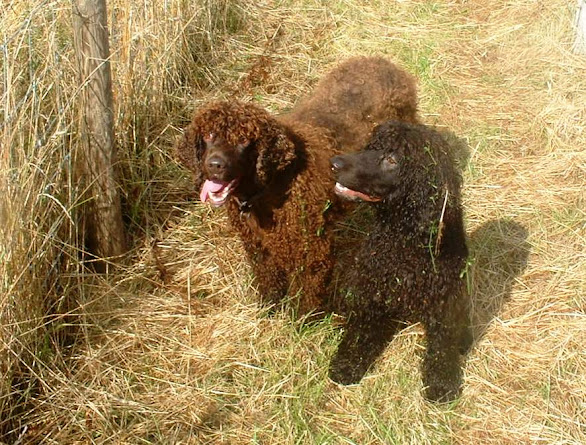
I've driven over the bridge that was built later and also over the suspension bridges over the River Humber and the River Severn. Not wanting to leave without a reference to dogs, this pair used to swim in the River Severn alongside their home.
Milly and Cara (Irish Water Spaniels)
But as this post has mainly been about Scotland perhaps this is more appropriate.
Poppy (West Highland Terrier)
I thought about ending with the theme from the Bridge over the River Kwai but settled for this instead.
Now it's up to you to march off to see who's on parade at sepia-saturday-154
Attributions:
LNER East Coast Express Photo by L&NE Ry; scanned from Alan, Cecil J (1928) The Steel Highway; scanned by Andy Dingley
Original Tay Bridge before its collapse, seen from the north (between 1878-1879); scanned by Peterrhyslewis 2007.
River Tay Bridge, middle section collapsed, photographed by Valentines in 1880; scanned by Peterrhyslewis 2007.
Tay Bridge (1981) The bridge that replaced the ill-fated original; Anne Burgess for geograph.org.uk - CC BY-SA 2.0
The Skye Road Bridge connecting the Isle of Skye to mainland Scotland - 10 June 2005 - by Jörn Albring.
Youtube - Paul Robeson - Skye Boat Song, Uploaded by Alberto Truffi on 11 Mar 2010
From the compilation An Evening with
Paul Robeson a famous Scottish folk song performed by the great singer
and actor. Taken from an Emitape mono 3 3/4 ips of the early sixties.
Youtube - Music Video for The Movie The Devil's Brigade - uploaded by Johnnyquest


_-_geograph.org.uk_-_833976.jpg)


.jpg)