Pages

Showing posts with label Edinburgh. Show all posts

Sunday, 25 April 2021

Sunday Stamps - Sports: Great Britain

 One games - three events in the 9th British Commonwealth Games.

Runners

Swimmers

Cyclists

This set was issued on 15th July 1970 for the Games held at Edinburgh.

Sunday, 20 September 2020

Sunday Stamps in Motion

 In 1986 Australia beat England in the final of the men's World Hockey Cup in London. A stamp to commemorate the World Cup was issued at the same time as stamps for the 13th Commonwealth Games at Edinburgh..

Great Britain - 15 July 1986

Hockey was a game I played for many years. 

It has been many years since I have run to catch a bus and the last double-decker that I rode on was on the way to Newcastle.
Perhaps a stationary one is more appropriate for me now. These are from the series for the 150th anniversary of the double-decker bus.

Great Britain - 15 May 2001

The 17th Commonwealth Games was held in Manchester in 2002 and was commemorate by a series of stamps, one of which really depicts people in motion and definitely running faster than I ever could.

Great Britain - 16 July 2002

Now it's your chance to get in Motion at Sunday stamps and run through the links posted there.


Sunday, 23 June 2019

Sunday Stamps - 'R'4' USA, Great Britain

Echo 1 was the first passive communication satellite launched in 1960. It was used to bounce radio wave signals from one point on  the earth to another.


USA - 15 December 1960
In 1778 Captain Cook, in command of the Resolution and Discovery, discovered the Hawaiian Islands. The next stamp was issued two hundred years later.

USA - 13 January 1978
A set of three stamps was issued to commemorate the ninth British Commonwealth Games held in Edinburgh in 1970. the 5d stamp depicted 'runners'.

Great Britain - 15 July 1970
 For more 'R' related stamps visit Sunday-stamps-r.

Sunday, 6 May 2018

Sunday Stamps II - A-Z ; 'L' Great Britain

I thought it was time I showed some stamps from Great Britain. 'L' has given me the opportunity to go back to 1963 with the 9th International Lifeboat Conference in Edinburgh.

Rescue at Sea
19th Century Lifeboat
Lifeboatmen
Now you need to row over to Sunday-stamps-l where more 'L' related stamps may be found.

Sunday, 22 January 2017

Books and Authors - Sunday Stamps II

Young Folks, a magazine for children, serialised a story between 1881 and 1882. The story was credited to 'Captain George North.'

On 14 November 1883 Cassell & Co published it as a book in the author's name.

Another Young Folks' story appeared in May/July 1886, followed by a second book.

Ill health in his later years caused the author to travel in the South Pacific and spend time in the Gilbert Islands, Tahiti and New Zealand. He eventually settled in the Samoan Islands where he built a family property which became his home for the remainder of his life.

On 29 April 1969 Samoa commemorated the author and his book on the 75th anniversary of his death.


I remember reading both of those books when I was boy.

I know the story of Stevenson's third book published in 1886. You all must know it as well.

Dr Jekyll and Mr Hyde
It has also appeared as 'The Strange Case of Dr Jekyll and Mr Hyde' and as just 'Jekyll and Hyde.'

The fourth book of Stevenson on the Samoan stamps was an unfinished novel, set in the Napoleonic Wars, cut short by his sudden death in 1894 from a cerebral haemorrhage.

Weir of Hermiston - (1896 Chatto & Windus)
Robert Louis Stevenson's tombstone rests atop Mount Vaea in Samoa.

Weir of Hermiston can be read as a virtual book here. Hermiston is a suburb of Edinburgh. In 1907 the city of Hermiston, Oregon was named after the book.

For other authors and their works check out Sunday-Stamps-II-110. where there is another Scottish connection.


Sunday, 24 January 2016

Cycles - Sunday Stamps II

As I couldn't find tricycles or any motorbikes I had to settle for bicycles.

I've always regarded cycling as a form of savage amusement as I learnt to ride on a fixed wheel bike and pedalled backwards too often by accident, with often spectacular results - for any spectators, that is.

By the time of the 1970  Commonwealth Games in Edinburgh I had given up and just admired this stamp, issued on 15 July, showing cyclists in action.


Great Britain - Ninth British Commonwealth Games
The road past our house is a favourite route for leisure cyclists, mainly men in Lycra who image they are Bradley Wiggins. Cycling club members may also be seen from time to time. 

It was 1978 that saw the centenaries of the Cyclists Touring Club and the British Cycling Federation commemorated on stamps.


Great Britain - 2 August 1978
Sir Bradley Wiggins currently holds the record, once held by Eddy Merckx, for the furthest distance cycled in one hour . Merckx set his record in Mexico City back in 1972. 

It's appropriate then that I should show a stamp issued in 1975 promoting the Mexican export of bicycles.

Mexico
I hope that when you have cycled over to Sunday-Stamps-II-58. you will find the links to some motor bikes and cycles from other countries.

Sunday, 31 May 2015

Places to live - Sunday Stamps II

I wondered why stamps showing cottages warranted a set of their own in 1970. To me a cottage has always been a place to live.

I have two of that 1970 set.

Great Britain - Architecture (Cottages) 1970
I discovered that the architectural feature of this cottage is not its size or where it is located; it's all about its weatherproof coating. Lime harling is a thrown or cast-on finish consisting of a slaked lime and coarse aggregate mortar usually with a rough-textured surface. A number of Scottish castles (also places to live) are finished in this way.

Great Britain - Architecture (Cottages) 1970
Thatching was introduced into Ireland in the 17th century, and subsequently became associated with poverty and despair. Modern building methods have led to its demise.

!975 was the European Architectural Heritage Year. The five commemorative stamps issued included two impressive places..

Great Britain - European Architectural Heritage Year - 1973
Charlotte Square is part of Edinburgh's New Town which is a designated UNESCO World Heritage Site.

Bute House in the square houses the HQ of the SNP.

The Rows at Chester are continuous half-timbered galleries forming a second row of shops above those at street level. The Rows are unique and no-one is sure why they were built this way.

Do Charlotte Square and The Rows qualify as places to live?

Check out what others have found at Sunday-Stamps-ii-24.

Sunday, 6 July 2014

Commonwealth Games - Sunday Stamps

The XX Commonwealth Games will be held in Glasgow from 23rd July to 3rd August. This will be the third time the Games have been held in Scotland. Edinburgh hosted the previous two.

The name of the Games has changed since the first event in 1930 when it was the British Empire Games. In 1954 it became the British Empire & Commonwealth Games. At Edinburgh in 1970 it changed again.

Great Britain - Ninth British Commonwealth Games
The final name change came in 1978 to the Commonwealth Games.

The Games are said to be the third largest multi-sport event in the world behind the Olympics and the Asian Games.

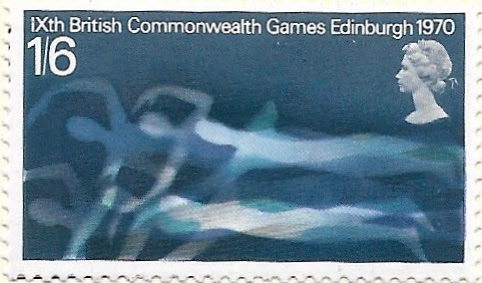
In 1970 42 countries took part in 121 events covering 9 sports. One of the countries involved was Malawi.


The sports on the 1970 stamps were:
  • 5d - Running
  • 1/6d - Swimming
  • 1/9d - Cycling
For more sporting exercise I suggest you visit the links at Viridian's Sunday-Stamps-178.

Sunday, 26 February 2012

Castles - Sunday Stamps

Back in 1955 this set of four stamps was issued.

Castle Stamps (1955) 
(Scanned from an old catalogue)

30 years later on the 18th October 1988 the Post Office released four new high value stamps featuring the same castle. These are the ones I have in my collection or so I thought.

Castle Stamps
The castles came  four different regions of Great Britain ; Carrickfergus (Northern Ireland), Caernarfon (Wales), Edinburgh (Scotland) and Windsor (England). The 1988 stamps had been based on photographs taken by Prince Andrew, Duke of York and were engraved and printed by Harrison and Sons Limited

Four years later in 1992 the set was re-released with enhanced security features. The original Queen's head was changed to a silhouette and an elliptical perforation was added half way up the sides of the stamp.If you look at my stamps you can see both the silhouette and the elliptical perforation

By 1995 inflation had taken its toll and the £1 Carrickfergus Castle design was replaced by a £1 stamp of the standard low-value Machin design. The Carrickfergus Castle was re-released as a £3 high value in 22nd August 1995. My stamps include both the £1 and £3 denominations

In 1997, the contract for printing the stamps was moved to Enschedé.  Enschedé had to re-engrave each design. Although the general appearance of the stamp barely changed, the individual engraving marks were completely different,

Apparently you can distinguish between the two printers by examining the letters 'C' and 'S' in the word 'Castle' where there are differences in the lower point of the 'C' and the lower tail of the 'S'. This is difficult to see on my scanned images. The £1 Carrickfergus must  be pre-1995 and be by Harrison and Sons. 

There is no doubt about the Windsor Castle stamp being by Enschedé because their design has the 'W' looking as if it comprises overlapping 'V's.

The sad thing to me is that these lovely castle stamps were discontinued and replaced in 1999 by small format Machins just showing the Queen's head.

As you may gather participating in Sunday Stamps this week has taught me things I didn't know about my stamps. Now you may check out others choices at Viridian's Sunday Stamps-59

Friday, 11 November 2011

Drink Up! - Thematic Photography

Finding something to post for Carmi's theme this week was driving me to drink until I found this:
Tankard finds new use as receptacle for pens
This tankard commemorating brewery tradition usually sits on the bottom shelf of my desk unit and as you can see it has acquired a new use.

The six breweries on it had '"Together 1000 years of Brewing Tradition." Alas many of them are no longer in existence - the victims of takeovers and demolition,

In the 1800s Edinburgh was known as 'Auld Reekie' due the number of breweries in the city.
Lorimer & Clark, Edinburgh
In 1869 George Lorimer and Robert Clarke opened the Caledonian Brewery. In 1919 it was taken over by Vaux Breweries in Sunderland but fortunately was subject to a management buy-out in 1987.

The second badge on the tankard hails from Belgium.
Liefmans, Oudenaarde, Belgium
Liefmans has been one of Belgium's cult breweries since 1679.

But Belgium is not the only country outside the UK to figure on the tankard.
Fred Koch Brewery, New York State
Fred Koch Brewery produced beer and ale in Dunkirk, New York  from the late 1880s to 1985. 

We are back in England for the last three firms on the tankard, all linked together in the story of their demise.
Vaux Brewery,  Sunderland
The Vaux family had been involved in the brewery business since 1806 but Vaux did not establish their own brewery until 1837. The first Vaux brewery was named after the founder Cuthbert Vaux, C. Vaux & Co. and would become one of Sunderland's most successful businesses.

By the 1990s the Vaux Group had expanded into hotels. Despite the brewing business being profitable and an offer to buy it having been received from management, in March 1999 the Board closed both its Sundeland breweries. The brewery was later demolished.

Vaux also figured in the demise of our next famous brewery.
Wards Sheaf Brewery, Sheffield
In 1837, William Roper and John Kiby started a brewery on Effingham Street. Roper died in 1842 leaving John Kiby in sole control. Septimus Henry Ward joined the company in 1868 when it ran into financial trouble. Due to the substantial amount he invested the primary brand was renamed Wards Best Bitter. . The business continued to expand buying up other breweries. In 1876 they bought the SOHO Brewery and made it their main premises, renaming it to Sheaf Brewery. It was made a limited company called S.H. Wards & Company Limited in 1896.

In 1972 the company was acquired by Vaux and continued to brew bitter as a subsidiary. Despite still being profitable the brewery was closed in 1999 as the Vaux company was broken up. The land was sold to developers who demolished most of it to make way for apartments. Ironically, it was revealed later that the price achieved was several £million less than the buyout that would have saved this much-loved brewer.

Darley's, Thorne, Doncaster
 
The Darley family were closely connected with the town of Thorne for many generations.  W.M. Darley operated a small firm with a few pubs in and around Thorne. His son, C.W. Darley assumed control of the firm in 1892 on the death of his father, when the brewery was enlarged and improved. The brewery remained in the family until October 1978 when it was acquired by Vaux Breweries of Sunderland. Brewing continued until 1986 when the brewery was closed and production transferred to Wards Brewery in Sheffield, also part of the Vaux group. And you know what happened to them.

If you haven't drunk up by now then I suggest you visit the other drinkers at Carmi's Thematic Photographic 170