We had an athletic meeting from Stockholm on TV yesterday. This reminded me of the one time holder of six world records from the USA.
Owens name has become iconic as a result of his exploits in the 1936 Olympic Games in Berlin. The stamp comes from the Celebrate the Century series for the 1930s.
From Great Britain I have chosen an Ox-Eye Daisy from 1967.
As a boy in the 1940s I used to walk and fish in the River Chater in the village of Ketton in Rutland. In those days I could follow otter hounds as they went hunting along the river. I'm pleased to say that they never found any.
When I was at school in the 1950s if you misbehaved a master or a prefect could issue you 'copies'. These had to be completed in your best writing on blue paper which had to be obtained from your House Master - in my case that meant having to collect the paper from the head table at lunch time. I have always remembered one of the lines to be copied -
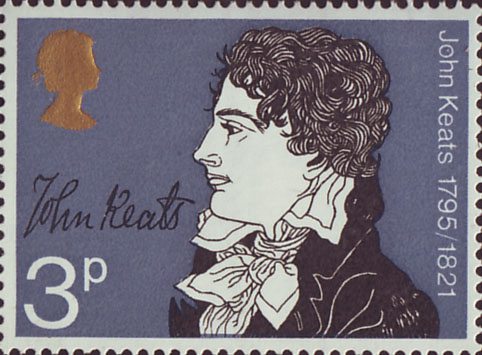
"A thing of beauty is a joy for ever."
It was some years later that I found out that this was the opening line of a poem by -
Great Britain
This was issued in on 28 July 1971 to commemorate the 150th anniversary of his death.
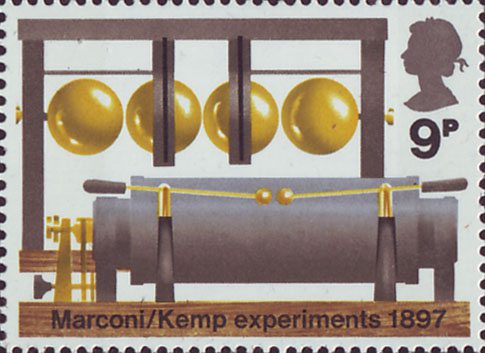
Great Britain - 13 September 1972
I guess we all have heard of Marconi and his roll in the development of the radio. I did not know that it was George Kemp, a Welshman, who played an essential part in the first experiments in sending messages -- Something-in-the-air.
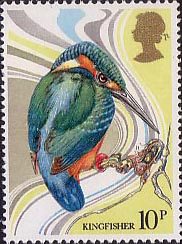
Great Britain - 16 January 1980
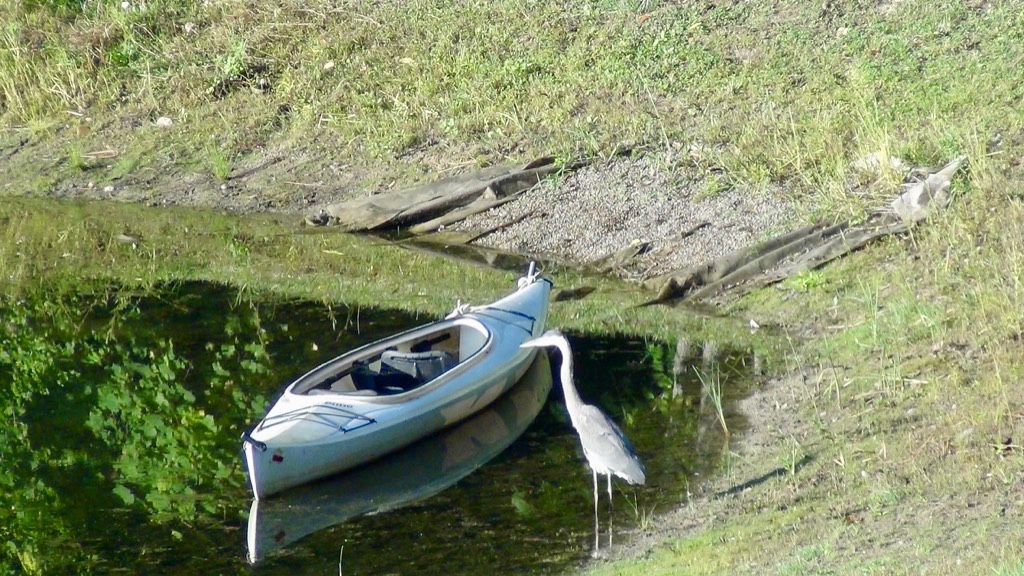
I used to see the kingfishers on the River Chater in Rutland when I was boy but unfortunately I can't remember when I last saw one on the Tees - now my much bigger local river. There is a white water centre on the Tees by the Tees Barrage. Kayaks use it too.To see the connection to 'K' stamps please visit Sunday-stamps-k.
This short river (only 24 miles) is one I remember with affection. A tributary, it runs through Leicestershire, Rutland and Lincolnshire until it enters the Welland beyond Stamford.
River Gwash just east of Empingham
In the early 1950s I worked on this river helping to keep it clear and to relocate coarse fish (caught by stunning them with electric prods) to encourage the trout. These days it is a river well known with anglers for its trout fishing.
At 'work' in rubber waders
In 1975 the Gwash was dammed to help create the Anglian Water reservoir known as Rutland Water.
Where the River Quash enters Rutland Water
The Gwash's flow is controlled as it exits the reservoir and remains the picturesque river I remember.
River Gwash looking towards Ryhall from a footbridge at Belmesthorpe
In my day we would have had to clean that out!
Photo attributions:
River Gwash east of Empingham: 22 April 2007, ex geograph.org.uk, by Graham Horn - CC BY-SA 2.0 licence.
Rutland Water (where the Gwash enters): 29 April 2006, ex geograph.org,uk, by Kate Jewell - CC BY-SA 2.0 licence
River Gwash towards Ryhall: 28 July 2008, ex geograph.org.uk, by R Croft - CC BY-SA 2.0 licence.
There were two rivers in the village in which I was born - both will feature in this Challenge. If you walked down Bull Lane in the Rutland village of Ketton, to get to Algate, the path took you across a footbridge over the River Chater.
River Chater at Ketton from the Sinc Bridge looking north
I must confess that I never knew the bridge had that name, but as children we used to paddle in that stretch of water. I was more familiar with the river upstream beyond the bridge over Church Road.
River Chater Bridge
That footbridge was not there when I was a boy. Further upstream was another footbridge reached by a path over the road from the Railway Inn beyond the church you can see in the background. It was from that bridge and the banks of the Chater that I fished for dace and caught minnows in a jam jar baited with bread.
From age 11 my route to school took me left over the bridge and along the road as it swung up to the railway station where I took a train each day down the line to Stamford. From the station there we crossed this bridge -
Town Bridge over the River Welland
I always thought that the river on the left was the Chater and the one from the right (just visible) is the Welland. The land in between is Stamford Meadows which used to be the place where a Roman ford crossed the river.
When we go to Cornwall to see our grandsons we always finish up having coffee at 'Down by the Ferry' in Padstow. From there a favourite walk is along the estuary of the River Camel.
Although the Camel rises on Bodmin Moor it's the Camel Trail along the estuary that we know best, from that is this bridge -
To where it meets the sea at Padstow Bay
Buster loved it too.
And even my wife went swimming on one occasion.
The only shot I'm allowed to show
We waited all day here but the camels never showed up!
Photo attributions:
River Chater from the Sinc Bridge: June 1999 ex geograph.org.uk by Humphrey Bolton - CC BY-SA 2.0 licence
River Chater Bridge: 27 April 2007 ex geograph.org.uk by Graham Horn - CC BY-SA 2.0 licence
Bridge over River Welland: ex wikipedia Commons - CC BY-SA 3.0 licence
Sketch Map of River Camel & its tributaries: 25 February 2010 by Andy F - CC BY 3.0 licence
Tolethorpe Hall, Little Casterton, Rutland (By Dave Crosby - 22 June 2013 - CC BY-SA 3.0)
This is the venue of the Rutland Open Air Theatre, the 'home' of the Stamford Shakespeare Company.
This June they will be performing 'A Midsummer's Night Dream' and 'Much Ado About Nothing'.
The first manor house on the site was built by the Norman de Tolethorpe family in the 11th century The setting of the hall overlooks parkland with the River Gwash running near by.
I cannot say that I have ever visited the hall, but before we left the area in the early 1960s I had helped to clean out the Gwash further upstream. I also played cricket against the Tolethorpe Park team.
The Stamford Shakespeare Company acquired the then near derelict hall in 1977. I'll confess that we have also never been fortunate enough to attend any of their performances.
For more details of this year's programme visit http://stamfordshakespeare.co.uk/ and don't forget to book dinner in Tolethorpe Hall itself.
This is the house in the Rutland village of Ketton in which I was born, eighty years ago next month.
The house of grey Portland stone and roof of Collyweston slate still retains its old character. I remember it in the 1940s and 1950s when the front had a grey wooden fence, a garden gate and a double gate across the drive at the left. It was fun to swing over them from one side to the other.
On either side of a concrete path to the front door were lawns each with diamond-shaped flower beds in their centre. At nine or ten, I had to cut the edges and woe betide me if I snipped off any flowers. They were in more danger from flailing sticks used to swat bumble bees attracted by the asters.
A rambling rose covered the head-high, wire fence between the lawn and drive. A small gate from the drive near the house opened onto a stone path crossing the front to the lawns and flower beds. Right of the house was a short path from the pavement into the garden of the landlord; he kept a beady eye on us especially as our Airedale, Punch, had killed his cat when it trespassed on ‘his’ lawn.
The drive up the left continued to the back boundary fence and contained a gate through which you could enter a stonemason’s yard – but only if he wasn’t there; he wasn’t keen on kids pinching his apples and plums from trees which were covered in the dust from the monuments and gravestones he made. Those houses you can see in the background on the left are where that stonemason's yard used to be, The tree on the left is the apple tree I used to climb. As you can see the wooden fences have gone, replaced by those stone walls. There are no gates. It had no name. Now a nameplate (not visible in the photo) proclaims it to be 'Saddlers Cottage'. My father's family were saddlers before the motorcar came along.
As a boy in the Rutland village of Ketton I walked alongside the wall many times and with other lads threw sticks to knock down conkers from the horse chestnut trees that grew along its length. I'll even admit to being given a 'bunk-up' to climb over it.
Later I walked to the gate at the far right end of the wall, then the entrance to Ketton Cricket Club. More recently it became the way in to a green burial site.
During WWII the Hall was the home of Air Marshal Sir John Baldwin, Acting Commander-in-Chief of Bomber Command (1942) and Air Officer Commanding Tactical Air Force (Burma), (1943-1944).
Lady Baldwin, a member of the York Terry's confectionery family, would stop and talk to me (as a five year old) when she passed the wooden gate to my home. I never lived down telling her that my oldest brother had gone to war to stick a bayonet up Hitler's arse!
As for Ketton Hall, it was recently on the market for £2.5 million.
Carmi wants us all to feel nostalgic this week so I have dug out some shots of the village where I was born. The pictures are of the house on the High Street in the Rutland village of Ketton, where we lived until the 1950s. The photos were taken in 2009.
100 High Street, Ketton
In the late 1940s there was a wooden fence and double gate and no stone wall. The small box hedges did not exist, and a single gate and path led to the front door.
A separate building existed where the stone wall on the left is now. The main road from Stamford to Leicester ran by the front of the house with a single white line down the middle - not the hatched arrangement shown above. The bollards in the next photo were not there either.
Why should I get nostalgic about a stretch of road like this?
Well it was 'our' football pitch which ran from the telegraph pole on the left to just beyond the car in the distance - no one had cars then!
The Blue Bell Inn pub was located on the right hand side of the road. My pal Harry's father ran the pub and used to take him to watch Leicester City play. In those days, the Premier League did not exist and Leicester played in Division 2. Jack Lee and George Dewis were two well known players (to Harry at least). This mean he had first choice and was always Jack Lee, leaving me to be George Dewis. This combination dates our games as Dewis left after the 1946/47 season, when I would have been 10. And in case you did not know Leicester City, 5000-1 outsiders, won the Premier League title yesterday, just over two weeks before I reach 79. Now we live near Middlesbrough and have to wait a little while longer to see if they gain automatic promotion to the Premier League - one more match to play, which they need to draw or win against Brighton on Saturday. Come on Boro! For other nostalgic feelings check the links at Thematic-Photographic-369.
My theme this year will be wild flowers. Most of us will be aware of the flowers that grow in our gardens but what surprises me is how few of the wild flowers that I know. I pass them every day but rarely look at them. Well this year will be different - even if many of them may fall under the letter 'X' for unknown. A-Z Challenge 2016 - A As a boy in the second half of the 1940s and the early 1950s I used to walk our dog up this road.
Barn near Ketton on Barrowden Road
(Ketton in the English County of Rutland was where I was born)
A short distance past the barn the road turns a sharp right towards Tixover. However a dirt road continues straight on.
Barrowden Road looking towards Fox Covert
On the right the verge is wide enough for the horse-drawn caravans to be parked by visiting gipsies. I was under instructions to be careful there as they were always trying to 'buy' our dogs.
I don't remember the road being so poor back then and I knew Fox Covert under the name of Barrowden Woods.
In spring the woodland floor used to be covered with white flowers rather like this.
Anemone nemorosa (in forest near Radziejowice, Poland)
The common name for these flowers is the wood anemone or windflower. In Greek, anemōnē means "daughter of the wind", from ánemos the wind god.
They have always been anemones to me.
Anemone nemorosa (Wood Anemone)
The woods were also a good place to find wild primroses - but they don't begin with the letter 'A'.
Photo attributions
Barn near Ketton on Barrowden Road and Barrowden Road near Ketton - 23 June 2006, ex geograph.org.uk, by Kate Jewell, CC BY-SA 2.0
Anemone nemorosa in forest near Radziejowice on Poland - 30 March 2007, by Tomasz Kuran (aka Meteor 2017), CC BY-SA 3.0
Anemone nemorosa - March 2007, Wikipedia Commons, by Lilly M, CC BY-SA 3.0
Back in November 2011 I went fishing on Sepia Saturday here.
Alan's prompt this week shows three miners on a fishing trip, but by the look of them they are relaxing, telling fisherman's tales.
I first when fishing when I was a young boy, a minor in fact. However it wasn't as long ago as this.
Children fishing for minnows with net 1882 - Van Ingen and Snyder
Our technique was to use a jam jar on a length of string; the bait was small pieces of bread inside the jar. The skill was to cast the jar into the river without losing the bread. It wasn't very long before fish would enter the jar after a feast but then you had to pull the jar out of the water quickly with the fish inside.
The most common fish we caught this way were small minnows and sticklebacks like these -
Minnow (3 March 2008 - Freddy Kreugar)
Stickleback (Ellen Edmondson & Hugh Chrisp)
If we were lucky we would lift a stone and find a Miller's Thumb.
Bullhead of Miller's Thumb (June 2009 - Hans Hillewaert - CC BY-SA 4.0)
These were good at camouflaging themselves in their surroundings. One would fit easily it the palm of your hand.
The river did not have to be very deep for these activities, although we rarely waded like this.
Children search for minnows (Ronald Laubertson - US Fish and Wildlife Service)
We never used a net and girls were not allowed.
In previous posts I have mentioned that I was born in the village of Ketton, in Rutland - England's smallest county.
River Chater at Ketton, where I used to fish (June 1959 - By Humphrey Bolton - CC BY-SA 2.0)
River Chater Bridge, Ketton (April 2007 - By Graham Horn - CC BY-SA 2.0)
The stone bridge was built in the 17th century and restored in 1849. The footbridge did not exist when I live there back in the 1940s. The Chater here was too fast flowing for fishing with jam jars to be successful.
Later I took to fishing with rod and line in the River Welland which was on the outskirts of the village. The Chater joins the Welland at Stamford c. four miles down stream. However my interest in fishing faded as I became too involved with sport - and discovered girls!
The last two weeks we have been staying with our daughter in Michigan and it was in lake in her property that, as I'm sure I have told you before that I caught my largest fish.
Bob's catfish in 2006
No, I'm not pulling its tail to make it longer.
I have not been able to get away from fish this week. This one was the most colourful I've seen.
Aquarium in a Chrysler service centre, Lake Orion
And just to prevent me bragging about the size of my catfish I was taken to Oxford Township's Library to see this monster.
I think he was looking for the exit!
His companions in the tank were more like the roach I used to catch in the River Welland.
My fisherman's tale is almost done so I'll leave you to search out others at Sepia-Saturday-253.
This week's prompt made me think of the ways things used to be.
The house where I was born was made of stone but lacked certain facilities.
My boyhood home - High Street, Ketton, Rutland
Beyond the back of the house to the
back of the drive were the outhouses with big double doors used as garages for
the cars of the next door landlord’s spinster daughters. –
Between the garages and the house were
two smaller outhouses - one for Dad’s tools and where the dog had its kennel,
and one for coal, the fuel that provided heating and hot water in the house.
Behind the coal house was the only toilet. No plumbing or drainage; it was
equipped with a big wooden seat, and beneath the hole, an open bucket emptied
once a week.
Behind that unmentionable place,
down one step to a stone flag floor was the wash house, in which Dad kept his
bike and with a bench against one wall at which to work. However in pride of
place was the large coal-fired copper in which the weekly washing was boiled up
and which provided, at the end of a week, a large tin bath full of water for a
proper wash.
Tin bath like ours
Not round and small like that on the outside wall of the prompt.
If it was exceptionally cold, as a luxury, I was sometimes allowed
to fill the bath in front of the hot black-leaded range in the kitchen. I've no photos to show you other that these of baths in use.
Little boy taking a bath in a tub (By Simple insomnia - CC BY 2.0)
Miner getting washed at home.
In "The Road from Wigan Pier," George Orwell wrote about miners and the use of pithead baths: -
"It is almost impossible for them to wash all over in their home homes. Every drop of water has got to be heated up, and in a tiny living room which contains, apart from a kitchen range, a quantity of furniture, a wife, some children and probably a dog, there is simply not room to have a proper bath.Even with a basin one is bound to splash the furniture."
At the time some people believed that miners would not use the pithead baths and some even said that there was no point in given baths to miners as they would only keep coal in them!
However round wash tubs like these have been put to many uses.
Wash Tub (Malalla Museum) (CC BY-NC 2.0)
It's not only children that get a bath in them.
Molly gets a bath (By Guny - CC BY 2.0)
I'm not sure who Molly is but apparently the dog is called Cosmo - he/she had run around in the woods and got muddy.
But a much more relaxed dog appeared on a Facebook page this week. My daughter's Golden Retriever would never have submitted to this indignity.
Now I'm off to relax - not in a bath, but under under a shower.
Suggest you take a look at what our prompt has inspired other Sepians to post at Sepia-Saturday-245.




.jpg)


