Pages

Showing posts with label River Tees. Show all posts

Thursday, 29 April 2021

A-Z Challenge 2021 - Photo Shoot: Y - Yarm

 If you follow the A67 from my previous post you will find yourself in the town of Yarm.

There you will be able to see the bridge built originally in the 1400s when it was the bridge over the River Tees nearest the sea.

Yarm Bridge with the Viaduct behind it.

Hopefully you will have seen a shot of the Viaduct under the letter 'V'.


You can get a feel for the size of it from this shot in the town.


The town hall (1700s) would probably fit under one of the arches.


If you have time it will be no problem to explore - 


Yarm Castle

Probably not what sightseers were expecting is it?

Friday, 16 April 2021

A-Z Challenge 2021 - Photo Shoot: N - Newport Bridge, Nuthatch

 The River Tees is crossed by many bridges between the town of Yarm and the sea. The only lift bridge carrying a road out of Middlesbrough does not lift anymore.

Newport Bridge

It's possible to walk along the river bank and get on to the path across the bridge and down the other side.

I have spent many hours trying to photograph birds in our and the garden next door. However I have had limited success in capturing a decent shot of this small bird (through our lounge window).

Nuthatch at a nesting box

Somehow I don't think I will be lucky enough to get anything as good as this - scanned from a bird book.


Saturday, 10 April 2021

A-Z Challenge 2021 - Photo Shoot: I - Infinity Bridge

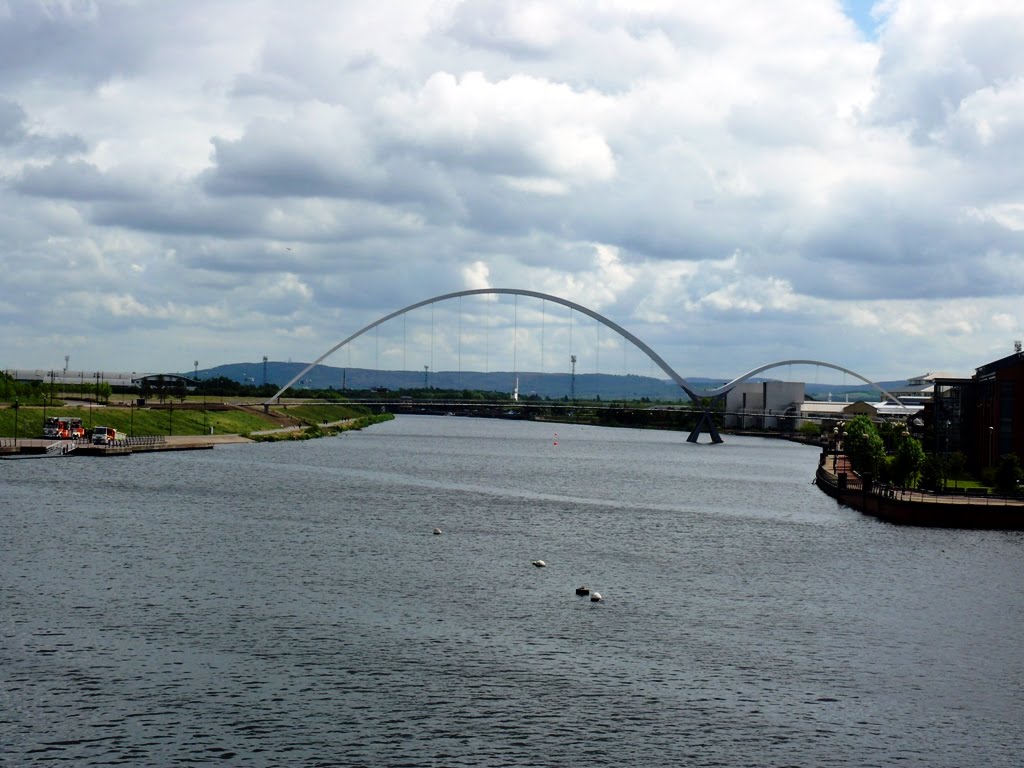
 When a new bridge was proposed across the River Tees at Stockton several designs were proposed for the public to select the one they wanted. One was a massive favourite but we were told that design could not be built. This went up instead.

The Infinity Bridge at Stockton-on Tees

A reflection of the bridge with it in the river is said to make the infinity sign. I've never seen it myself.

The bridge however make interesting shots possible.


In fact you could take all day and finish up with an infinite number of shots.

Sunday, 5 May 2019

Sunday Stamps K4 - Great Britain

When I was at school in the 1950s if you misbehaved a master or a prefect could issue you 'copies'. These had to be completed in your best writing on blue paper which had to be obtained from your House Master - in my case that meant having to collect the paper from the head table at lunch time.

I have always remembered one of the lines to be copied -
"A thing of beauty is a joy for ever."
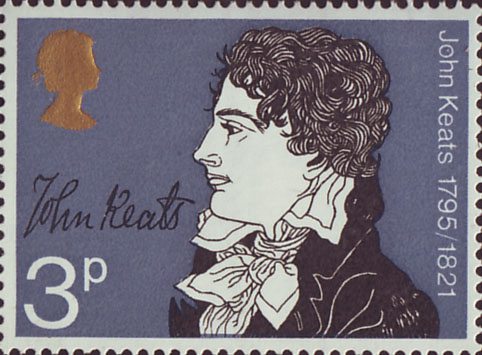
It was some years later that I found out that this was the opening line of a poem by -

Great Britain
This was issued in on 28 July 1971 to commemorate the 150th anniversary of his death.


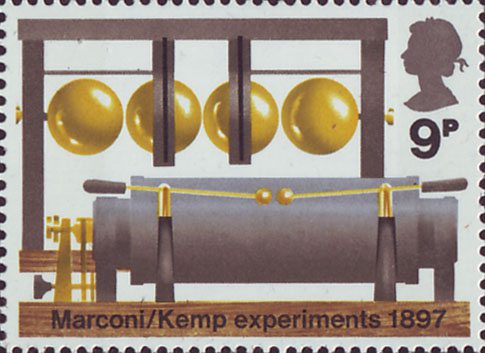
Great Britain - 13 September 1972
I guess we all have heard of Marconi and his roll in the development of the radio. I did not know that it was George Kemp, a Welshman, who played an essential part in the first experiments in sending messages -- Something-in-the-air.


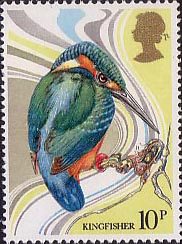
Great Britain - 16 January 1980
I used to see the kingfishers on the River Chater in Rutland when I was boy but unfortunately I can't remember when I last saw one on the Tees - now my much bigger local river.

There is a white water centre on the Tees by the Tees Barrage. Kayaks use it too.To see the connection to 'K' stamps please visit Sunday-stamps-k.

Monday, 23 April 2018

A-Z Challenge 2018 - British Rivers: 'T' Tees

There are so many rivers beginning with 'T' - Tay, Tweed, Tyne, Tees, Trent,Thames, Test, Taw, Tamar - it's impossible to cover them all.

So I'll stick to the one I know best.


River Tees 'looping' round the town of Yarm
Here you can hardly miss the railway viaduct that appeared in my 'Theme Reveal' post.

Railway viaduct crossing the River Tees
That's it, together with the road bridge, at the left of the first photo.

Upstream of the viaduct the river looks very peaceful. A seal has been fishing there this week.


You can see the road bridge with the viaduct behind from this shot taken from down stream.


The name of Yarm is derived from the Anglo Saxon 'yarum' meaning 'fish pools'

The road bridge was built in 1400 by Walter Skirlaw, Bishop of Durham; now it is twice the width of that 1400 bridge, but original stonework still makes up part of the pillars you can see.

The first bridge over the Tees at Stockton, further downstream, was built in 1771. Until that time the port of Yarm had been the nearest place to the North Sea where River Tees could be crossed. As ships got bigger port facilities moved down river, first to Stockton, then and now to Middlesbrough.

When we first moved to Yarm in 1970 the Tees was a tidal river up to and beyond the town. It was not uncommon for the town to be flooded; high water heights are recorded on some buildings.

In the 1990s a tidal barrier was installed between Stockton and Middlesbrough. The Tees at Yarm is now no longer tidal with the water level controlled by the Tees Barrage.

Geese on the River Tees at Yarm
Raised floodgate on the Barrage
High Tide
Low Tide
Meanwhile back at Yarm the geese line up - 


For their turn in a gala on the River
We cannot leave the Tees without taking a look at some bridges further down river,

The Infinity Bridge at Stockton
(with the Tees Barrage in the background)
The Infinity Bridge was erected to celebrate the end of the 20th century.

You can walk alongside the River from the Infinity Bridge down past the Tees Barrage, alongside the Portrack Nature Reserve. Then if the mood takes you can cross over to the other side via - 

Newport Bridge
Designed as a lift bridge to allow ships to past, the road section is now fixed in place and only small craft pass to go up to the Barrage and through its lock to Stockton and beyond.

Along that stretch of the Tees you may, if the mood takes you, indulge some bird watching.

A curlew in the mud
Closer to the sea you come to Middlesbrough and the bridge that has become an icon for the town.

Middlesbrough Transporter Bridge in action


Friday, 13 April 2018

A-Z Challenge 2018 - British Rivers: 'L' Leven

This North Yorkshire river rises in the North Yorkshire Moors  and runs into the River Tees at Yarm.

I'm ashamed to say that although I have walked beside it where it passes through - 

Great Ayton 
(The childhood home of Captain Cook)


and over the packhorse bridge at -


Stokesley

and  I know it enters the Tees -


River Leven entering the Tees at Yarm

I have no photos of my own of this river which is around 30 miles long.

I usually see it from a car window where it goes under the road at Leven Bank or under a viaduct which carries the A19 dual carriageway over it. 

This sketch map shows the stretch from Yarm to beyond the A19.


(Ex Teesmouth Bird Club website, with permission)

Now I must walk as much of that route as possible. I just wonder why part of it is called Weary Bank.

Photo attributions:

  • Great Ayton - River Leven between High and Low Green: 18 October 2007 ex geograph.org.uk by Trish Steel - CC BY-SA 2.0 licence
  • Stokesley - 17/18 century packhorse bridge over the River Leven: 19 October 2010 ex geograph.org.uk by Carole Walker - CC BY-SA 2.0
  • Mouth of River Leven as it joins the Tees at Yarm: 9 August 2006 by Andrew Duffell CC BY-SA 3.0 licence.

Monday, 19 March 2018

A-Z Challenge 2018 - Theme Reveal:British Rivers

If you live in the United Kingdom you are never far from a river, as this map for England shows - 


My theme this year will be British Rivers and you will soon see that many I will show will not appear on this map.

The River Tees is the nearest major river to where we live so it's only natural that I should include a view of it here.


Railway viaduct over the River Tees at Yarm, North Yorkshire
Initial searches show me that I will be able to cover all but two letters (X and Z) without cheating.


Photo Attribution:

Wednesday, 19 April 2017

A-Z Challenge - Houses, some real, some not - 'P'

P - Preston Hall

Preston Hall and Park overlooks the River Tees at Eaglescliffe. The Preston Hall Museum and its surroundings in 100 acres of beautiful park land which has undergone a make-over as the result of a Heritage Lottery Grant.


In addition to the winter gardens at the right, the museum houses displays of art, which normally includes Georges de la Tour’s famous Dice Players, armour and social history. 

Exhibitions show visitors what life was like in the 1800s with craft workers in a typical local street of the1890s. The street includes the shop of John Walker from Stockton; Walker was the inventor of the safety match.


Permanent attractions include an aviary, riverside and woodland paths. The Butterfly World  contains hundreds of butterflies from around the world and even some meerkats.

You may ride on the Teesside Small Gauge Railway or take a trip on the river to Yarm and Stockton aboard the pleasure boat, the Teesside Princess.

The park is an ideal place to walk a dog. Other facilities include safe surface play area for children, crazy golf and a café.

The walks by the river and the Quarry Wood Nature reserve are havens for wild life. 


Grassy areas are perfect for picnics and if you have a piscatorial bent the banks of the Tees provide pleasant spots for plumbing its depths.

[This is an edited post from the first A-Z Challenge I entered in 2011]

Tuesday, 14 February 2017

Favourites for Thematic Photographic's 400th Outing

Congratulations to Carmi for having the dedication to run Thematic Photographic for over 8 years and for this, his 400th theme.

You always have to think about how to take photos which you interpret will match his theme.

This week choice of your favourite shots enables me to show four of what are/will be among the all time best for me.

In the days before digital cameras my photographs of people were never very good and frequently out of focus as well. However one I'll always cherish is a particular close up - 

Summer portrait at the Yorkshire village of Hutton-le-Hole
Last year I took pictures of hundreds of wild flowers and one beside the River Tees turned out better than I expected.


Another with a water theme was taken on Labour Day at Lake Orion, Michigan. What we thought was a metal statue hidden away in a stream turned out to be -

A rather splendid heron

Dogs have figured in many of my 261 thematic photography posts. This, from September 2016, will always be a favourite with me.

Scout - telling me to put my camera away.
He did not like to hear a camera click and usually turned away.

Unfortunately he crossed the Rainbow Bridge last Christmas and we all miss him so much.

Check out all the favourites for Carmi's 400th anniversary at Thematic-Photographic-400.

Saturday, 23 April 2016

A-Z Challenge 2016 - Wildflowers 'T'

My theme this year is wild flowers. Most of us will be aware of the flowers that grow in our gardens but what surprises me is how few wild flowers that I know.


I pass them every day but rarely look at them. Well this year will be different - even if many of them may fall under the letter 'X' for unknown.

'T' - Tansy, Thistles

This is a shot taken alongside the River Tees at Yarm in North Yorkshire. You should recognise one of the flowers in it if you have visited 'I'


The pink flower is Indian Balsam but it's the yellow flower that was involved in a country practice, to eat in a Tansy pudding at Easter in remembrance of bitter herbs eaten by Jews at the Passover.

The Tansy can have up to 100 flower heads in its dense, flat-topped yellow clusters. An aromatic herb, its strong smell has medicinal and insecticidal properties. Its fern-like leaves once were used to staunch and to prevent miscarriages.

The ferny leaves may be used to spice up omelettes and cakes. At one time Tansy cakes were  a traditional Easter treat.

A more macabre use was its insect repellent properties to keep blowflies off meat and .... corpses!

In preparation for the Challenge over the last year I have taken hundreds of photos of flowers. Now I have have come to write the posts I have discovered that I should have paid more attention to their leaves as well if I was going to differentiate between species.

I never knew, for instance that there are 11 varieties of - 

Thistles
The AA Book of the British Countryside illustrates the various sorts.


Spear Thistle - the famous emblem of Scotland
This biennial which can grow to a height of 6ft grows in hedgerows, waste places and disturbed ground is regarded by many as a vigorous weed. There is no mistaking its prickly nature.

The welted, melancholy, musk and meadow thistle have no prickles. The stemless (or dwarf) thistle will make you painfully aware of its presence should you be unfortunate enough to sit down on one at a picnic.

The flowers of the cotton thistle (the tallest of them all) are covered in white hairs and the woolly's flowers with a white cotton like growth. I have not seen any of these nor the white flowers that make the carline thistle stand out.

Carline thistle
Attribution:
  • Carline thistle heads - 18 May 2008, ex geograph.org.uk, by May and Angus Hogg - CC BY-SA 2.0 generic.

Sunday, 27 December 2015

Favourite choice - Sunday Stamps !!

With so many available and after 36 hours of rain it was difficult to make a choice.

As I have recently transferred all my American stamps to a stock book and arranged them in date of issue sequence I decided to include just one.

USA - George Washington 1923
I chose this one because it is the oldest in my collection from the States.

Closer to home and much more recent it just had to be one from a set of 10 issued in 2015 that I have shown before.

Great Britain - Tees Transporter Bridge, River Tees
Now it has stopped raining we might even go out and take a look at it in real life - if the river banks are not flooded, that is.

I know that Violet has chosen bridges for next week to start the New Year off, but I could not resist showing you my favourite stamp of 2015.

Hope you had a very merry Christmas and I wish you all the best for the New Year.

Don't for get to check out others' favourites at Sunday-Stamps-II-54.


Friday, 4 December 2015

Island Beaches - Sepia Saturday

I must have walked a few miles along island sands, sometimes with a dog, but never with a gun like Robinson Crusoe below:


The Isle of Skye may be connected to the mainland now by a bridge but in 1957 it was unreachable from -

The foreshore on the island of Raasay
The week of our geological expedition from St Andrews the weather threatened to spoil our stay.


Whereas on the Isles of Scilly it was much more welcoming.

Tresco beach
And not crowded at all.

One man's footsteps
He must have got separated from his dog.

Buster waiting for someone to join him
A North Yorkshire beach is comparatively crowded.

Dogs at Saltburn
Further down that beach the cliffs are menacing.


Any footprints here are filled in quickly in the squelchy sand.

Those in Cornwall are much easier to see even though we may not know who made them at the time.


While Aphrodite strides out from beneath the sea


a curlew decides to make itself scarce along the River Tees.


If you had wondered where I've been for so long I'll just leave you to guess on which deserted island I have been marooned while you check other posts at Sepia-Saturday-308.