There are lots of inventions that we take for granted which would not exist without the men who were in it at the "Beginning." With so many to chose from I decided to chose a few who you could say are connected with our ability to communicate.
Great Britain - issued 1995
In the 1860s, a Scottish physicist, James Clerk Maxwell had predicted the existence of radio waves; and in 1886, the German Heinrich Rudolph Hertz demonstrated that rapid variations of electric current could be
projected into space in the form of radio waves similar to those of
light and heat. In 1888 an American, Mahlon Loomis demonstrated "wireless telegraphy."
Loomis was able to make a meter connected to one kite cause another one
to move, marking the first known instance of wireless aerial
communication.
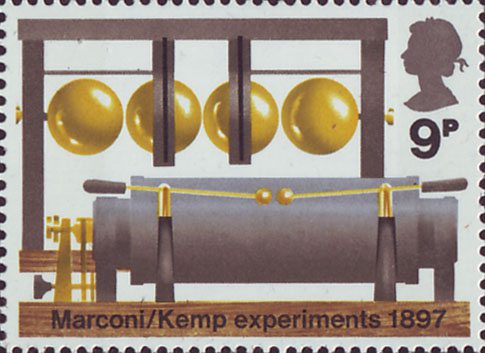
But it was Guglielmo Marconi who proved the feasibility of radio communication. He
sent and received his first radio signal in Italy in 1895. By 1899 he
flashed the first wireless signal across the English Channel and two
years later received the letter "S", telegraphed from England to
Newfoundland. This was the first successful transatlantic radiotelegraph
message in 1902.
One year later the Wright Brothers made the first controlled, powered and sustained heavier-than-air flight on December 17, 1903.
 |
| USA - issued 2003 |
There are several stamps commemorating that first flight but this was issued on the centenary of the flight that was the beginning of aviation as we know it.
The first non-stop transatlantic flight came in 1919.
 |
| Great Britain - 1969 |
The stamp shows a page from the Daily Mail newspaper and was issue for the 50th anniversary of the flight. Alcock and Brown flew a modified World War I Vickers Vimy
bomber from St John's Newfoundland to Clifden in County Galway in Ireland.
There was a small amount of mail carried on the flight making it the first transatlantic airmail flight.