Pages

Showing posts with label Scarborough. Show all posts

Tuesday, 5 January 2016

Blue - Thematic Photography

And still it rains! After the wettest December since records began 1910, it's enough to make anyone feel blue.

I didn't really know where to start especially as 19 of my earlier thematic posts have included things blue before.

Of course the answer was right in front of me - 

Blue desktop
Christmas may be over and our decorations put away but others have still to get around to dismantling their display.

Blue coat
A local notice stands out as a reminder not to encroach.


The prison inmates do a great job in clearing litter for the woods at that side of the road.

I just wish someone would do the same in the woods across the other side.


It was much better to see the blue of the Atlantic off the North Cornish coast last summer.


While at Scarborough in October a blue surfer waited for his turn to try and catch a wave.


After a 20 minute session in the sea it's a wonder he wasn't blue all over.

To see how blue is viewed by others check out the links at Carmi's Thematic-photographic-362.

Friday, 4 April 2014

Scarborough to Ferryside _Sepia Saturday

This week's prompt suggests a number of topics to me, but as I have retired I'll ignore working at heights.


Looking down at harbours is a favourite pastime of mine, so where better to start than in North Yorkshire.


Scarborough Harbour
That shot was taken from way up at the Castle.

At Whitby we were up on the 199 steps to the Abbey.

Whitby Harbour (between the houses and the 'pier'.)
Neither are as exotic as the harbour at Monaco.

Monaco Harbour (from the way up to the Palace)
In our prompt the resting workmen were looking down on a ferry station. From Monaco you can catch boats to Rome, Nice, Barcelona and Corsica but I flew in and out by helicopter.

When in Fowey, Cornwall I have only watched the ferry cross the estuary to Polruan.

Fowey - Polruan Ferry
(Trevor Harris; CC BY-SA 2.0 = Geograph Collection)

In "Vanishing Cornwall" Daphne du Maurier wrote of arriving in a hire car when she was 19 and seeing Fowey harbour for the first time from the Bodinnick side. The car deposited them at the foot of the hill by the ferry (The Bodinnick/Fowey ferry not the one from Polruan). 

'Before climbing the hill to lunch our eyes were caught by a board saying "For Sale" on a gate just above the ferry. Behind the gate was a rough piece of ground and a house by the water's edge, a strange looking house built like a Swiss Chalet.

"Yes," said the ferryman standing near by, "they call it Swiss Cottage." '

Swiss Cottage
The du Mauriers later bought Swiss Cottage and it was there that Daphne wrote her first novel, "The Loving Spirit" which was published in 1929.

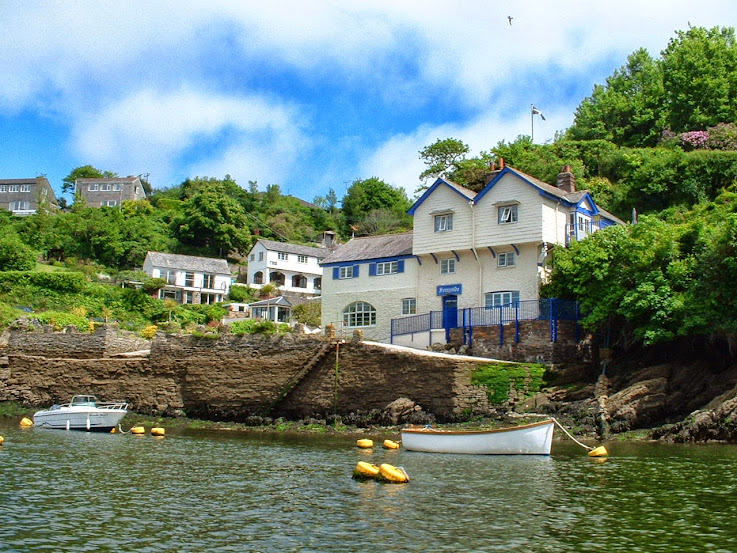
Because of its location the du Mauriers renamed the house Ferryside, the name it still bears today.

Ferryside
The road up to Bodinnick is on the left hand side of the photo: that's where the ferry docks.

If you study the next photo taken from a different angle -


you may be able to make out a figure on the right hand corner of the house.

This is the figurehead from the schooner Jane Slade.


Daphne was inspired to write "The Loving Spirit" after discovering the wreck of the schooner in nearby Pont Creek. The figurehead was added to the house at a later date.

The Slade family were shipbuilders in Polruan. Their life and history were used by Daphne to create the saga, in "The Loving Spirit," of four generations if shipbuilders and mariners in the fictional Cornish village of Plyn.

Daphne du Maurier's son and his wife live at Ferryside today.

If you check out the links at Sepia-Saturday-222 you can see where others have been.


Thursday, 7 March 2013

Harbour Views - Sepia Saturday

When I saw the prompt for this week I knew immediately some shots I wished to post.


You could argue that my first two pictures are not coastal views, but at least they are from a Yorkshire seaside town.

Scarborough - Peasholm Glen
At least there is writing on the postcard and , I believe Peasholm is a boating lake even if no boats are in sight.

Scarborough Pleasure Park
There are boats galore here, and a water chute - the bank on the right has seats to view acts at the open air theatre opposite. It looks a lot different today I'm told.

Fowey on the south coast of Cornwall is one of my favourite places to visit.

Fowey - viewed from across the Fowey Estuary
And if you look across the estuary in the other direction this is what you see.

Polruan - viewed from Fowey
But I've had to go to Stavanger in Norway for a shot of a ship of any size.

Royal Yacht Britannia - Stavanger 1980s
The Queen and Prince Philip were on board. I was working at Rosenberg Verft at the time.

On that royal note I'll leave you to check out other voyages and tales at Sepia-Saturday-167.

Thursday, 10 January 2013

Beached - Sepia Saturday

I thought I would explore some beaches found in my archives and take you on a tour from the West of Scotland via the Adriatic coast to Egypt and end up in the South West of England, before a friendly warning.

A seaside postcard from Ayr, Scotland
This card was one of several linked to Robbie Burns but apart from the views contains no other information to help you date when it was taken. It looks prewar to me.

I cannot date my second card from Yorkshire either and you need good eyes to see anything on the South Bay beach.

The Spa and South Bay, Scarborough
I can put a rough date on the next shot taken in the 1940s, probably somewhere in Egypt during the war when the Fleet Air Arm crews were on a beach.

Egypt (?) - 1940s
Sorry that there have been no bathing belles to admire so far; we get a bit closer on the Adriatic coast of Montenegro.

Beach on the isthmus to the island of Sveti Stefan - c1986
Coming back to Cornwall all I have to show are empty beaches.

Camel Estuary, Padstow - May 2011
At least you can see some footprints - I wonder where Man Friday went?

Crantock Beach, Cornwall
That sea is waiting for the surfers to appear.

Meanwhile this little girl is counting her collection.

Hope she hasn't lost count
I wonder if "she sells seashells on the seashore?"

Finally here's that friendly warning that all can see.


I just wish I could remember where this was taken, I must ask my wife to jog my memory - on second thoughts, I had better not.

For more sand and sea take a trip or donkey ride to Alan's place.


Friday, 22 June 2012

Swings and Roundabouts - Sepia Saturday

Three famous fairs came to my mind as soon as I saw this week's 'merry-go-round' (or is it a Noah's Ark?).


Some of you may recognise this place.

Scarborough - 1981
Just in case you've forgotten here's a little reminder about Scarborough Fair.

Scarborough Fair - Simon & Garfunkel

Scarborough Fair originated from a charter granted by King Henry III in 1253. The charter gave Scarborough the privilege of a yearly fair to be held from the Feast of the Assumption until the Feast of St Michael. The 45-day fair started on August 15th and was a huge trading event. In the early 17th century competition from other towns' markets and fairs made Scarborough's fair financially untenable. Scarborough Fair ended in 1788.


Widdecombe Fair is much younger taking place on the second Tuesday in September since c1850 in the Dartmoor village of Widdecombe-in-the-Moor in Devon. It's the subject of a folk song, also called Tam Pierce, known all over the world.

Tam Pierce - Burl Ives

Originally described as a cattle fair Widdecombe Fair soon was known for other livestock especially the local-bred sheep and Dartmoor Ponies. A sports day for schoolchildren and stalls for rural arts and crafts were introduced in the 1920s and 30s. Today visitors will see, in addition to the livestock, displays of farm produce, vintage farm machinery, bale tossing, a dog show and terrier racing. The terrier racing replaced pony classes cancelled in 1989 after an outbreak of equine flu. 

Naturally Uncle Tom Cobley makes a traditional appearance riding a grey mare.


For my last fair I'm coming back to Yarm where I lived for over 20 years.The charter for a fair was granted to Yarm by King John in the early 13th century. Originally the fair saw the sale of cattle, horses, sheep and cheese and at one time the fair was the biggest fair for cheese in North East England. In the early 1900s over 500 tons of cheese would be traded from unprotected stacks on the pavement. There would be no chance of that happening these days.

Fair in c.1949

Modern ride at Yarm fair

In 1901 the High Street was packed with shows, roundabouts, cattle and sightseers The modern fair consists of white knuckle rides, fortune tellers, lots of bright lights and loud music. Many businesses now close down while the fair is in town and the horse trading has been moved away from the main street.

Yarm High Street
(Photo by Ian Britton - www.freephoto.com - Creative Commons licence)

Yarm Town Hall
(Photo by Ian Britton - www.freephoto.com - Creative Commons licence)

At one time hundreds of horses would be bought and sold after being put through their paces. In his book, The Yarm of Yesterday, Malcolm Race tells the story of a young boy left in charge of a horse while his grandfather was in one of Yarm’s many pubs.  The boy was only too pleased the lead the animal up and down the High Street for a prospective buyer. The man had handed over £50 and was leading the horse away when he discovered that the horse was blind. The boy had long since disappeared!


Yarm Fair - rides surround the Town Hall
(Photo by thornej - www.flickr.com - Creative Commons Licence)

For more fun of the fair I suggest you visit Sepia-saturday-131 where I'm sure you will find some more to make you dizzy.

Sunday, 23 January 2011

Canned - Sepia Saturday

“…a poem, a stink, a grating noise, a quality of light, a habit, a nostalgia, a dream.”

This is how John Steinbeck described Cannery Row in Monterey, in California in the opening sentence of his book. Doc, the marine biologist, in Cannery Row was based on Steinbeck’s friend Ed Ricketts.

Ricketts had a laboratory and store at 800 Cannery Row in the period 1928-1948


 (By Lord Harris – GNU Free Documentation License V1.2+

As I had no hat connection to Alan’s post I spent some time in the US government archives and discovered this cannery shot.

 Noon hour at an Indianapolis cannery (1908)

You’ll notice there’s a lot of young faces here. Apparently the photo was part of a series dealing with child labour.

I then discovered a photo of native girls in Hawaii packing pineapples into cans in an exhibition on the history of work in America.

 (By Edgeworth, for Katakura & Company, Nov 20 1928.
Records of the Women’s Bureau, National Archives)

Then I remembered something much closer to home. Scarborough, North Yorkshire was once the tuna fishing capital of the UK. Tuna fishing began in 1929 the climax being reached in 1933 when a gentleman named Mitchell-Henry caught a fish that is still the UK record weighing 851lbs off Whitby.

 (Scarborough tuna)