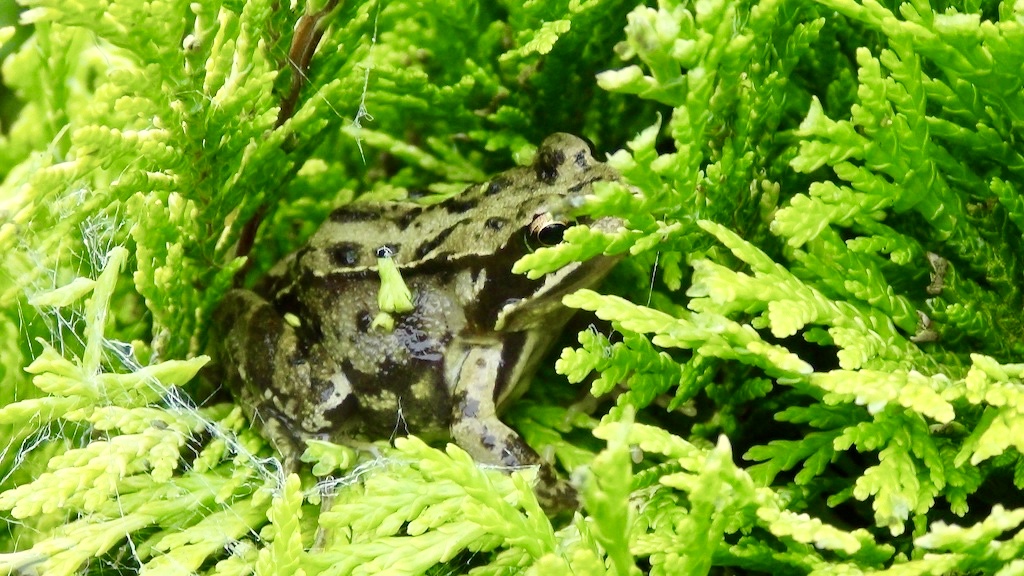
If you had met Finn you would enjoy taking him for a walk -
You might need stronger arms however.
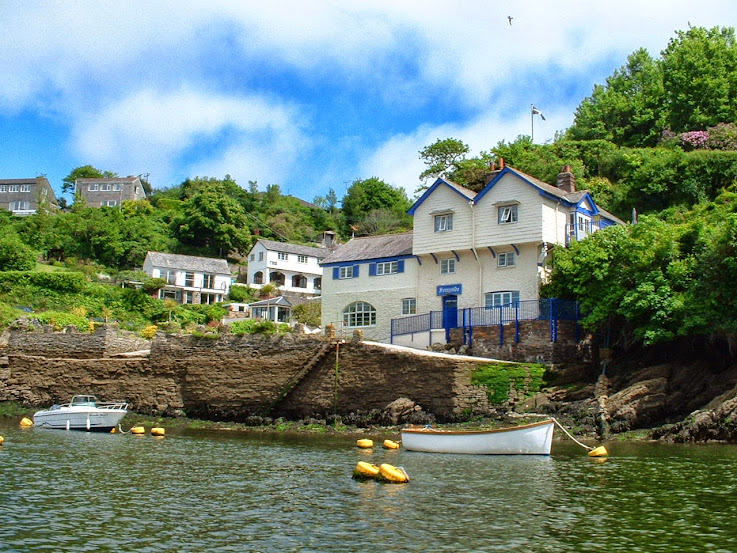
If you visit Cornwall, Fowey is the place to visit and there you can see the house in which Dapne du Maurier wrote her first novel - The Loving Spirit.
Ferryside
The house next door to us has a pond and I just wonder whether what I find in our garden migrates from there.
I first went to the Cornish town of Fowey in 2007 just after my elder son moved there to live. 2007 also happened to be the centenary year of the birth of Daphne du Maurier.
Ferryside by the River Fowey
Ferryside was the house where Daphne wrote The Loving Spirit, her first novel. Daphne's son Kit and his family live in Ferryside today. If you look closely at the right corner of the house you should be able to make out the ship figurehead from the Jane Slade which inspired Daphne to write that first book.
Further along the Fowey estuary on the town side you will come to -
Neptune's Point at Readymoney Cove
Daphne lived at Readymoney - not that big house - back from the beach in 1942 and 1943.
The River Fowey rises on Bodmin Moor and flows to the sea on the south coast.
Sketch map of the rivers of South Cornwall including the River Fowey
Fowey harbour was one of those on the South Coast from which invasion fleets sailed on D-Day 1944. This view looking towards the open sea, with the village of Polruan on the opposite bank, looks much more peaceful.
These days of course, visits to Fowey are made by many cruise ships.
I must say I prefer the cruises on much smaller vessels along the Fowey and from which to admire the town.
Fowey from the river
Photo attribution:
Sketch map: 15 May 2009, by Andy F - CC BY-SA 3.0 licence.
Jamaica Inn, in the middle of Bodmin Moor was built as a staging post for changing horses for stagecoaches crossing the moor. It was made famous by Daphne du Maurier in the fourth of her novels. Jamaica Inn told the story of Cornish wreckers led by a parson. On a winters night in 1930 stayed at the Inn with her friend Foy, the daughter of Sir Arthur Quiller Couch. While they were there they went riding on Bodmin Moor. Finding themselves lost in bad weather they apparently sheltered for some time in a derelict cottage on the moor being eventually led back to Jamaica Inn by their horses. During that stay at Jamaica Inn Daphne also met and talked to the parson from the nearby church at Altarnun. Her story tells the tale of Mary, an orphan who goes to live with her Aunt Patience and Uncle Joss Merlyn, the terrifying landlord of Jamaica Inn and the mystery surrounding her uncle’s business - smuggling along the Cornish coast.
Today Jamaica Inn is both a pub and a museum, alongside the A30 Hitchcock's 1939 film of Jamaica Inn had its ending altered due to restrictions of the American Hays Production Code - the leader of the wreckers could not be seen as a man of the cloth and was changed to the local squire. Daphne did not appreciate the changes. Recently Jamaica Inn was made into a BBC TV series, ruined for me and hundreds of viewers by mumbling, inaudible dialogue.
In 1926, when
she was 19, Daphne du Maurier's family found Swiss Cottage, a house on the bank of the River Fowey in Cornwall.
Swiss Cottage
Daphne
later described that discovery in Vanishing Cornwall:
"There was a smell in the air of tar
and rope and rusted chain, a smell of tidal water. Down harbour, round the
point, was the open sea. Here was the freedom I desired, long sought-for, not
yet known. Freedom to write, to walk, to wander, freedom to climb hills, to
pull a boat, to be alone. It could not be mere chance that brought us to the
ferry, and the bottom of Bodinnick hill, and so to the board upon the gate
beyond that said For Sale.
I remembered a line from a forgotten book, where a lover looks for the first
time upon his chosen one – ‘I for this, and this for me."
The house subsequently renamed Ferryside is
inhabited today by Daphne’s son, Christopher (Kits).
It was at Ferryside in 1929 that she wrote
her first novel, The Loving Spirit, the title taken from a poem by Emily
Bronte:
Alas! the countless links are strong
That bind us to our clay;
The loving spirit lingers long,
And would not pass away!
The discovery of the wreck of the schooner Jane Slade in Pont Creek
inspired Daphne. The Slade family were shipbuilders in the nearby village of Polruan on the same side of the Fowey
estuary as Ferryside. Daphne researched the family and visited their graves at
the local church
of Lanteglos. In the
book, Polruan became Plyn, Lanteglos became Lanoc and Jane Slade became Janet
Coombe. The Loving Spirit is a family saga spanning four generations of the
Coombe family, shipbuilders and mariners in and around the Cornish village of Plyn. The figurehead from the Jane Slade
was later added to the front of Ferryside.
Ferryside
If you look closely you can see the figurehead on the right hand corner of the house, next to the tree.
Having waited all week to have a sky worth photographing I've given up and gone back to shots from my archives.
Traverse City, Michigan - 22 July 2007
From a shot exactly eight years ago to one slightly earlier in Cornwall.
Readymoney Cove, Fowey - May 2007
The elevated house in the centre of the picture was then the home of Dawn French and Lennie Henry. The house obscured by the rock on the right of the beach was occupied by author Daphne du Maurier in 1943.
I shown shots of Stockton's Infinity Bridge before where the sky has enhanced the photo significantly. Here's another one.
My elder son lives in Fowey on the south coast of Cornwall in the south-west of England and I've shown fences from there before.
Mawgan Porth Beach (from a hotel window)
Much older is the view through the window of St Catherine's Castle at Fowey.
The Fowey Estuary
The author Daphne du Maurier had a long association with the area and in 1929 wrote her first novel, 'The Loving Spirit,' in the house behind the blue fence.
Ferryside
At the right end of
the house is the figurehead from the schooner Jane Slade.
Daphne was inspired to write the book after discovering the wreck of the
schooner in Pont Creek. The figurehead was added to the house at a later date.
The Slade family were
shipbuilders in the nearby village
of Polruan. Their life
and history were used by Daphne to create the saga, in The Loving Spirit, of four
generations of shipbuilders and mariners in the fictional Cornish village of Plyn.
Daphne du Maurier’s
son and his wife live at Ferryside today.
If I had to cross the river at Bristol I'd definitely use the suspension bridge.
Clifton Suspension Bride
The Avon is a long way down even from the road that skirts it.
Looking down from the bridge
Daphne du Maurier first saw Cornwall's River Fowey at the age of 19 when their hire car deposited her, her mother and sisters at the foot of the hill at Bodinnick by the slipway for the ferry to Fowey.
The ferry slipway is at the centre left edge of the photo above. The house with the blue door is the house the du Mauriers were to buy and rename Ferryside and were Daphne was to write 'The Loving Spirit', the first of her novels.
I'm not a lover of ferries as the only Channel crossing I ever took (in 1959) was horrific even before we had left Calais.
The brook that our sons were threatening to jump looked much more friendly in the 1960s'.
Andrew & Adrian
The rocks did not look big enough to be stepping stones.
However some do not need any help to cross.
Egret in the Fowey Estuary
Other damsels chose to rest on reeds beside a lake.
Bluet Damselflies
Some just pause to drink at the water's edge with no thought of crossing.
Fawn at lakeside
But are those rocks intimidating her.
This pup has been cast adrift to make the crossing on his own.
Scout getting ready to paddle with his stick
Now grown up, he would just jump in and swim across.
We have just left him back in Michigan where he lives next to that lake. Of course we have to take a plane back across the pond. But first we have to decide whose in charge.
In the Airbus Cockpit (2013)
Do we push or pull?
Well we crossed safely again this year and now it's time for you to cross over to see what other watery treats are on offer at Sepia-Saturday-254.
This week's prompt suggests a number of topics to me, but as I have retired I'll ignore working at heights.
Looking down at harbours is a favourite pastime of mine, so where better to start than in North Yorkshire.
Scarborough Harbour
That shot was taken from way up at the Castle.
At Whitby we were up on the 199 steps to the Abbey.
Whitby Harbour (between the houses and the 'pier'.)
Neither are as exotic as the harbour at Monaco.
Monaco Harbour (from the way up to the Palace)
In our prompt the resting workmen were looking down on a ferry station. From Monaco you can catch boats to Rome, Nice, Barcelona and Corsica but I flew in and out by helicopter.
When in Fowey, Cornwall I have only watched the ferry cross the estuary to Polruan.
In "Vanishing Cornwall" Daphne du Maurier wrote of arriving in a hire car when she was 19 and seeing Fowey harbour for the first time from the Bodinnick side. The car deposited them at the foot of the hill by the ferry (The Bodinnick/Fowey ferry not the one from Polruan).
'Before climbing the hill to lunch our eyes were caught by a board saying "For Sale" on a gate just above the ferry. Behind the gate was a rough piece of ground and a house by the water's edge, a strange looking house built like a Swiss Chalet.
"Yes," said the ferryman standing near by, "they call it Swiss Cottage." '
Swiss Cottage
The du Mauriers later bought Swiss Cottage and it was there that Daphne wrote her first novel, "The Loving Spirit" which was published in 1929.
Because of its location the du Mauriers renamed the house Ferryside, the name it still bears today.
Ferryside
The road up to Bodinnick is on the left hand side of the photo: that's where the ferry docks.
If you study the next photo taken from a different angle -
you may be able to make out a figure on the right hand corner of the house.
This is the figurehead from the schooner Jane Slade.
Daphne was inspired to write "The Loving Spirit" after discovering the wreck of the schooner in nearby Pont Creek. The figurehead was added to the house at a later date.
The Slade family were shipbuilders in Polruan. Their life and history were used by Daphne to create the saga, in "The Loving Spirit," of four generations if shipbuilders and mariners in the fictional Cornish village of Plyn.
Daphne du Maurier's son and his wife live at Ferryside today.
If you check out the links at Sepia-Saturday-222 you can see where others have been.
The theme this week is drink up, celebrating any form of consumable liquid, and a theme that can be interpreted in many different ways.
This summer in the UK has not given us many chances to sit out and celebrate in the sun so there has only been the odd day like this.
A Half Empty Glass
Or is it half full?
One of my favourite books begins with the line, "It was a cold grey day in November." - the day that Daphne du Maurier's heroine, Mary Yellan, arrived here.
Cornwall's Jamaica Inn
For one reason or another it's several years since I had an alcoholic drink but not so long ago as when this source of water was in everyday use.
Stocks Hill monument, Ketton
The monument at Ketton, the village where I grew up, was erected including the cold water tap to commemorate the Diamond Jubilee of Queen Victoria in 1897. Forty years later I was born in a house a stone's throw from Stocks Hills. The only water available twenty years after that was still from a cold water tap on the outside of the house.
Many years later with two children as well the opportunity came to drink up something stronger abroad.
Who's been in the sun
You should be able to date this pair in the process of drinking up from the size of those shoulder pads.
Eat your heart out, Sue Ellen
Just occasionally I managed to get in on the act too, when home from Norway for Christmas.
Brandy, Sir?
They say you can take a horse to water but you can't make it drink - not true in this case at least.