Pages

Showing posts with label A-Z Challenge. Show all posts

Wednesday, 25 April 2018

A-Z Challenge 2018 - British Rivers: 'V' Valency

I studied chemistry at university and thought I had learnt a lot about valency.

I had never heard of the North Cornish village of Boscastle but like many I was shocked to see the TV news in August 2004.


Boscastle Harbour
This photo was taken in April 2004. In it you can see the steep sides of the Valency valley. The river itself is very short - c.5 miles. It has many tributaries, including a very short River Jordan (not one of those in my 'J' post) which joins the Valency just above Bocastle.

In its wooded stretches the Valency looks very mild.

River Valency at New Mills

After several days of heavy rain in August 2004 and 24 hours in which a month's rain came down, the Valency turned into a raging torrent which caused extensive structural damage in Boscastle. Cars were washed away and people trapped in their houses until rescued by helicopters.


The harbour was protected by two stone walls erected by Sir Richard Grenville in 1584. I assume that these are those in the first photo above.

Protected from the Atlantic Ocean by these walls, Boscastle harbour was unprotected from what became the raging Valency.

There are a number of videos on YouTube which show the Boscastle floods if you wish to get an idea about how bad the conditions were.

Photo attributions:
  • Boscastle Harbour: 14 April 2004 by JUweL - CC BY-SA 3.0 Licence
  • River Valency at New Mills: 18 May 2007 by Jan Coupland ex geography.org.uk - CC BY-SA 2.0 Licence

Saturday, 4 April 2015

A-Z Challenge 2015 - Butterflies 'D'

D - Duke of Burgundy Fritillary

I didn't expect to have trouble so early in the Challenge, 'D' proved harder that I expected until, that is, I found the Duke of Burgundy - the Fritillary that isn't related to the other butterflies with that name.

The Duke of Burgundy, no-one knows how that name came about, is the European representative of a family of tropical butterflies. It's the only member of the genus Hamearis in the family Riodinidae.


Duke of Burgundy Fritillary
It is found in Southern England but rare elsewhere with isolated colonies in the Lake District and on the North Yorkshire Moors, close to where I live.

It's a small (1" wingspan) springtime butterfly, frequenting sunny chalk and limestone grasslands, and sunny  woody clearings. You may find it in woods where cowslips and primroses grow.


Cowslips on a grassy bank in North Yorkshire
It lays it's eggs on these plant as it's slug like caterpillar only feeds on cowslips and primroses.

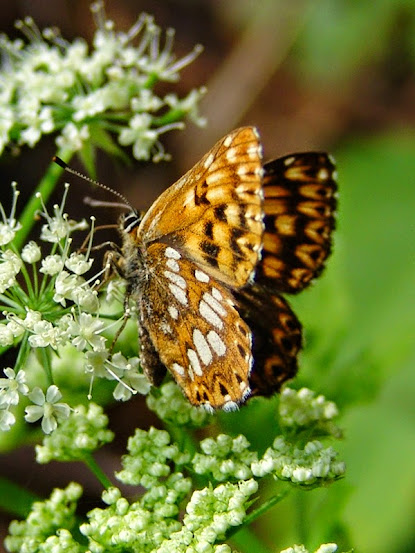
The male Duke of Burgundy is brown with tawny (orange) spots, the females slightly paler. The underside of its hind wings have rows of white spots.

Duke of Burgundy Fritillary - underside.
The adults feed on flowers of the bugle, buttercups, hawthorn and wood spurge. I have to confess that I had to look up the bugle and the wood spurge as I would not recognise either of these.

Wood Spurge
I shall have to look out for it.

Bugle
I know where I can find some of these, but I did not know what they were called before.

The Duke of Burgundy Fritillary is one of the most rapidly declining butterflies in the UK. Fortunately conservationists are coming to its rescue as this short video shows.


Love is like a butterfly
As soft and gentle as a sigh
The multicolored moods of love are like its satin wings
Love makes your heart feel strange inside
It flutters like soft wings in flight

Photo Attributions:

  • Duke of Burgundy Fritillary (Hamearis lucina): April 2007, by Hertonicus - CC BY-SA 3.0
  • Duke of Burgundy Fritillary - underside: June 16 2006, by Mnolf - CC BY-SA 3.0
  • Wood spurge: 1 May 2006, geograph.org.uk, by Bob Embleton - CC BY-SA 2.0
  • Bugle: 17 May 2009, geograph.org.uk, by Glynn Baker - CC BY-SA 2.0
  • Video: Rescuing a rarity - National Trust.


Friday, 3 April 2015

A-Z Challenge 2015 - Butterflies - C

C - Comma

A comma  is a punctuation mark, but it is also a butterfly in the Nymphalidae family.


                                       Caress
                                       Of a
                                       Moon-shaped
                                       Mark
                                       A pause

(Acrostic poem; Liana Mahoney  - Commashavewings.com)

When I came across this dead butterfly on my garden path last summer I had no idea what it was.


Dead Comma
It had definitely come to a full stop!

Not at all like a living specimen.

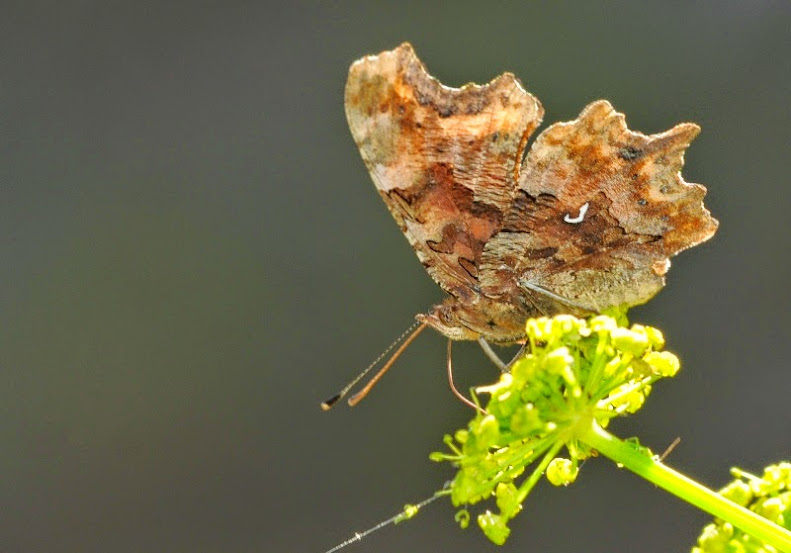
Comma butterfly at rest
Its tattered looking wings help it to remain undetected among dead leaves on the trees where it hibernates. The white comma marks on the underside of its wings give the Comma its name.

Comma butterfly - underside
As you can see the underside is dull in comparison with the upper side. This disguise enables it to hibernate safely as with its wings folded it looks like a dead leaf on the trees where it hibernates.

The population declined at one time due to a reduction in hop farming but has recovered since the 1960s with a preference for the common nettle as the larval food plant. It's now found throughout England and Wales; its range has also reached Scotland.

Eggs (on a nettle leaf?)
The caterpillars are brown and white and spiky; they feed on nettles (and hops) for about seven weeks before pupating.

Comma caterpillar
What a shame that I have cleared out all the nettles from my garden. I have no chance to see the caterpillar and must hope that I get to see adult butterflies in the countryside feeding on thistles, brambles, ivy or knapweed.


Love is like a butterfly

As soft and gentle as a sigh
The multicolored moods of love are like its satin wings
Love makes your heart feel strange inside


Photo Attributions:
  • Comma at rest: By P matthews 123 - CC BY-SA 3.0
  • Comma underside: 7 July 2011, Zeynel Cebici - CC BY-SA 3.0
  • Eggs: 6 July 2009, Giles San Martin - CC BY-SA 2.0
  • Larva (caterpillar): Jan 1 2006, Lilly M - CC BY-SA 2.0


Thursday, 2 April 2015

A-Z Challenge 2015 - Butterflies - 'B'

B - Brimstone

Brimstone is the archaic name for sulphur which may be associated with volcanic fumaroles like this:


Sulphurous fumarole (Italy)
Fire and brimstone occurs in the Bible as an expression for the wrath of God.

"The breath of Jehovah, like a stream of brimstone, doth kindle it." - Isaiah 30:33

The expression is also used to describe a style of Christian preaching that uses a vivid description of judgement and eternal damnation.

However the word butterfly is believed to be derived from "butter-coloured fly" which is attributed to the - 

Male Brimstone Butterfly (in flight)
The Brimstone (Gonepteryx rhamni) is one of the longest living (c.11 months) British butterflies and one of the few to hibernate as an adult.

Its larvae feed on the leaves of the Buckthorn (Rhamnus cathartia) or Alder Buckthorn (Frangula alnus). The caterpillar feeds on the food plant and are found lying along the mid-rib on the upper side of the leaf.

Brimstone caterpillar
Male Brimstone on a bluebell
Although the male is a bright high yellow, the female is a very pale yellow, almost white.

It occurs in England and Wales but not in Scotland; its range extends from England and the welsh borders north to Yorkshire, Cheshire and the southern parts of the Lake District. I have yet to see one in the hedges and verges in North Yorkshire.


Love is like a butterfly
As soft and gentle as a sigh
The multicolored moods of love are like its satin wings


Photo attributions:
  • Fumarole - Jan 1 2006, by Brisk g - Public domain
  • Common Brimstone butterfly male in flight - 22 July 2014, by Charles j Sharp; CC BY-SA 2.0
  • Brimstone caterpillar on buckthorn leaf - 28 May 2012, by Giles San Martin (Namur, Belgium); CC BY-SA 2.0
  • Male Brimstone butterfly on bluebell - 22 Apr 2008, geograph.org.uk, by Graham Newell - CC BY-SA 2.0
  • Video - Brimstone Butterfly, Anna Rubato

Wednesday, 30 April 2014

A-Z Challenge - 'Z'


Z - Zounds! It's Zara

Well I've made it to 'Z' again and still feel astounded that I managed to find dogs to get here from 'A'.

An Alsatian pup name Alfie featured at the start of the Challenge. At the end there's another Alsatian.
A young Alsatian named Zara
I used to meet Zara in the village but unfortunately she became very territorial and attacked the postmen. On her lead she was as gentle as could be, but she has had to give way to the Labrador pups that appeared under 'L'

I must pay tribute to all the dogs that I have met personally; not one objected to being photographed. I suspect however that owners in the village will be pleased that only their legs and shoes appeared in the shots.

My special thanks to my daughter's dogs - Sam, Maxie, Gem. Jack, Cody, Scout and Lily, not forgetting Gabby the Golden Labrador who has made up the latest "Gang of Four" in Michigan.


The Gang of Four (No. 3) - Gem, Gabby, Scout and Lily
And by the way Gem had her 15th birthday recently.

Sam was my daughter's first dog. He appeared earlier in the Challenge with his sister Maxie.

This is the tribute to Sam written for him after he had been put to sleep in 2010.
Sam Was My Good Boy

"Sam was my first dog. He was such a good boy.
Good? Maybe not—at least not at his first home in Troy.
The words “come” and “no” and the electric fence meant nothing to him.
And he was a lab, yet he couldn’t fetch, retrieve, or even swim.

Sam was my first dog. Okay, maybe he was “kind of” good.
Chasing deer in their new home, he and Moo would escape through the wood
They’d come home with deer parts, possums and the occasional mouse
And traipse their big dirty paws throughout the whole house.

Sam was my first dog. But he really was good.
He never fought for food, chewed up shoes, or rolled in mud.
When the new rescue dog, Jack, tried to eat his food and bite his nose--he didn’t mind.
When Jack was sick, it was always Sam who would lie with him—he was SO kind.

Sam was my first dog. And, YES, he was a good boy.
From the day we chose each other, he brought me so much joy.
Even when he went blind and had to live in the dark,
He still took himself for walks and played, and, boy, did he still love to bark.

Sam was my first dog. He was good and I love him still
He holds a place in my heart that no one will ever fill."                          


Tuesday, 29 April 2014

A-Z Challenge 2014 - 'Y'


Y - Yorkshire Terrier ("Yorkie")

The Yorkshire Terrier was developed in the 19th century, as the name suggests, in Yorkshire specifically to catch rats in clothing mills.

One famous dog is still regarded as the "father of the breed."
Huddersfield Ben
(Scanned for 'The Dogs of the British Isles by John Henry Walsh)
An authority on the breed wrote (in 1891), "Huddersfield Ben was the best stud dog of his breed during his lifetime and though his puppies has defined the breed as we know it today. He is still referred to as the father of the breed."

The Yorkie I meet almost every day is very sprightly.
Charlie - Yorkshire Terrier
He may be a Toy Terrier and blind in one eye, but that does not prevent him walking so briskly that it's a job to keep up with him. He knows exactly where he's going and where he is going to stop and sniff.

Dogs 101 claim that the Yorkie is the second most popular dog in the world. Check out what they say on this video Yorkie.

Monday, 28 April 2014

A-Z Challenge 2014 - 'X'


X - Crossbred; Sprocker, Labradoodle, Cockapoo

When I first met Gus I thought he was a Spaniel but his owner said he was a crossbreed resulting from the mating of a Springer Spaniel female with a Cocker Spaniel dog. That gave me the idea of what to include unde 'X'.
Sprocker Spaniel - Gus (6 months)
Of course you may obtain a Sprocker in several different ways by crossing:
  • Springer with a Cocker
  • Springer with a Sprocker
  • Cocker with a Sprocker
  • Sprocker with a Sprocker
It's not surprising then that they occur in a variety of colours, weights and heights.

If you are looking for a dog that does not shed its hair you might look no further than a dog like Milly. She's a -
Labradoodle - Milly
The Labradoodle results from crossing a Labrador Retriever with a Standard/Miniature or Toy Poodle. The term Labradoodle first appeared in 1955 but was not popularised until 1988.

In Australia they were trained as Assistance Dogs for a time.
A group of Labradoodle Assistance Dogs
Mette-Marit, Crown Princess of Norway and Crown Prince Haakon, heir apparent to the throne of Norway own a black Labradoodle.

Spaniels and Poodles get around a bit because an English Cocker Spaniel crossed with a Poodle (Miniature or Toy) produces dogs like the one we met earlier in the Challenge under P (for Pippa)
I meet her almost every day.
Cockapoo (Pippa)
She's a hypoallergenic dog too.


Saturday, 26 April 2014

A-Z Challenge 2014 - 'W'


W - West Highland Terrier, Wheaten Terrier, Whippet,
       Welsh Terrier

There used to be stories about an English man, an Irish man, a Scots man and a Welsh man.The same principal applies to this post about dogs, but in a different sequence.

Poppy, a West Highland Terrier, featured in my series about North Yorkshire Village dogs.


Poppy - West Highland Terrier
You may read about her here.

"Westies" originated from Scotland and have a distinctive white coat. They were bred to hunt small rodents at places such as farms. However the Westie I met at Whitby in North Yorkshire had a carriage of its own.
Fast asleep - it had had a busy day
I always like meeting Archie, he's the most laid back dog I know.
Archie - Soft Coated Wheaten Terrier
The Soft Coated Wheaten Terrier originated in Ireland and is possibly one of the oldest Irish dog breeds. They were once known as the 'poor man's dog,' working on farms as herders and hunters of vermin and small game.

When I first Archie he had a patch of ginger hair. He had rolled on a dead hedgehog and had to have some hair cut off before the vet could remove all the spines. For a while, as his hair grew back, you could not miss that ginger patch.

When I was boy towards the end on WWII my father bought a whippet from Monmouthshire (South Wales). I used to take her out for walks. I wrote a (long) story about one such walk called 'The Chase.' It began - 

"The whippet sat bolt upright on the grass, shivering with anticipation of being allowed to run. When the command came, ‘Away Flick, away,’ she was gone. She cleared the dry stone wall by the roadside at such a speed that from afar she appeared to be just a flash of brown against the grey dry stones and against the green field where she landed – or did she? She seemed to be flying - close to the ground like a different-coloured swallow on the wing in a desperate hunt for flies." 

Phoebe - a brindle/white Whippet
Whippets are sight hounds, popular as racing dogs. They can reach speeds of 35 mph (56 km/hr). The English Whippet or Snap Dog was even known as the 'poor man's racehorse.'

When I first met my Welsh dog I thought she was an Airedale puppy; I was wrong.

Tilly - Welsh Terrier
She is owned by the same couple that used to own Joe, the Airedale Terrier, I included in the Challenge under 'A.

The Welsh Terrier is claimed to be the oldest dog breed in the UK. Bred originally to hunt rodents and badgers they are now largely a show dog.

Famous owners of Welsh Terriers have included President J F Kennedy and the UK Prime Minister Clement Attlee.


I hope you have the time to watch the video with which I end the post. It's quite delightful.


Friday, 25 April 2014

A-Z Challenge 2014 - 'V'


V - Vizsla

I'm only able to show one breed of dog for the letter 'V' and I had to go to Hungary for that.
Vizsla
(12.11.06; by Plepie 2000 - CC BY-SA 3.0)
Vizslas originated in Hungary; sporting dogs they are the smallest of the Pointer breed. Classed as a gun dog they are used for hunting fowl and upland game. Although they are sporting dogs a Vizsla makes a good household companion and a family dog.

Excellent swimmers, they love the water as Rosie demonstrates.
Rosie dives in.
(21 April 2007; by Bryon Realy - CC BY 2.0)
A Vizsla bred in Australia was Best in Show at Crufts in 2010. Known as Yogi, his show name was "Hungargrunn Bear It'n Mind."

There is a Wire-haired Vizsla also, but it is a separate breed developed in 1930 by interbreeding of a Vizsla with the German Wire-haired Pointer. 

I have yet to see either in the flesh.

Thursday, 24 April 2014

A-Z Challenge - 'U'


U - Utility Group Dogs - Poodle, Schnauzer

It's thanks to Crufts 2014 that I have found some dogs to include for 'U'. The dog that won the Best of Breed title for the Utility Group this year went on to become Best in Show. It was a black Standard Poodle named Ricky but I can find no photos of him to use so let's look at some others instead.
Standard Black Poodle haircut
(21 April 2011; by Inbalsigal - CC BY 3.0)
Ricky was shorn so that his rear end looked naked, so much shorter that the dog in my photo. Apparently the Poodle is a water dog and the commentators said the haircut, more like that of my next dog, is to give it extra buoyancy.

Utility Poodle
To me it's just that someone has decided that this is the way it should look. I wonder what would happen if it became the fashionable thing for people to dress to show their naked backsides.

These dogs, also in the Utility Group, look much more natural and attractive.
Two Miniature Schnauzers (female/male)
(30 May 2013; by Hakatas = CC BY-SA 3.0)
Schnauzers originated in Germany in the 15/16th century. Their name derives from the German word for "snout." The official colour of these two is "Salt and Pepper."


Wednesday, 23 April 2014

A-Z Challenge - 'T'


T - Tibetan Terrier, Border Terrier, Bedlington Terrier

Although this was meant to be a 'Terrier' post, the Tibetan isn't a Terrier at all.


Tibetan Terrier - Sasha
Originally bred by monks almost 2000 years ago, the Tibetan name for this dog is Tsang Apso - shaggy or bearded (apso) from the province of Tsang.

Sasha featured in my North Yorkshire Dogs series here. I don't see her anymore as her owners have moved away. But this is her on her favourite perch.

Sasha at home
The Border Terrier is an energetic dog  and is essentially a working terrier, bred as a fox and vermin hunter, They originated in and take their name from the Scottish borders region.

They always seem to be keen to meet people even when they are out for a run on a lead.

Border Terriers
These two always stop as they remember that I once gave them a treat.

The Bedlington Terrier is named after the Northumberland mining town of Bedlington in North East England and were bred initially to hunt vermin in the mines.

These terriers look like lambs from a distance and have a characteristic pear-shaped head.


I meet one that lives in the village.


Bedlington Terrier - Billy
And two others, usually out for a six-mile walk.

Curly (who is blind)
His real name is Henry, but everyone calls him Curly. He has been blind for three years but has no trouble getting about with his companion whose rear end you can just see above


Curly's companion


Tuesday, 22 April 2014

A-Z Challenge 2014 - 'S'


S - Saint Bernard, Scottish Terrier, Shetland Sheepdog, 
     Skye Terrier, Springer Spaniel

I think just about everyone would recognise my first dog, often depicted with a barrel hanging from its neck.

Saint Bernard
Named after a medieval Hospice in the Swiss Alps, Saint Bernards are famous for their mountain search and rescue role.

This one was hoping to be rescued from having to wait outside the entrance to Whitby Abbey in North Yorkshire.

The "Scottie" had a different role and was bred in Scotland as a vermin catcher; the different coloured varieties were often depicted in advertisements for Black and White Scotch Whisky.

Scottish Terrier - Champion Bapton Norman
(1914 Journal of Heredity - author unknown)
And then there was Barney and Miss Beazley two "Scotties" owned by President G W Bush.

Barney holds his first Presidential Briefing
(Photo by Alex Cooney)
If the next dog reminds you of "Lassie", it shouldn't. Lassie was a Rough Collie (see 'C')

Shetland Sheepdog
The "Sheltie" originated in the Shetlands of the North East Coast of Scotland.

The Isle of Skye sits off the West Coast of Scotland, It was there that the Skye Terrier was developed to go to ground after badgers, foxes, otters and rabbits. However it's in Edinburgh that a Skye Terrier has been immortalised.

Greyfriars Bobby in 1865
(Cropped from an albumen print - National Galleries of Scotland)
Bobby spent 14 years guarding the grave of his owner (policeman John Gray) until he died himself in 1872.

Edinburgh's smallest listed building is the memorial statue for him.

Statue of Greyfriars Bobby
(Photo by Michael Rowe, September 2003 - CC BY-SA 3.0)
If you own an English Springer Spaniel then you are sure of plenty of exercise. One of the oldest British Spaniels it was used to flush out or "spring" game birds.If you see it operate in long grass it is easy to see where the 'springer' comes from.

Springer Spaniel
And of course they just love water!

I'm waiting, come on in!
But my all time favourite from over 50 years ago was the Springer that posed for me at my wife's former home.

Major