Pages

Showing posts with label Comma. Show all posts

Friday, 3 April 2015

A-Z Challenge 2015 - Butterflies - C

C - Comma

A comma  is a punctuation mark, but it is also a butterfly in the Nymphalidae family.


                                       Caress
                                       Of a
                                       Moon-shaped
                                       Mark
                                       A pause

(Acrostic poem; Liana Mahoney  - Commashavewings.com)

When I came across this dead butterfly on my garden path last summer I had no idea what it was.


Dead Comma
It had definitely come to a full stop!

Not at all like a living specimen.

Comma butterfly at rest
Its tattered looking wings help it to remain undetected among dead leaves on the trees where it hibernates. The white comma marks on the underside of its wings give the Comma its name.
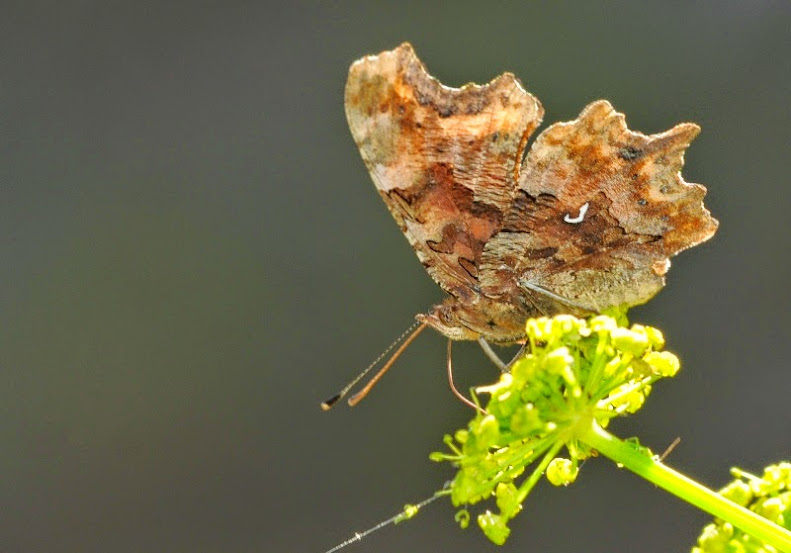
Comma butterfly - underside
As you can see the underside is dull in comparison with the upper side. This disguise enables it to hibernate safely as with its wings folded it looks like a dead leaf on the trees where it hibernates.

The population declined at one time due to a reduction in hop farming but has recovered since the 1960s with a preference for the common nettle as the larval food plant. It's now found throughout England and Wales; its range has also reached Scotland.

Eggs (on a nettle leaf?)
The caterpillars are brown and white and spiky; they feed on nettles (and hops) for about seven weeks before pupating.

Comma caterpillar
What a shame that I have cleared out all the nettles from my garden. I have no chance to see the caterpillar and must hope that I get to see adult butterflies in the countryside feeding on thistles, brambles, ivy or knapweed.


Love is like a butterfly

As soft and gentle as a sigh
The multicolored moods of love are like its satin wings
Love makes your heart feel strange inside


Photo Attributions:
  • Comma at rest: By P matthews 123 - CC BY-SA 3.0
  • Comma underside: 7 July 2011, Zeynel Cebici - CC BY-SA 3.0
  • Eggs: 6 July 2009, Giles San Martin - CC BY-SA 2.0
  • Larva (caterpillar): Jan 1 2006, Lilly M - CC BY-SA 2.0


Tuesday, 23 August 2011

Vibrant Nature - Thematic Photography

This is the second week in a row that I have set out to take photos to match the theme. At this time in the summer there is a lot of vibrancy to be seen in nature. Here are some things that caught my eye within three miles of my home.

The air was full of house martins and swallows and it seems that they are practicing for the departure for the warmth of Africa.

Swallows/House Martins on telelephone wires
Above them stretch high voltage power lines; how they miss them in flight remains a mystery to me.

The haws and sloes light up the hedgerows wherever you look.

Haws on a hawthorn hedge
Sloes
If nothing else a bottle of sloe gin should ensure you feel vibrant.

Farmyard Cow
She certainly was making her feelings known and no - she hasn't swallowed the fence.

Lesser Burdock
The burdock in a roadside verge has picked a spot where its burrs will get picked up by man or beast and deposited elsewhere for next year's vibrant plant.

Common Knapweed
Here the knapweed has atrracted a hoverfly and a battered Meadow Brown butterfly. Below an even more battered Comma.

Comma on knapweed
But there is now danger of mistaking this vibrant butterfly.

Peacock butterfly
This one however as had a rough time somewhere even if his colours are not dimmed.

Peacock with damaged wings
This intruder from abroad has taken over whole swathes of hedgerows with a mass of vibrant shades of pink.

Indian Balsam
This yellow flower may have a common name but farmers are meant to destroy it on their fields as it poisons cattle. It thrives however in hedgerows and on uncultivated land. Bees and hoverflys love it and help to maitain its vibrancy.

Ragworth
Coming full circle on my tour it's back to the vibrant power of the sun and that created by man.

Power Pylon
But let's not forget the energy stored in the crops beneath the high voltage power lines.

Wheat field
For further injections of vibrancy don't forget to visit Carmi's Thematic Photographic 159

Monday, 25 July 2011

The Floating Comma

The comma is a punctuation mark which indicates the shortest pause. Despite there  being some simple rules for their use many writers tend to write long sentences with many commas in them. It's much better to use fewer commas, and write shorter, more direct sentences.

I won't bore you with all the rules. There are many places where you may find them. Just don't become like one writer whose articles resulted in him being called 'the comma man.'

I'd like to introduce you the 'floating'comma. To give you a clue I'll quote Mohamed Ali, "Float like a butterfly..."

The first comma butterfly I've ever seen in my garden floated from place to place before decided on a place to rest.

Comma butterfly on buddleia flower
It could not decide on where it should position itself and was confused by the number of  flowers to settle on.

Comma in a different place.
Eventually it changed it's mind and abandoned the buddleia altogether.

Comma on forsythia bush
This is one comma that I would be delighted to see at any time. If I had a lot of these I would be quite content to be called 'the comma man.'