Pages

Showing posts with label knapweed. Show all posts

Wednesday, 13 April 2016

A-Z Challenge 2016 - Wildflowers 'K'

My theme this year is wild flowers. Most of us will be aware of the flowers that grow in our gardens but what surprises me is how few wild flowers that I know.

I pass them every day but rarely look at them. Well this year will be different - even if many of them may fall under the letter 'X' for unknown.

'K' - Kingcup, Knapweed

In Ireland bunches of the first of my flowers were hung over doors on May Day to protect cattle from witches and fairies. Not bad for what may be one of the longest established native plants in Britain, one which would have thrived in the melt waters of the ice age. One of the buttercup family it grows in marshy places, damp meadows and riversides.


Kingcup or Marsh Marigold
It's a plant that is known by a plethora of names - Mollyblobs, Horse Blob, Gollins and the Publican; in Scotland it's the water gowan or water gowland. But I've always known it as the Kingcup.

The large, golden, cup-shaped flowers can hardly be missed.

Kingcups
While the whole plant is poisonous its buds were once used as a substitute for capers.


My second flower resembles a thistle without prickles.

Common Knapweed
There is a marvellous story about this plant.

If a woman puts its open florets inside her blouse and any open into the flower, then a lover will come her way.

Its knob-like heads are sometimes called hard-heads. Knap is another name for knob.

Medicinal uses include relieving sore throats and healing wounds and scabs.

There is no doubt that knapweed is a favourite with bees and butterflies.

Peacock butterfly on knapweed
Attributions:
  • Kingcup or Marsh Marigold - 14 April 2009, ex geograph.org.uk, by Keith Edkins in Byron's Pool Nature reserve - CC BY-SA 2.0 generic
  • Kingcups - 20 May 2008, ex geograph.org.uk, by M J Richardson - CC BY-SA 2.0 generic
  • Common Knapweed - 3 July 2013, by Natalie S - CC BY-SA 4.0

Wednesday, 8 April 2015

A-Z Challenge 2015 - Butterflies 'G'

G - Gatekeeper and Grayling

These are two brown butterflies, mostly brown with black spots and white markings resembling eyes on their wings The eye spots are to confuse their enemies.

The Gatekeeper is known by two other names


Gatekeeper butterfly (Pyronia tithonus)
Its second name of Hedge Brown indicates its favourite habitat while Small Meadow Brown shows it is closely related to the Meadow Brown.

That eye spot may also be seen on the underside of its wings.

Gatekeeper feeding on thistle
The Gatekeeper is common in most of lowland England and Wales, rare in Ireland and unknown in Scotland.


There is just one generation of Gatekeepers a year with adults emerging in July and peaking in early August. They spend much of their time basking with their wings open.

A variety of grasses are the foodplants for their caterpillars - bents, fescues, meadow and common couch grass.Brambles and ragwort are the adult butterfly's favourites along with thistles and fleabane.

Common Ragwort (with hover fly)

The ragwort photo was shot on a nature reserve at Stockton beside the River Tees. A second nature reserve is on the opposite river bank.

Maze Park with the A-19 flyover in the background
Maze Park, created from what was once an industrial eyesore is one home of the Grayling butterfly although I have yet to see one.

Grayling butterfly on knapweed
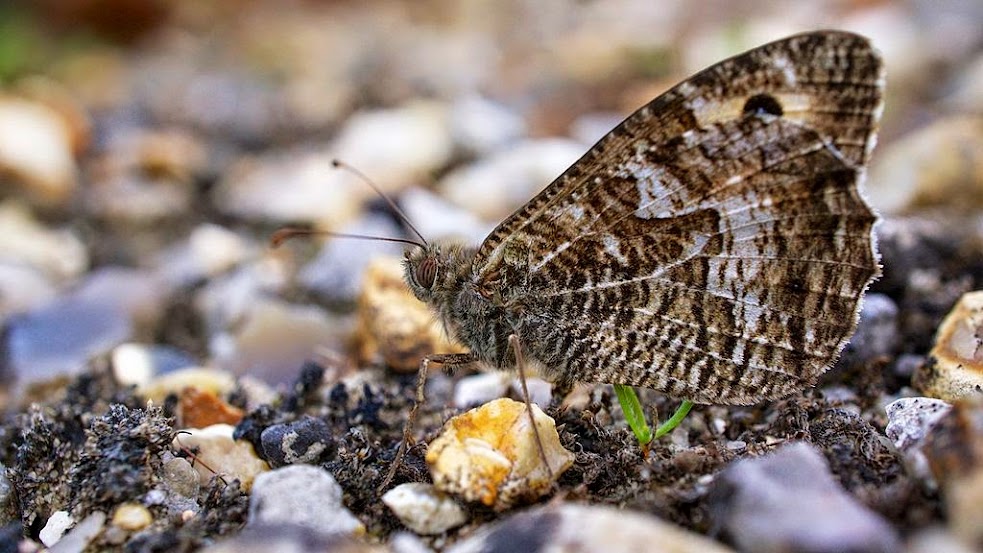
The Grayling (Hipparchia semele) is the largest of the brown butterflies with a wingspan of 2 inches or more. Notoriously camera shy its habitats are dry grasslands, sandy heath lands with colonies frequently near the sea.

Difficult to photograph because it always keeps its wings closed when settled. It often conceals its 'eye' behind the hindwing when at rest.

Grayling - DWT nature reserve
This video will enable you to see the upper wings of this butterfly, feeding on sea holly at Hightown, Merseyside in England.


Love is like a butterfly
As soft and gentle as a sigh
The multicolored moods of love are like its satin wings
Love makes your heart feel strange inside
It flutters like soft wings in flight
Love is like a butterfly, a rare and gentle thing

I feel it when you're with me
It happens when you kiss me

Photo attributions:
  • Gatekeeper butterfly (Pyronia tithonus): 25 July 2014, Clacton-on-Sea, Sansese at English Wikipedia - CC BY-SA 3.0
  • Gatekeeper butterfly feeding on a thistle: 26 July 2005, geograph.org.uk, by Martin Addison - CC BY-SA 2.0
  • Youtube Video: Gatekeeper aka Hedge Brown - Butterflies in Cornwall, Paul Dinning
  • Maze Park; 12 July 2005, geograph.org.uk, by Mike Garret - CC BY-SA.2.0
  • Grayling butterfly feeding on knapweed: 17 July 2006, geograph.org.uk, by Anne Burgess - CC BY-SA 2.0
  • Grayling - DWT nature reserve: 21 August 2013, by Ian Kirk, Broadstone, Dorset - CC BY-SA 2.0
  • Youtube Video:Grayling Butterfly Hipparchia semele, by Steve Cross. 


Friday, 3 April 2015

A-Z Challenge 2015 - Butterflies - C

C - Comma

A comma  is a punctuation mark, but it is also a butterfly in the Nymphalidae family.


                                       Caress
                                       Of a
                                       Moon-shaped
                                       Mark
                                       A pause

(Acrostic poem; Liana Mahoney  - Commashavewings.com)

When I came across this dead butterfly on my garden path last summer I had no idea what it was.


Dead Comma
It had definitely come to a full stop!

Not at all like a living specimen.

Comma butterfly at rest
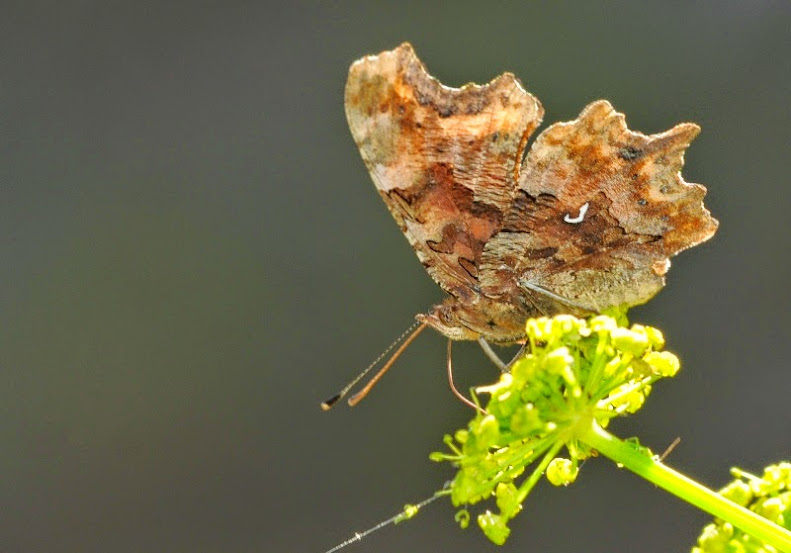
Its tattered looking wings help it to remain undetected among dead leaves on the trees where it hibernates. The white comma marks on the underside of its wings give the Comma its name.

Comma butterfly - underside
As you can see the underside is dull in comparison with the upper side. This disguise enables it to hibernate safely as with its wings folded it looks like a dead leaf on the trees where it hibernates.

The population declined at one time due to a reduction in hop farming but has recovered since the 1960s with a preference for the common nettle as the larval food plant. It's now found throughout England and Wales; its range has also reached Scotland.

Eggs (on a nettle leaf?)
The caterpillars are brown and white and spiky; they feed on nettles (and hops) for about seven weeks before pupating.

Comma caterpillar
What a shame that I have cleared out all the nettles from my garden. I have no chance to see the caterpillar and must hope that I get to see adult butterflies in the countryside feeding on thistles, brambles, ivy or knapweed.


Love is like a butterfly

As soft and gentle as a sigh
The multicolored moods of love are like its satin wings
Love makes your heart feel strange inside


Photo Attributions:
  • Comma at rest: By P matthews 123 - CC BY-SA 3.0
  • Comma underside: 7 July 2011, Zeynel Cebici - CC BY-SA 3.0
  • Eggs: 6 July 2009, Giles San Martin - CC BY-SA 2.0
  • Larva (caterpillar): Jan 1 2006, Lilly M - CC BY-SA 2.0


Tuesday, 23 August 2011

Vibrant Nature - Thematic Photography

This is the second week in a row that I have set out to take photos to match the theme. At this time in the summer there is a lot of vibrancy to be seen in nature. Here are some things that caught my eye within three miles of my home.

The air was full of house martins and swallows and it seems that they are practicing for the departure for the warmth of Africa.

Swallows/House Martins on telelephone wires
Above them stretch high voltage power lines; how they miss them in flight remains a mystery to me.

The haws and sloes light up the hedgerows wherever you look.

Haws on a hawthorn hedge
Sloes
If nothing else a bottle of sloe gin should ensure you feel vibrant.

Farmyard Cow
She certainly was making her feelings known and no - she hasn't swallowed the fence.

Lesser Burdock
The burdock in a roadside verge has picked a spot where its burrs will get picked up by man or beast and deposited elsewhere for next year's vibrant plant.

Common Knapweed
Here the knapweed has atrracted a hoverfly and a battered Meadow Brown butterfly. Below an even more battered Comma.

Comma on knapweed
But there is now danger of mistaking this vibrant butterfly.

Peacock butterfly
This one however as had a rough time somewhere even if his colours are not dimmed.

Peacock with damaged wings
This intruder from abroad has taken over whole swathes of hedgerows with a mass of vibrant shades of pink.

Indian Balsam
This yellow flower may have a common name but farmers are meant to destroy it on their fields as it poisons cattle. It thrives however in hedgerows and on uncultivated land. Bees and hoverflys love it and help to maitain its vibrancy.

Ragworth
Coming full circle on my tour it's back to the vibrant power of the sun and that created by man.

Power Pylon
But let's not forget the energy stored in the crops beneath the high voltage power lines.

Wheat field
For further injections of vibrancy don't forget to visit Carmi's Thematic Photographic 159