Pages

Tuesday, 30 April 2013

A Vegetative Thematic Photography

When I saw Carmi's theme for the week I had several ideas before finally setting on plants and vegetation. In 2007 I carried out a study on a small local wood which I visited once a fortnight throughout the year. I took many photos each time and even wrote some articles about what I saw. Unfortunately I could not get any editors to publish them.

An aerial shot of the area by the Tees Archaeological Society shows the wood is shaped like a boot - so I christened it Boot Wood.
Boot Wood (btm left) - © Tees Archaeological Society
My first shot is of the field just above Boot Wood; this is used as pasture for horses of a riding school.
Field of Buttercups (May 2007)
 In a clearing in the wood there are many types of vegetation.

Clump of Thistles (July 2007)
Earlier in March before the wood floor is covered in plants I came across these;

White Sweet Violets (and some Stinging Nettles)
Elsewhere among the ferns and more nettles were a wide varieties of grasses; this is one that caught my eye.
Grass - Seed Head (May 2007)
Towards the end of May some areas beneath the trees were a sea of white.
Parsley
When I was a boy the thickest stems of this plant could be used as peashooters.

To see what others have chosen for 'vegetative' shoot over to Thematic-photographic-242.


A-Z Challenge 2013 - Zed


My A-Z posts this year are based on my garden – flowers, animals, the birds and the bees, butterflies - with a bit of poetry thrown in. For some letters I am expecting to cheat somewhat – wishing they were here.

Zed

“Thou whoreson zed! thou unnecessary letter”  (King Lear. Act 2 Scene 2, Line 68)

Z - Zinnia

Like many I am pleased to get to ‘Z even although I have no flowers in my garden beginning with ‘Z’.

So I have chosen Zinnia as a flower we could grow if I went out and bought some bedding plants. Hopefully they would look like this - eventually,

Bunch of Zinnias
I do not know of a bird or butterfly for ‘Z’ so I guess Zinnia will have to be my swansong this year, unless you will accept this:
  
Zebra Plant (Calathea zabrina)
I have never seen a plant like this and I don't think that we will ever see a real zebra in our garden.

The garden theme has taught me just how much we take for granted and how many things there are that I have still not photographed.

Finding poems connected with my posts has taken me down avenues that I had never been down before, Hope you have enjoyed what I found as much as I did.

My special thanks to everyone who has commented. I know many others have visited my posts as well – thank you for that.

Photos:
  • Zinnias - Drilnoth - Public domain
  • Zebra Plant - Cliff from Arlington, Virginia, USA - CC BY 2.0 (upload Magnus Manske)

Monday, 29 April 2013

A-Z Challenge 2013 - 'Y' - Yellowhammer


My A-Z posts this year are based on my garden – flowers, animals, the birds and the bees, butterflies - with a bit of poetry thrown in. For some letters I am expecting to cheat somewhat –wishing they were here.
Y – Yellowhammer, Yew

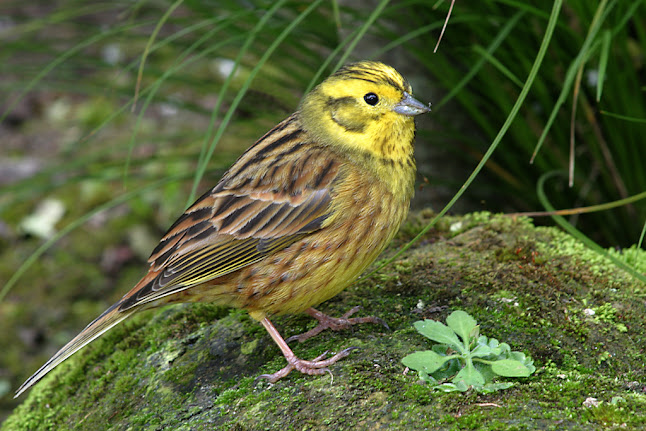
I was always told that if you listened to the yellowhammer’s song you would hear it sing “a little bit of bread and no cheese.”


The yellowhammer, trailing grass, will come
To fix a place and choose an early home,
With yellow breast and head of solid gold.

Yellowhammer
 Unfortunately the last yellowhammer I can remember seeing was when I was a boy back in the early 1950s when I lived in Rutland, England’s smallest county, not that far from where John Clare, the poet, had lived.

The yew tree is famed for its longevity; many stand in churchyards. Ours is very young, little more than a shrub.

Yew (centre)
It has a long way to go before it can match that which Wordsworth praised.

There is a Yew-tree, pride of Lorton Vale,
Which to this day stands single, in the midst
Of its own darkness, as it stood of yore:

Poems:
  • The Yellow Hammer – John Clare
  • Yew Trees – William Wordsworth

Photo:
  • Yellow Hammer – wikicommons CC BY-SA 2.0

Sunday, 28 April 2013

Malaysia - Sunday Stamps

As Viridian has given us a free choice this week I've decided to show a set I recently acquired.

Malaysia - Butterflies

Selangor is one of the thirteen states of Malaysia. It's difficult to read the names of the butterflies, even with a magnifying glass. However I have made out the one at the bottom left. 

Precis orithya wallacei is named after Alfred Wallace. Thanks to wikipedia I can add:

Alfred Russel Wallace, OM FRS (8 January 1823 – 7 November 1913) was a British naturalist, explorer, geographer, anthropologist and biologist. He is best known for independently conceiving the theory of evolution through natural selection, which prompted Charles Darwin to publish his own ideas in On the Origin of the Species

To see what others have chosen this week just follow the links at Viridian's Sunday-Stamps-120


Saturday, 27 April 2013

A-Z Challenge 2013 - 'X' - Xanthoceras


My A-Z posts this year are based on my garden – flowers, animals, the birds and the bees, butterflies - with a bit of poetry thrown in. For some letters I am expecting to cheat somewhat –wishing they were here.

X –.Xanthoceras, Xanthorhiza, Xantus’s Hummingbird.

You have probably guessed already that I have had to cheat or be marked with a rather large X.

Xanthoceras sorbifolium
This beautiful shrub, appropriately photographed in April (2009), was in the Botanical Garden of the University of Vienna and is also known as Yellowhorn. Anyone would want it in their garden not just me.

Xanthorhiza simplicissima (Yellow Root)
Yellow Root which has yellow flowers in Spring is rare in British gardens but I understand it may be seen at Westonbirt Arboretum, near Tetbury, Gloucestershire.

For several years I have been trying to photograph hummingbirds at my daughter’s home in Michigan, I haven’t succeeded yet so I was delighted to find one that begins with ‘X’

Xantus's Hummingbird - Baja, Mexico
Xantus’s Hummingbird is predominately green on its upperparts and back; its straight tail is darkly coloured and it has a white eye stripe.

I couldn't find a poem that related to the photos but I did find this, an Alphabet poem for the letter 'X'
X was once a great king Xerxes,
Xerxy
Perxy
Turxy
Xerxy
Linxy Lurxy
Great King Xerxes!

Poem:
  • Alphabet Poem; Letter 'X' - Edward Lear.  
Photos:
  • Xanthoceras sorbifolium –Athenchen – CC BY-SA 3.0
  • Xanthorhiza simplicissima – TheAlphaWolf – CC BY-SA 3.0
  • Xantus’s hummingbird – marlin harms – CC BY-SA 2.0

Friday, 26 April 2013

Moon Shots - Sepia Saturday

I had never had a camera at the time of the moon landings so I have had to resort to postcard pictures for views of the moon to meet this week's prompt.


I managed to get a car or two (if you look hard) in my first moon shot.

Moon over Fort Lauderdale
Next is a shot that you will not be able to take again.

The Ill-fated Twin Towers - New York Manhattan
I haven't been to Fort Lauderdale or Manhattan, but the next shot is at a scene I knew well; shame it does not include the benches on which I've sat.

Stavanger Harbour, Vagen
I did get English newspapers while working there in the 1980s but my newspaper fame came later much nearer home when I made it into The Times. The first occasion was a 'Readers' Reply' column on an etiquette page.

Four years later I made it to the Letters Page; maybe not the coveted bottom right spot but at least bottom right of section on Engineers.


I've enlarged the letter so that it can be read.


If the moon makes you frisky and you feel the need to dance, then perhaps the way to finish is by listening to:


Before you go you should dance across and moon at others at Sepia-Saturday-174

A-Z Challenge 2013 - 'W' - Wagtail


My A-Z posts this year are based on my garden – flowers, animals, the birds and the bees, butterflies - with a bit of poetry thrown in. For some letters I am expecting to cheat somewhat –wishing they were here.

W – Wagtail, Wallflower, Weigela, Woodpecker, Wood Pigeon, Wren.

It seems strange to call this fellow grey, when really he is anything but,
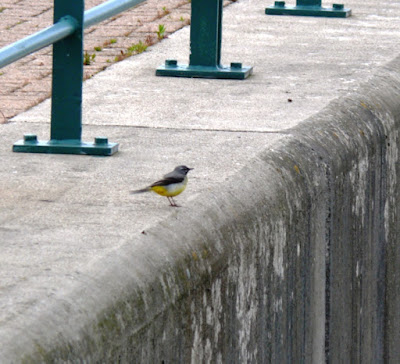
 
Grey Wagtail on dock wall at the Tees Barrage
There is no better description of the one that has visited our garden that that by John Clare. He obviously studied this bird.

Pied Wagtail
 Little trotty wagtail he went in the rain,
And tittering, tottering sideways he ne'er got straight again,
He stooped to get a worm, and looked up to get a fly,
And then he flew away ere his feathers they were dry.

Our village is in North Yorkshire so I was pleased to find a verse in dialect that ended:

Folk ‘at’s tired gits churlish
An’ starts t’ owd World’s disorders—
Ther’d be less quarrels if they grew
Wallflowers I’ their borders.

Wallflowers
The wallflowers in our border however have set themselves; they appear every year no matter how many we pull up.

As I could not find another ‘W’ flower we grow I have had to make do with a shrub,
Weigela Bush (and Foxglove)
 I mentioned one species of woodpecker under ‘L’, but the most recent visitor is the Greater Spotted variety – a bird that moves so quickly it’s difficult to photograph. I wrote about it separately here.
Greater Spotted Woodpecker
  But the top bird in our garden and certainly the most numerous is this one in the sycamore tree.
 
Wood Pigeon
And in the bird bath which it thinks it owns.
 
Bird Bath (between Potentilla and the Rose)
Nesting in the hedge alongside the garden shed.
 
Nesting Wood Pigeon
Despite its presence the bird that, for its size, surprises you most with the strength of its song remains:
 
Jenny Wren
Small and pert she hops around
Hither and thither all over the ground
Speckled and neat her rich brown coat
Pale eyebrow and buff coloured throat
Poems:
  • Little Trotty Wagtail – John Clare
  • Wallflowers – Dorothy Una Ratcliffe
  • Jenny Wren – Bumpsysmum
Photos:
  • Pied Wagtail – Ken Billington – CC BY-SA 3.0
  • Wren – Ken Billington – CC BY-SA 3.0