Pages

Showing posts with label yew. Show all posts

Friday, 29 April 2016

A-Z Challenge 2016 - Wildflowers 'Y'

My theme this year is wild flowers. Most of us will be aware of the flowers that grow in our gardens but what surprises me is how few of the wild flowers that I know.

I pass them every day but rarely look at them. Well this year will be different - even if many of them fall under the letter 'X' for unknown.

'Y' - Yellow Rattle, Yew

As we have nearly reached 'Z' I guess it's time to think about celebrating. What better way is there than to make a noise with a rattle.


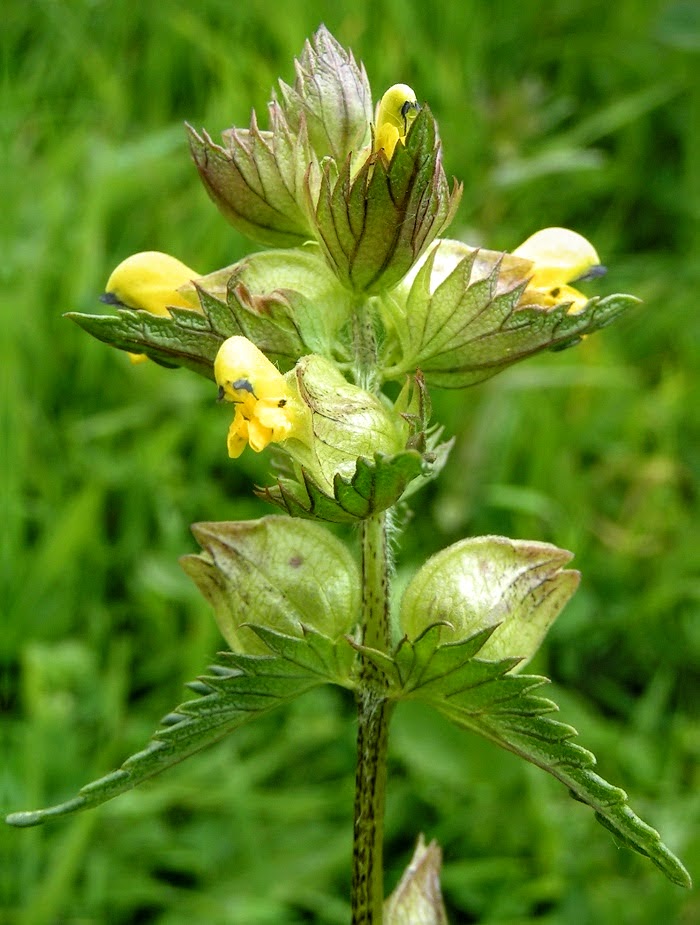
Yellow Rattle (Rhinatus minor)
This is actually a pernicious weed. and a semi-parasite, that grows on grasslands and in old meadows. It helps itself to minerals and water by means of its roots making contact with the roots of grasses and other plants.

The flowers appear from May to August, each one developing into a swollen capsule containing numerous large seeds. When the capsule is dry and the stem is knocked or shaken, the loose seeds inside make a rattling sound. This natural alarm clock was once used to signal the time for haymaking.


One of the tasks I have set myself is following the development of flowers from when they appear until they have faded away and turned to seed. Sometimes this has not been possible and I'm starting the other way around. The Yew tree is a marvellous example of this.

Berries on a Yew tree
It was only last month that I wondered what the its flowers looked like.

Yew tree flowers on a local tree
Not very obvious, are they?

Flowers on a churchyard tree
There is an ancient tradition that the evergreen yew sheltered the first Christian missionaries to Britain - before churches were built - and this is why so many yew trees are found in our churchyards.

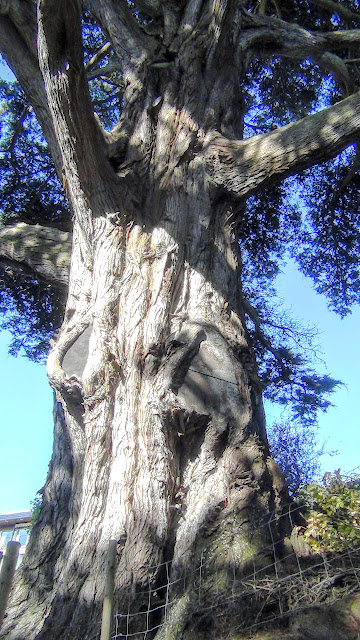
Last summer I found a magnificent yew in Cornwall just outside the village of St Mawgan. Because of where it was located I could not get all of it in one photo.


By the size of its trunk, it must be hundreds of years old. I'm left wondering whether it is a male or female tree.

Attributions:

  • Yellow Rattle; Great Holland Pits, Essex, 30 May2004, ex en.wikipedia.org,by Sannse - CC BY-SA 3.0
  • Common or English Yew, flowers on a male tree - St Mary's Churchyard, 19 February 2009, ex geograph.org.uk, by Trish Steel - CC BY-SA 2.0 generic

Monday, 29 April 2013

A-Z Challenge 2013 - 'Y' - Yellowhammer


My A-Z posts this year are based on my garden – flowers, animals, the birds and the bees, butterflies - with a bit of poetry thrown in. For some letters I am expecting to cheat somewhat –wishing they were here.
Y – Yellowhammer, Yew

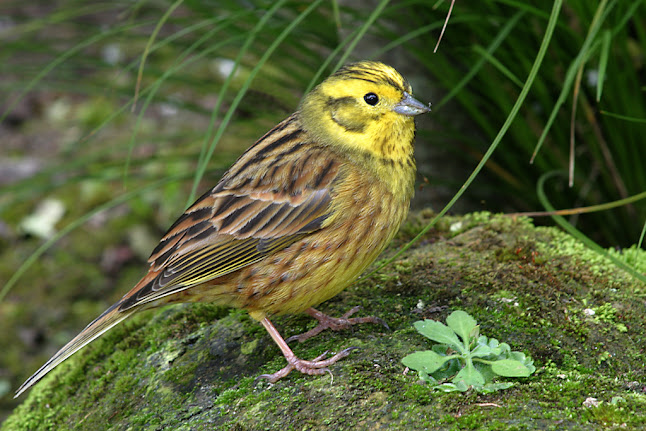
I was always told that if you listened to the yellowhammer’s song you would hear it sing “a little bit of bread and no cheese.”


The yellowhammer, trailing grass, will come
To fix a place and choose an early home,
With yellow breast and head of solid gold.

Yellowhammer
 Unfortunately the last yellowhammer I can remember seeing was when I was a boy back in the early 1950s when I lived in Rutland, England’s smallest county, not that far from where John Clare, the poet, had lived.

The yew tree is famed for its longevity; many stand in churchyards. Ours is very young, little more than a shrub.

Yew (centre)
It has a long way to go before it can match that which Wordsworth praised.

There is a Yew-tree, pride of Lorton Vale,
Which to this day stands single, in the midst
Of its own darkness, as it stood of yore:

Poems:
  • The Yellow Hammer – John Clare
  • Yew Trees – William Wordsworth

Photo:
  • Yellow Hammer – wikicommons CC BY-SA 2.0

Tuesday, 27 September 2011

Ketton - A Village in Rutland - Thematic Photography


Carmi's theme this week is "It's in the details." What we post is up to us, so I thought I would take you to the village where I was born. Ketton is in Rutland, England's smallest county.

People who know will say I'm not into religion but the details of my post are about the village church.


St Mary's Church, Ketton
The entrance to the west end of the churchyard is down the lane on the far left. But there are more formal entrances.
The Railway Inn and the church lychgate
The lychgate has the cross on top. Further down the road on the right the church comes into view.
South door and west end
 The elevated path from the lychgate runs between the wall and the gravestones. The west door is hidden by a gravestone under the branches of the yew tree on the left.
West door (Norman style arch)
Perhaps I should say that the church is mentioned in the Domesday Book. Can you see the small hole in the protruding column to the left of the door at roughly the same height at top of the arch. Let's take a look in more detail.
Gnomon hole
A gnomon is the projecting piece of a sundial that shows the time by the shadow it creates. You should be able to see two of the radial graduations below the hole.

Inside the porch of the south door, the main entrance into the church, are notice boards and two rolls commemorating personnel from the village who served in WWI and WWII. I hope you will be able to make out their names.
WWI Roll
My father and one of my uncles appear on this list, my brothers on WWII.
WWII Roll
I think that's enough detail for now, so I'll end with a shot of the east end of the church.
St Mary's Church, Ketton
For more details of a myriad of things please visit others participating in Thematic photographic 164 - It's in the details.