Pages

Tuesday, 7 April 2015

A-Z Challenge 2015 - Butterflies 'F'

F - Fritillaries

There are nine species of Fritillary found in Britain, one is a rare migrant from the Continent. Six frequent woodlands and three the open country. The woodland varieties have a rapid flight, whilst those in open country have a weak fluttering flight, frequently resting with their wings open like a moth.

Orange brown with dark spots they are named for their resemblance the spotter flower of the Snake's Head Lily, or Fritillary.


Snake's Head Fritillary

Silver Washed Fritillary
The woodland fritillaries comprise:
  • Silver Washed
  • Pearl Bordered
  • Small Pearl Bordered
  • High Brown
  • Dark Green
  • Queen of Spain - (you will have to wait for 'Q' in the Challenge for this one.)
The underside of the Dark Green Fritillary is green as the name implies. Others have silver markings on their wings.

The Silver Washed Fritillary is the largest with a 2.1/2 inch wing span. It flies July - September and is found south of the Lake District.

It feeds on bramble flowers.

Male Silver Washed Fritillary on bramble flower
It's eggs are laid on the bark of trees, the caterpillars hatch out in about two weeks. After eating the egg shells, the caterpillars hibernate. In the spring they seek out dog violets on which to feed.

Common Dog Violet - beside a woodland path
The Marsh, the Heath and the Glanville Fritillaries are the open country butterflies.


Glanville Fritillary
The first specimens were found in Lincolnshire in the 1690s.

The butterfly takes its name from Lady Eleanor Glanville, an eccentric 17th and 18th English enthusiast whose memory was said to have suffered from her curiosity.

So much so that some of her relations, disappointed by her Will, attempted to put it aside by the Acts of Lunacy. They suggested that none but those who were derived of their senses would go in pursuit of butterflies.

I'm glad that she did.


Love is like a butterfly
As soft and gentle as a sigh
The multicolored moods of love are like its satin wings
Love makes your heart feel strange inside
It flutters like soft wings in flight
Love is like a butterfly, a rare and gentle thing

I feel it when you're with me

Photo Attributions:

  • Snake's Head Fritillary: 13 April 2010, by Amandajm - CC BY-SA 3.0
  • Silver Washed Fritillary (Argynnis paphia): 11 July 2014, by gail hampshire from Cradley, Malvern - CC BY-SA 2.0
  • Silver Washed Fritillary on bramble in Hampshire: 7 July 2007, by Steve Povey, geograph.org.uk - CC BY-SS 2.0
  • Common Dog Violet: 12 April 2007, by Mary and Angus Hog, geograph.org.uk - CC BY-SA 2.0
  • Glanville Fritillary (Melitaea cinxia): uploaded by Ayacop, 24 April 2006 - CC BY 2.5


Monday, 6 April 2015

A-Z Challenge 2015 - Butterflies 'E'

E - Purple Emperor

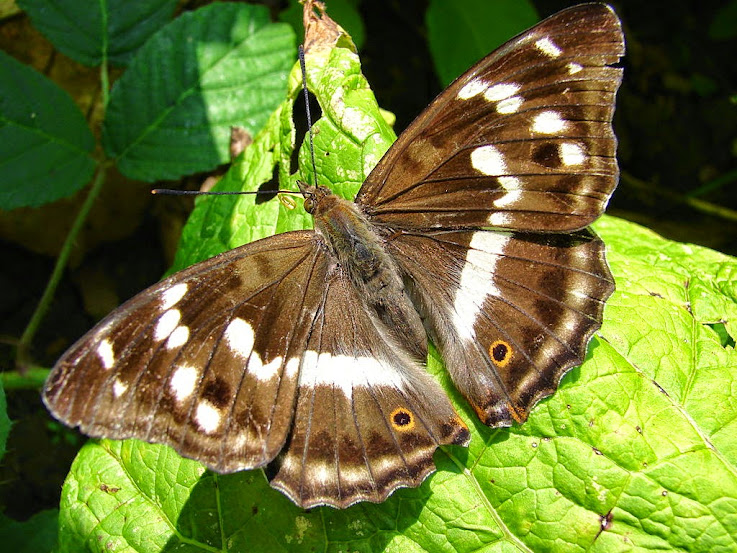
The male butterfly gives this species its name.


Male Purple Emperor
Its upper wings have a purple sheen; the iridescent wings appear purple when viewed from a certain angle.

The female is slightly larger with a 3 inch wing span; her wings are a duller colour.

Female Purple Emperor
She lays her eggs on the leaves of low growing goat willow. I'll confess I had not heard of this tree by this name or as sallow.

February catkins of the Pussy Willow
Apparently the goat willow got its name because goats used to browse on it. To me it has always been pussy willow - it's so soft to the touch.

The caterpillars (larvae) are green with two horns as you may be able to see in the plate from a book published in the 1840s.

Plate from British Entomology
The Purple Emperor spends most of its time high in oak trees when it flies in July and August. The male will descend to suck juices from rotting carcasses. They may, if your lucky, land on you hand to drink your sweat.

It's one of the rarest British butterflies occurring in the South-East in a few woods in a triangle formed by Oxford, Lyme Regis and Eastbourne.


Love is like a butterfly
As soft and gentle as a sigh
The multicolored moods of love are like its satin wings
Love makes your heart feel strange inside
It flutters like soft wings in flight
Love is like a butterfly, a rare and gentle thing

Photo Attributions:
  • Male Purple Emperor (Aptura iris); by Fabelfroh, 2 July 2006 - CC BY-SA 2.0
  • Female Purple Emperor; 22 July 2007 in Romania, by Xulescu-g - CC BY-SA 2.0
  • February catkins; 11 Feb 2008, geograph.org.uk, by Colin Smith - CC BY-SA 2.0
  • British Entomology, Vol 5, Plate 38, by John Curtis, 1840s - Public Domain


Sunday, 5 April 2015

Easter - Sunday Stamps II

I've had to cheat today and reuse some stamps from Great Britain I've shown before to make an Easter connection.

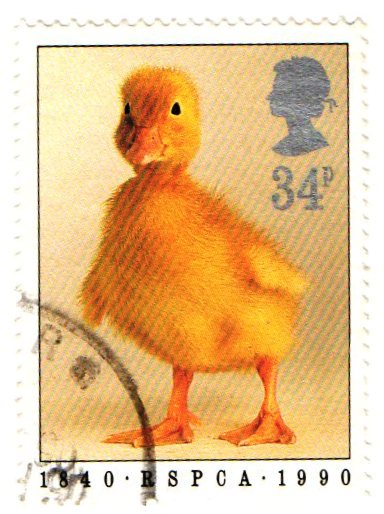
I found a chick:


And a rabbit:


However I could not find an egg for Easter and had to settle for some flowers instead.

Päskelille
You may know these flowers as daffodils but in Norway a päskelille is an Easter lily.

God Päske at Sunday-Stamps-ii-16.

Saturday, 4 April 2015

A-Z Challenge 2015 - Butterflies 'D'

D - Duke of Burgundy Fritillary

I didn't expect to have trouble so early in the Challenge, 'D' proved harder that I expected until, that is, I found the Duke of Burgundy - the Fritillary that isn't related to the other butterflies with that name.

The Duke of Burgundy, no-one knows how that name came about, is the European representative of a family of tropical butterflies. It's the only member of the genus Hamearis in the family Riodinidae.


Duke of Burgundy Fritillary
It is found in Southern England but rare elsewhere with isolated colonies in the Lake District and on the North Yorkshire Moors, close to where I live.

It's a small (1" wingspan) springtime butterfly, frequenting sunny chalk and limestone grasslands, and sunny  woody clearings. You may find it in woods where cowslips and primroses grow.


Cowslips on a grassy bank in North Yorkshire
It lays it's eggs on these plant as it's slug like caterpillar only feeds on cowslips and primroses.

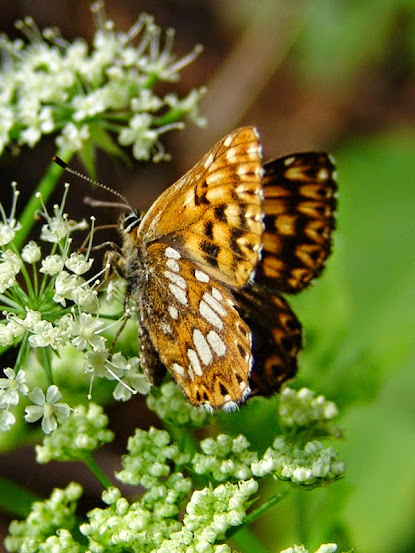
The male Duke of Burgundy is brown with tawny (orange) spots, the females slightly paler. The underside of its hind wings have rows of white spots.

Duke of Burgundy Fritillary - underside.
The adults feed on flowers of the bugle, buttercups, hawthorn and wood spurge. I have to confess that I had to look up the bugle and the wood spurge as I would not recognise either of these.

Wood Spurge
I shall have to look out for it.

Bugle
I know where I can find some of these, but I did not know what they were called before.

The Duke of Burgundy Fritillary is one of the most rapidly declining butterflies in the UK. Fortunately conservationists are coming to its rescue as this short video shows.


Love is like a butterfly
As soft and gentle as a sigh
The multicolored moods of love are like its satin wings
Love makes your heart feel strange inside
It flutters like soft wings in flight

Photo Attributions:

  • Duke of Burgundy Fritillary (Hamearis lucina): April 2007, by Hertonicus - CC BY-SA 3.0
  • Duke of Burgundy Fritillary - underside: June 16 2006, by Mnolf - CC BY-SA 3.0
  • Wood spurge: 1 May 2006, geograph.org.uk, by Bob Embleton - CC BY-SA 2.0
  • Bugle: 17 May 2009, geograph.org.uk, by Glynn Baker - CC BY-SA 2.0
  • Video: Rescuing a rarity - National Trust.


Friday, 3 April 2015

A-Z Challenge 2015 - Butterflies - C

C - Comma

A comma  is a punctuation mark, but it is also a butterfly in the Nymphalidae family.


                                       Caress
                                       Of a
                                       Moon-shaped
                                       Mark
                                       A pause

(Acrostic poem; Liana Mahoney  - Commashavewings.com)

When I came across this dead butterfly on my garden path last summer I had no idea what it was.


Dead Comma
It had definitely come to a full stop!

Not at all like a living specimen.

Comma butterfly at rest
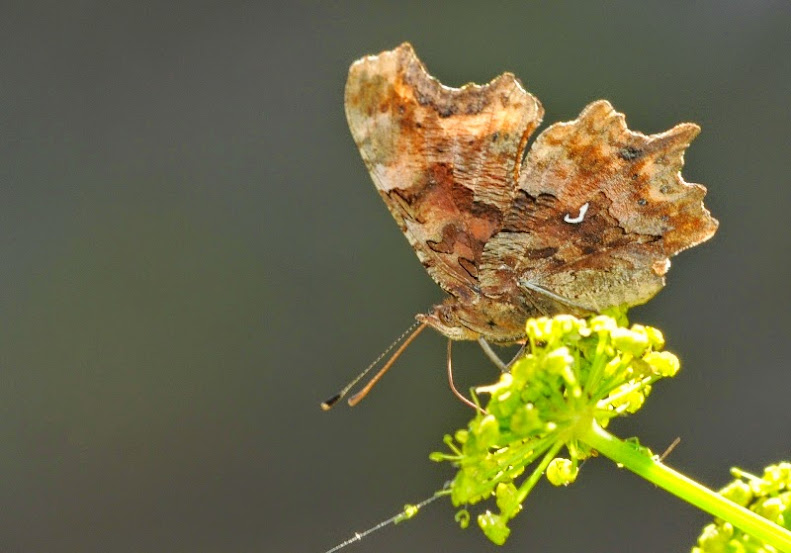
Its tattered looking wings help it to remain undetected among dead leaves on the trees where it hibernates. The white comma marks on the underside of its wings give the Comma its name.

Comma butterfly - underside
As you can see the underside is dull in comparison with the upper side. This disguise enables it to hibernate safely as with its wings folded it looks like a dead leaf on the trees where it hibernates.

The population declined at one time due to a reduction in hop farming but has recovered since the 1960s with a preference for the common nettle as the larval food plant. It's now found throughout England and Wales; its range has also reached Scotland.

Eggs (on a nettle leaf?)
The caterpillars are brown and white and spiky; they feed on nettles (and hops) for about seven weeks before pupating.

Comma caterpillar
What a shame that I have cleared out all the nettles from my garden. I have no chance to see the caterpillar and must hope that I get to see adult butterflies in the countryside feeding on thistles, brambles, ivy or knapweed.


Love is like a butterfly

As soft and gentle as a sigh
The multicolored moods of love are like its satin wings
Love makes your heart feel strange inside


Photo Attributions:
  • Comma at rest: By P matthews 123 - CC BY-SA 3.0
  • Comma underside: 7 July 2011, Zeynel Cebici - CC BY-SA 3.0
  • Eggs: 6 July 2009, Giles San Martin - CC BY-SA 2.0
  • Larva (caterpillar): Jan 1 2006, Lilly M - CC BY-SA 2.0


Thursday, 2 April 2015

A-Z Challenge 2015 - Butterflies - 'B'

B - Brimstone

Brimstone is the archaic name for sulphur which may be associated with volcanic fumaroles like this:


Sulphurous fumarole (Italy)
Fire and brimstone occurs in the Bible as an expression for the wrath of God.

"The breath of Jehovah, like a stream of brimstone, doth kindle it." - Isaiah 30:33

The expression is also used to describe a style of Christian preaching that uses a vivid description of judgement and eternal damnation.

However the word butterfly is believed to be derived from "butter-coloured fly" which is attributed to the - 

Male Brimstone Butterfly (in flight)
The Brimstone (Gonepteryx rhamni) is one of the longest living (c.11 months) British butterflies and one of the few to hibernate as an adult.

Its larvae feed on the leaves of the Buckthorn (Rhamnus cathartia) or Alder Buckthorn (Frangula alnus). The caterpillar feeds on the food plant and are found lying along the mid-rib on the upper side of the leaf.

Brimstone caterpillar
Male Brimstone on a bluebell
Although the male is a bright high yellow, the female is a very pale yellow, almost white.

It occurs in England and Wales but not in Scotland; its range extends from England and the welsh borders north to Yorkshire, Cheshire and the southern parts of the Lake District. I have yet to see one in the hedges and verges in North Yorkshire.


Love is like a butterfly
As soft and gentle as a sigh
The multicolored moods of love are like its satin wings


Photo attributions:
  • Fumarole - Jan 1 2006, by Brisk g - Public domain
  • Common Brimstone butterfly male in flight - 22 July 2014, by Charles j Sharp; CC BY-SA 2.0
  • Brimstone caterpillar on buckthorn leaf - 28 May 2012, by Giles San Martin (Namur, Belgium); CC BY-SA 2.0
  • Male Brimstone butterfly on bluebell - 22 Apr 2008, geograph.org.uk, by Graham Newell - CC BY-SA 2.0
  • Video - Brimstone Butterfly, Anna Rubato

Wednesday, 1 April 2015

A-Z Challenge 2015 - Butterflies A

A- Z Challenge 2015

My A-Z posts this year will be about butterflies with an emphasis of those from Britain. I expect that I shall have to include some from elsewhere as well. Until I get started I'm not sure what other connections will occur. You will just have to wait and see. As usual I am expecting to cheat for some letters of the alphabet; I’m sure you will see why.

In 1978 there was a sitcom on British TV called 'Butterflies.' Its theme tune was one I always associate with Dolly Parton - "Love is like a butterfly."

Dialogue in the first episode included these words, "We are all kids chasing butterflies. You see it, you want it, you grab it and there it is all squashed in your hands."

I promise you that no butterflies have been harmed in this Challenge. 

After all, "Love is like a butterfly, a rare and gentle thing."


A - Adonis Blue


Adonis was the Greek god of beauty and desire whose name in modern times is often applied to handsome youths.

Adonis Blue - Male
This brilliant sky blue butterfly is the most vivid of British blue butterflies. The female is chocolate brown.

Adonis Blue - Female
As you can see both have chequered fringes to their wings with the female having flecks of yellow.

Although it has become a declining species conservationists are trying to encourage populations by managed grazing programs in their chalk grasslands. They are to be found on the limestone and chalk of southern England in Dorset, the Isle of Wight, the Chilterns, Wessex and Kent.

Hippocrepsis comosa
The horseshoe vetch (hippocrepsis comosa) is the only flower on which this butterfly feeds so you are unlikely to find it on the bush that bears its name.

Buddleja davidii - Adonis Blue
The buddleia, apply known as the butterfly bush, in our garden attracts many butterflies each year but unfortunately not the Adonis Blue.

Each Sunday I contribute to the Sunday Stamps meme. How I wish I could include this stamp.

Hungary


Photo Attributions:
  • Adonis Blue - Male: Polyommatus bellargus, 25 June 2006, Harold Süpfle - CC BY-SA 2.5
  • Adonis Blue - Female: Polyommatus bellargus, 25 June 2006, Harold Süpfle - CC BY-SA 2.5
  • Horseshoe vetch hippocrepsis comosa, uploaded by Tigerente, June 11 2006 - CC BY-SA 3.0
  • Buddleja davidii, Adonis Blue, 22 Aug 2012, Ptelea - CC BY-SA 3.0
  • Hungarian Stamp, scan by Darjac