Pages

Showing posts with label Chaucer. Show all posts

Thursday, 9 January 2014

Photo Archives - Sepia Saturday.

The prompt this week is just the thing to lead me astray; do I concentrate on books or photos or both?


I have found several books which you might classify as old in one way or another, but they did not contain any loose photos - sepia or otherwise. However I do have a box file (not a cardboard box like Alan's) in which are stored sepia photos, postcards and my newest book.

'Sepia Saturday' Box File
The photo on the left has been annotated on the back, "Is it you, or is it me? Mick" My wife is convinced that this is her elder sister Mick when she was young.

The one on the right is the old ferry at Hartlepool.

I left with a bit of a quandary. How do you judge the age of a book - by when it was written or when it was printed? Here's four to illustrate the point.

Chaucer - The Canterbury Tales &
John Bunyan -The Pilgrim's Progress
Chaucer was born about 1340 and died in 1400. He is buried in Westminster Abbey.
Bunyan, born in 1628, died 1688 lies in the Bunhill Fields Cemetery, London along with Daniel Defoe and William Blake.
The Penguin Classic, The Canterbury Tales was first published in 1951 - note the price of 5/-
The New American Library's edition of The Pilgrim's Progress appeared in 1964 at $1.75.

I noticed that the book in our prompt had the text in two columns. I can match that with our copy, a wedding present from 1958, of The Complete Works of William Shakespeare ( baptised in April 1564, died 23 April 1616).

Shakespeare' s The Winter's Tale
The last of my books is The Pickwick Papers, the first novel of Charles Dickens published in 1836.

The Fat Boy Awakes - The Pickwick Papers
What's special about this book for me? Just look at the inscription.

Form Prize at Stamford School 1949
Having been carried away by books I turned back to archives and this file of:

Prospekt Kort (Postcards)
This is the file put together by my daughter while I was working in Norway between 1979 and 1988. The cards are those I sent to her during that time - some have appeared on Sepia Saturday before.

In my archive search I came across some 'old' albums.

I wonder what happened to them
But when I turned the page, this is what I found.
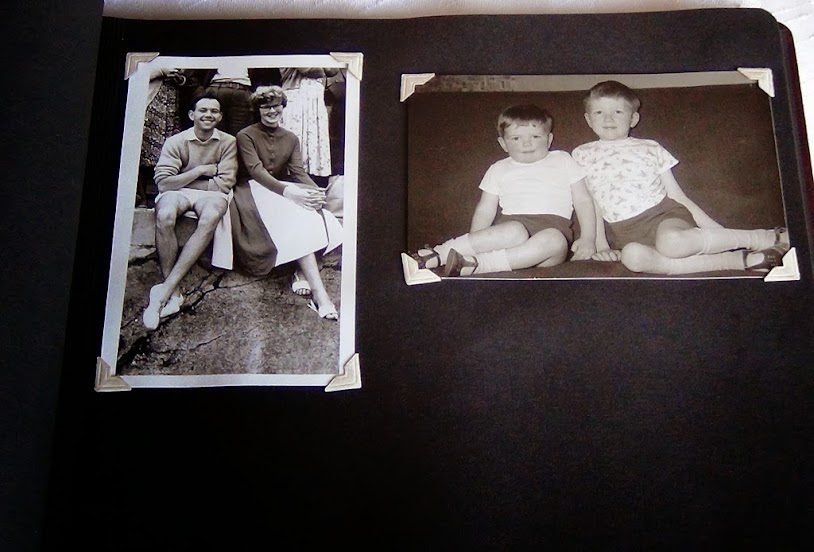
Honeymoon(?) on the left in 1958; our two sons in 1960s
The second album contained more photo's, all in colour.

Cutting Our Wedding Cake
Finally I opened the top drawer of the desk in our lounge and found the largest collection of all.

Photos, photos, photos!
Now I need advice. Do I throw them all away when they are all stored here,


and on the Internet?

For other Sepians' views check out the links on Sepia-Saturday-210.

Thursday, 17 November 2011

Classic Thematic Photography

Carmi's classic theme gave me problems for a while until I remembered that I am taking part in the Dickens Journals Online Project. I received a copy of  his 'Pickwick Papers' as a prize when I was at school. This sent me to my bookcase to look for it.
Classic Top Shelf
You may not be able to read the titles of the books on the top shelf at the left. There are no banned titles and none obscured so let's take a closer look.
Classic Book Selection
From left to right we have tucked in the corner a once banned book, 'Lady Chaterley's Lover' (D H Lawrence); 'The Return of the Native' (Thomas Hardy); Villette (Charlotte Bronte); Mansfield Park and Emma (Jane Austen); The Canterbury Tales (Chaucer); The Pilgrim's Progress (John Bunyan) and, the thin green book, The Thirty-nine Steps (John Buchan)

Daphne Du Maurier's 'Rebecca' is next before my prize copy of 'Pickwick Papers' and Mary Shelley's 'Frankenstein.'
More Classic Books
I think you can make out the titles of the five at the right but from the left after Frankenstein is Mrs Gaskell's 'Cranford', 'The Moonstone' (Wilkie Collins), Barchester Towers ( Anthony Trollope), 'Wuthering Heights' (Emily Bronte), 'Jane Eyre' (Charlotte Bronte) and before 'The Works of Robert Burns' is 'The Diary of Ann' Frank').
I hope you like the classic collection which we have assembled over the years. But before I sign off my attention was drawn to ornaments on the walls and on top of my 'classic' bookcase.
'Real' copy of figure from the Classical Period 530 BC
This plate and the one that follows came from a holiday we took in Crete about 30 years ago.
Plate from Crete
Any voulnteers to translate the inscription?
Any my final classic piece is this:
Vase - Museum Corinth 560 BC Exact Copy
This vase (or jug) is about 6 inches tall.

For other classic collections you need to visit Carmi's Thematic Photographic 171

Monday, 14 February 2011

"I'll Be Your Valentine..."


“If you will be mine.” Was this once a song or was it, “I’ll be your sweetheart if you will be mine?” That was a song remembered from the wartime years. Sixty years ago there was a school-days rhyme saved specially for St Valentine’s Day when young boys expressed their disgust at all things feminine.
“Roses are red,
violets are blue,
horses**t stinks
and so do you.”
How quickly their views changed in a few years time!
It’s strange to think that there were three St Valentines all martyred apparently on the fourteenth day in February. The origin of St Valentine’s Day is obscure and shrouded in fanciful legends. The holiday has it roots  in the ancient Roman festival of Lupercalia, a fertility celebration commemorated annually on February 15. This pagan festival was designated a Christian feast day in circa 496 when Pope Gelasius I declared February 14 to be St. Valentine's Day.
In “Chaucer and the Cult of Saint Valentine” the 14th century scholar Henry Ansgar Kelly said it was Chaucer who first linked St Valentine’s Day with romance. In his 1381 poem “The Parliament of Foules” Chaucer associated the feast day with the royal engagement of Richard II with Anne of Bohemia and the mating of birds:
“For this was sent on Seynt Valentyne’s day
Whan every foul cometh ther to choose his mate.”
Over the years the day became special to lovers and as an occasion for love letters and sending lovers’ tokens. This practice may be found in both French and English literature of the 14th and 15th centuries, Those who chose each other under these circumstances have been called by each other their Valentines, In the “Paston Letters” Dame Elizabeth Brews wrote about a match she hoped to make for her daughter, “And cousin mine, upon Monday is Saint Valentine’s Day and every bird chooses himself a mate, and if you like to come on Thursday night, and make provision that you may abide till then. I trust to God that ye shall speak to my husband and I shall pray that we may bring the matter to a conclusion.”
Perhaps this is what has led to the popular belief that birds choose their mates on St Valentine’s Day.
By the 18th century, gift-giving and exchanging hand-made cards on Valentine's Day had become common in England. Hand-made valentine cards made of lace, ribbons, and featuring cupids and hearts eventually spread to the American colonies. The tradition of Valentine's cards did not become widespread in the United States until the 1850s. Today, the holiday has become a commercial success, although some regard it as a nightmare.
With the advent of silent movies one Rodolfo Alfonzo Raffaelo Pierre Filibert Guglielmi di Valentina d'Antonguolla was one of the most popular stars of the 1920’s. The untimely death of Rudolph Valentino, know as the “Latin Lover” caused mass hysteria among his female fans and propelled him into icon status.
In 1929 the morning of Thursday 14th of February saw a much more macabre event in Chicago when six members of the “Bugs” Moran gang and a doctor were lined up against a garage wall and shot to death. This has been known ever since as the St Valentine’s Day Massacre – with no association with love.
Coincidentally, also in 1929, Richard Bryce was born in London. If you’ve never heard of Richard Bryce then you might recognise his stage name of Dicky Valentine, a popular singer of the 1950s. With a name like that it may be no surprise that he became a heartthrob for young girls and for some, not so young ladies, with his marriage causing scenes of hysteria. Like Valentino he came to tragic end – in a car crash in Wales.
However, if on this day of love, you must compose a verse for your Valentine beware you don’t choose one like this:
“Oh, Carol I do love you so.
I also love Becky and Jo,
they take it in turns
Fulfilling my yearns.
You’re jealous, don't tell me, I know”.

Monday, 29 March 2010

Don't Laugh At Me...

In 1708 a correspondent in a British magazine asked, “Whence proceeds the making of April Fools?”

At that time the custom of April Fool’s Day was well established in northern Europe. However there had been few comments in written records about its origin. References as early as the 1500s were infrequent and often vague. Shakespeare in the 16 and 17th centuries made no mention of April Fool’s Day despite being, as Dickens described, a writer “who delights in fools.”

The popularity of Elizabethan jesters is shown in the plays of the time. Shakespeare characters included a Fool in Timon of Athens, the Clown in Othello, Costard in Love’s Labours Lost, Touchstone in As You Like It and Puck in Midsummer Night’s Dream.

Despite many suggestions the making of April Fools remains a mystery. A popular theory about the origin of April Fool’s day involves the reform of the French calendar in 1564 when the start of the year was moved from the end of March to January 1st. Those who clung to the old calendar system and continued to celebrate New Year in the week between March 25th and April 1st had jokes played on them. Paper fish would be stuck surreptitiously to their back. The victims of the prank were called Poisson d’Avril, or April Fish. This is still the French term for April Fools.

It has been suggested that the first reference to April Fool’s Day can be found in Chaucer’s The Nun’s Priest’s Tale. Chanticleer, a vain cock, falls for the tricks of a sly fox and as a result is almost eaten. It has been argued that the wording meant that the event took place thirty-two days since March began, i.e., on April 1st. But other translations have placed the day as May 3rd.

It appears that the April Fool’s Day dates back to at least the 16th century and that it originated in continental Europe before spreading to Britain.

D’Amerval’s 1508 French poem uses the phrase “poisson d’avril” the French term for April Fool. However he may have just intended to use the term for a foolish person.

In 1539 a comical poem by a Flemish writer tells of a nobleman who plans to send his servant back and forth on absurd errands on April 1st. The medieval Dutch title roughly translates to, “Refrain on Errand Day/ which is first of April.” The last line of each stanza has the servant saying, “I am afraid… that you are trying to make me run a fool’s errand.”

In 1686 John Aubrey, an English antiquarian, researched popular customs and superstitions and wrote, “Fooles holy day. We observe it on ye first of April.” By 1698 it was a popular prank to send gullible people to see the lions being washed at the Tower of London. It became traditional for this prank to be played on the first of April; it was referenced as late as the mid-nineteenth century.

In British folklore April Fool’s Day is linked to the town of Gotham in Nottinghamshire. It was traditional in the 13th century for any road that the King placed his foot on to become public property. Hearing that King John planned to travel through the town, the people of Gotham refused him entry. When soldiers send by King John arrived they found the town full of apparent lunatics drowning fish or attempting to cage birds in roofless fence. Although their foolery was an act, the King declared the town too foolish to be punished. Since then, according to legend, April Fool’s Day has commemorated their trickery.

A 1630 woodcut shows a citizen of Gotham trying to trap a cuckoo inside a roofless fence. In Scotland a “gowk” is a cuckoo or a foolish person and April’s Fool’s Day was once called Hunt-the-Gowk Day. A traditional prank was to ask someone to deliver a sealed message requesting help. The message read, “Dinna laugh, dinna smile. Hunt the gowk another mile.” The recipient would then explain he could only help by contacting someone else. The unsuspecting victim was then sent onwards with an identical message.

If you decide to play a joke on someone on April Fool’s Day, just remember that April 1st is the day on which we are reminded of what we are on the other three-hundred and sixty-four.

Politicians seem to think we are fools. They should remember the words of Lincoln when he said, “You can fool all the people some of the time, and some of the people all the time, but you cannot fool all the people all the time.” Be careful where you put your X at the forthcoming election and remember that the trouble with practical jokers is that they often get elected.