Pages

Showing posts with label Dickens. Show all posts

Thursday, 9 January 2014

Photo Archives - Sepia Saturday.

The prompt this week is just the thing to lead me astray; do I concentrate on books or photos or both?


I have found several books which you might classify as old in one way or another, but they did not contain any loose photos - sepia or otherwise. However I do have a box file (not a cardboard box like Alan's) in which are stored sepia photos, postcards and my newest book.

'Sepia Saturday' Box File
The photo on the left has been annotated on the back, "Is it you, or is it me? Mick" My wife is convinced that this is her elder sister Mick when she was young.

The one on the right is the old ferry at Hartlepool.

I left with a bit of a quandary. How do you judge the age of a book - by when it was written or when it was printed? Here's four to illustrate the point.

Chaucer - The Canterbury Tales &
John Bunyan -The Pilgrim's Progress
Chaucer was born about 1340 and died in 1400. He is buried in Westminster Abbey.
Bunyan, born in 1628, died 1688 lies in the Bunhill Fields Cemetery, London along with Daniel Defoe and William Blake.
The Penguin Classic, The Canterbury Tales was first published in 1951 - note the price of 5/-
The New American Library's edition of The Pilgrim's Progress appeared in 1964 at $1.75.

I noticed that the book in our prompt had the text in two columns. I can match that with our copy, a wedding present from 1958, of The Complete Works of William Shakespeare ( baptised in April 1564, died 23 April 1616).

Shakespeare' s The Winter's Tale
The last of my books is The Pickwick Papers, the first novel of Charles Dickens published in 1836.

The Fat Boy Awakes - The Pickwick Papers
What's special about this book for me? Just look at the inscription.

Form Prize at Stamford School 1949
Having been carried away by books I turned back to archives and this file of:

Prospekt Kort (Postcards)
This is the file put together by my daughter while I was working in Norway between 1979 and 1988. The cards are those I sent to her during that time - some have appeared on Sepia Saturday before.

In my archive search I came across some 'old' albums.

I wonder what happened to them
But when I turned the page, this is what I found.
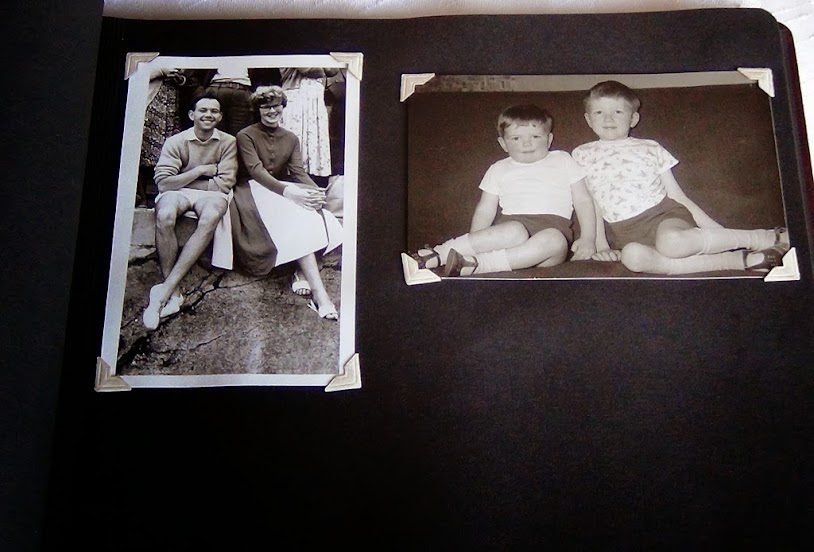
Honeymoon(?) on the left in 1958; our two sons in 1960s
The second album contained more photo's, all in colour.

Cutting Our Wedding Cake
Finally I opened the top drawer of the desk in our lounge and found the largest collection of all.

Photos, photos, photos!
Now I need advice. Do I throw them all away when they are all stored here,


and on the Internet?

For other Sepians' views check out the links on Sepia-Saturday-210.

Saturday, 21 December 2013

Christmas Past and Present - Sepia Saturday

It doesn't seem a year since Alan put up last year's Christmas post but already it's time he said for us to celebrate.


I usually find a link to Dickens and this year is no exception; it's time to let your hair down and have a ball


Mr Fezziwig's Ball - A Christmas Carol
1843 Hand coloured etching by John Leach
Perhaps you would prefer to party outside as they did in 1852.

A Christmas Party
1852 Oil painting by George Henry Durrie

All the weathermen seem to be able to offer us is heavy rain and strong winds. I don't think we will be able to look out of our window and see a sight like this.


Santa Claus may be coming but so far there are no presents under our tree.

Christmas Tree 2013

So I guess that all there is left for me to do is wish all Saturday Sepians (and all my blog visitors too)  a Merry Christmas and a Happy New Year from us at:


Meanwhile take a look at more Sepia Christmases at Sepia-Saturday-208.

Friday, 21 December 2012

Merry Christmas Sepians

I'm pleased that Alan gave us the go ahead to take his photo in any direction we wished for Christmas.


Now I've always been a Dickens fan and he did Christmas rather well in much of his work. Mr Pickwick came immediately to mind.

Christmas Eve at Mr Wardle's
By Phiz (Hablot K Browne)
Image scanned by Phillip V Allingham; source www.victorianweb.org

Dickens was also very good at ghost stories - I sure you all know the ghosts in his 'Christmas Carol.' At Christmas in 1859 there was a series of ghost stories in 'The Haunted House,' the Extra Christmas number of 'All the Year Round.' So if you have the time and fancy a good read you can have one on line here

It's time for Santa to get in on the act and thanks to Project Gutenberg I found a delightful, illustrated poem by Elizabeth Andersen called 'The Goblins' Christmas.'

Santa Claus (The Goblins' Christmas - by Alexander Sharp 1908)
I also came across the work of Thomas Nast - 'Christmas Drawings for the Human Race' - including this rather rotund gentleman.

Santa Claus
Nast first drew Santa Claus for the 1862 Christmas season edition of Harper’s Weekly; he is said to have  “invented” the image popularly recognized as Santa Claus in America.

Christmas is a time when presents are exchanged and I have been privileged to play with one of mine already. As a result during the Twelve Days of Christmas I cannot promise my love two turtle doves, nor a partridge in a pear tree so I've compromised with this video clip.

One Wood Pigeon in an Apple Tree

All that remains is for me to wish all my fellow Sepians a very Merry Christmas and to thank you all for for your comments and encouragement throughout the year.

Meanwhile I must find a sleigh to hitch up to this chap before I visit you all at Sepia-saturday-157-christmas

Ho,ho, ho!
 

Thursday, 1 December 2011

Heigh-ho, the derry-o - Sepia Saturday


When I saw the photo I didn't know where to start. Googling nurses got me to some naughty pictures so I though I would start nearer home with one of my favourite castles.
Richmond Castle

(By Ambersky235 - ex flickr - CC B-NC-SA 2.0)

I had to go much further away to find my group of nurses all looking very smart.
Early Memphis Nursing Sisters
But then I remembered this.
Nurse's Song (Innocence)
The poem by William Blake starts 
When voices of children are heard on the green
And laughing is heard on the hill,
My heart is at rest within my breast
And everything else is still.

From one song to another with a nurse involved.
The child takes a nurse,
The child takes a nurse.
Heigh-ho, the derry-o,
The child takes a nurse.
The nurse takes a dog,
Heigh-ho, the derry-o,
The nurse takes a dog

I hope you all recognised the song - The Farmer in the Dell - which originated in Germany in 1820.

Now we are in December and Christmas is drawing near it's time for Dickens and I'm sure you'll all remember his character Tiny Tim. That link's enough for me to launch into the lyrics of  Tiny Tim.

Miss Lucy had a baby, a baby.
Miss Lucy had a baby and she named him Tiny Tim.
She put him in the bathtub to teach him how to swim.

He drank up all the water,
He ate up all the soap he tried to eat the bathtub
But it wouldn't go down his throat.
Miss Lucy called the doctor
Miss Lucy called the nurse,
Miss Lucy called the lady with the alligator purse.

Operation said the doctor,
Operation said the nurse,
Operation said the lady with the alligator purse.
Out came the water, out came the soap,

Out came the bathtub that wouldn't go down his throat.
Goodbye said the doctor,
Goodbye said the nurse,
Goodbye said the lady with the alligator purse. 

It's goodbye from them and goodbye from me. But before you leave don't forget to see other Sepia Saturday posts 
[Attributions: Bathtub - monicams; soap - laurianne; Alligator bag - nerissa's ring - CC BY 2.0]

Sunday, 12 December 2010

Festive Ghosts


Christmas and New Year’s Eve vie with Halloween for ghosts.

Local legend in Dorset concerns a phantom donkey standing on Newton Heath, near Studland. Its owner was robbed and killed while travelling across the heath; the donkey disappeared without trace. The animal returns each year on 22 December in the hope of finding its master.

 Rochester Castle
 (photo by Stephen - www.picturesofengland.com)

Famous ghosts are those immortalised in Charles Dickens’ Christmas Carol. Dickens ghost walks through the gravestones in the graveyard at Rochester Castle on Christmas Eve. Dickens loved Rochester throughout his life and wanted to be buried there. In fact he lies in Westminster Abbey. His ghost is said to appear outside the Corn Exchange at midnight, winding the hands on his watch.

Hever Castle
(photo by Sarah Dawson -  www.picturesofengland.com)

On Christmas Eve a ghostly female, thought to be Anne Boleyn, glides across the bridge over the River Eden in the grounds of Hever Castle in Kent. She is also seen under the great oak where Henry VIII courted her.

December 24th is the time at which a ghost of a monk is to be seen wandering through the ruins of the old Cistercian abbey at Strata Florida, Ceredigion in the north-east of Tregaron.

There is more than one version of why the ghostly ringing of a sunken bell may be heard at Bomere Pool, near Shrewsbury, Shropshire on Christmas Eve. A village once existed where the pool is today.
One farmer persisted in cutting his corn on a Sunday; the whole village was punished for this infringement of the 10th Commandment by being sunk beneath the waves.
An alternative story says the people gave themselves to godless and riotous living; one year they refused to go to church on Christmas Eve. As a consequence the waters rose and drowned the village and its inhabitants.
Some people claim to hear the voices and cries of children and the church bells still toll in the watery world of Bomere Pool.

More bells but this time from the depths of a lake in Cheshire. Monks removed the bells from Combermere Abbey, near Nantwich when the original abbey was dissolved. The bells fell off the boat in which they were being transported. Now on 24th December the bells are sometimes heard, often accompanied by sightings of a ghostly monk.

The Tudor mansion, Madingley Hall in Cambridgeshire was built by Sir John Hynde in 1543. The ghost of Lady Ursula, his wife forever walks the Hall wringing her hands in despair. Lady Ursula was distressed at her son’s destruction of the local church of St Ethelreada in Histon to obtain building materials for the Hall. Each Christmas Eve she walks between the Hall and the church.

It was Prince Albert who introduced the Christmas tree to England when he had one set up at Windsor Castle. Albert bought Sandringham House for Queen Victoria and it remains a royal residence today.

Sandringham is known for its Christmas poltergeist. Noisy activity is seen and heard in the servants’ quarters on Christmas Eve and around the Christmas period. Cards are strewn around; footsteps heard and unpleasant presence felt. Staff have felt uneasy to be alone in the footman’s corridor.

Festive Ghosts will be continued with that of Thomas à Becket and the ghosts of New Year’s Eve in a later  post.