Pages

Monday, 16 April 2012

Nottingham Castle and the gentle Mortimer.


 A-Z Challenge 2012 - N
Nottingham Castle

In the legends of Robin Hood Nottingham Castle is the scene for the showdown between the Sheriff of Nottingham and the outlaw. However there is much more to the history of the castle than its ‘connection’ to Robin Hood.

Reconstruction of Nottingham Castle - 1896
The castle held a commanding position on a promontory known as “Castle Rock”, with 40m cliffs to the south and west. At various times it has been a major fortress and royal residence. After the execution of Charles I it was largely destroyed. The Ducal Mansion now occupying the site was built in the late 1600s.

Nottingham Castle - 2005
Built by William the Conqueror in 1067, the wooden structure with a motte and bailey design was replaced by a stone castle in 1170 by Henry II. In 1194 Richard the Lionheart regained the castle from Prince John with siege engines Richard had used during the crusades at Jerusalem - the only time that an occupier of Nottingham Castle was defeated.

In 1212 King John held sons of Welsh nobles as hostages in the Castle before ordering their execution. The boys’ cries rang round the Castle as they were taken one by one to the ramparts and hanged. Their ghostly pleas for mercy are still said to be heard within the castle precincts.

More drama occurred on the night of 19th October 1330, when the lovers, Roger Mortimer, 1st Earl of March and Queen Isabella were in residence. The pair were acting as Regents for the young Edward III following their murder of his father Edward II. The young king and his supporters entered the castle by the secret tunnel now known as Mortimer’s Hole and burst into the lovers chamber. Despite Isabella pleading ‘Fair son, have mercy on gentle Mortimer,’ Edward imprisoned him I the castle. Sir Roger was taken to London and executed there as a traitor; hung drawn and quartered on 29th November his remains were stuck on spikes and left to rot on traitors gate at Tyburn.

Ghostly echoes from the time may still be heard in the Ducal Mansion now occupying the sight. Footsteps are heard pacing to and fro in the subterranean chamber where Mortimer was held. Sometimes in the castle a woman’s voice pleads, ‘Bel fitz, eiez pitie du gentil Mortimer!’

Charles I raising his standard at Nottingham Castle 1642
In August 1642 at the start of the Civil War Charles I raised his standard outside the castle walls but for most of the war the castle was held by the parliamentary forces. After the execution of the King in 1649, the castle was razed to the ground.

The site was bought by the 1st Duke of Newcastle in the 1660s; the Ducal Mansion was completed by his son in 1678. The building was attacked and burn down by rioters in 1831. Later a local architect was appointed to adapt the Castle into a building to be used as a museum and art gallery.

The Prince of Wales, later Edward VII, opened Nottingham Castle in 1878 and Nottingham celebrated being the first municipal museum and art gallery outside London.

Nottingham Castle Gatehouse 2005
Manorbier Castle, Pembrokeshire was Hilary Melton-Butcher's castle for M on Saturday.

Attributions:
  • Reconstruction of Nottingham Castle 1896; Source Mackenzie, James D. (1896) The Castles of England: Their Story and Structure, Vol II. New York: Macmillan. Author James Mackenzie (1830-1900) PD
  • Nottingham Castle. Nottingham Castle 2005; author Rob Bradford; Creative Commons Attribution-ShareAlike 2.0 license
  • Painting by Henry Dawson 1847 of King Charles I raising his standard at Nottingham Castle 24 August 1642 public domain
  • Nottingham Castle's Gatehouse 2005; author Rob Bradford; Creative Commons Attribution-ShareAlike 2.0 license

Saturday, 14 April 2012

Muncaster Castle and Tom the Fool


 A-Z Challenge 2012 - M
Muncaster Castle

Muncaster is another castle that stakes a claim to be one of Britain’s most haunted.

Muncaster Castle (Morris - 1880)
Muncaster Castle overlooks the River Esk near Ravenglass, Cumbria in North West England. The lands were granted to Alan de Penitone in 1208. Roman foundations on the site date back to 79AD. The castle was built on these in 1258 by Gamel de Mulcaster. Extended and enlarged over the centuries records show that the castle had 14 chimneys in 1678 while in 1746 window tax records indicate a total of 103 windows.

After his defeat at the Battle of Townton in 1461 Henry VI was sheltered at the castle by Sir John Pennington. On his departure Henry presented Sir John with his glass drinking bowl as a token of his gratitude, saying that they would prosper for as long as the bowl remained unbroken. To this day the glass, known as “Luck of Muncaster” remains intact.

Of all the ghostly tales about Muncaster the most famous is that of Tom the Fool. Tom Skelton was a jester at the castle who died around 1600. He is said to be responsible for a number of deaths. He loitered under a chestnut tree outside the castle and directed travellers looking for Ravenglass down to the quick sands rather than to the road. He is also supposed to have cut off the head of a local carpenter under the instructions of Sir William Pennington. The carpenter had been the lover of Sir William’s daughter Helwise.

Thomas Skelton’s portrait still hangs in the castle. One tourist standing looking at the portrait said she heard footsteps on stone flooring behind her. When she turned there was no one there. It was later pointed out to her that the stairs and corridor were, in fact, fully carpeted.

It’s believed that the expression “Tom Fool” and “tomfoolery” originated with Thomas Skelton.

The Tapestry Room is supposedly the most haunted room in the building with people experiencing disturbed nights, hearing footsteps outside the room, seeing the door handle turning, and the door opening although there is no one there. A child is heard crying, and sometime a lady sings as though comforting a child.

The “Muncaster Boggle” or White Lady haunts the gardens and roadways. She is the ghost of Mary Bragg, a young girl murdered in area in the early 1800s.

Muncaster Castle - North East Front - 2007
Hilary Melton-Butcher's castle for L was Lullingstone Castle, Kent.

Attributions:
  • Muncaster Castle in England from Morris's Country Seats (1880).
  • North East Front of Muncaster Castle 2007; author Alexander P Kapp; Creative Commons Attribution Share-alike license 2.0

Friday, 13 April 2012

Later Flight - Sepia Saturday

I couldn't resist putting up a second flight when Little Nell had Albert Ball VC in her post.

A Hero's Salute - Andrew Mynarski VC
The statue of Andrew Mynarski VC stands outside the former Officers' Mess of RAF Middleton St George, now the Durham Tees Valley Airport. I've written about how this Canadian officer won his posthumous VC during WWII here.

There are several planes in flight in my brothers war photos.

WWII Action
Meanwhile Eden Camp in North Yorkshire has replica planes on show.

Eden Camp - entrance

No matter how we try we still can't match what is strictly for the birds.

Turkey Vulture
In flight we are nowhere near as elegant.


Just don't miss Sepia Saturday 121

Lindisfarne Castle, Northumberland


A-Z Challenge 2012 - L
Lindisfarne Castle

Lindisfarne Castle stands on a whinstone hill, the highest point of Holy Island.

Lindisfarne Castle - 2006
Holy Island – Lindisfarne – is world famous as an important centre of early English Christianity. The remote location led to St Aidan founding a monastery, Lindisfarne Priory, there in AD 635. Later in 684 St Cuthbert became the Bishop of Lindisfarne. At low tide each day a causeway links the island to the mainland.

The ghost of St Cuthbert is said to haunt the island, being seen on the craggy rocks down by the shore, He has also been seen on a stone slab inside the ruin of the old Priory. He is also allegedly responsible for what are known as “Cuddy’s beads.” On dark and stormy nights the sound of his hammering can be heard as he chips away at stone to make the beads.

Lindisfarne is home to other ghosts; a Cromwellian soldier seen at the castle, phantom monk who disappears through a wall, other monks seen walking across the causeway and a monk believed to be St Cuthbert himself.

Peter Underwood, in his book The Haunted Isle, says of the ghost of St Cuthbert:
Perhaps the most famous appearance of this ghost, if not the best authenticated, is the occasion when it was seen by Alfred the Great, who was a fugitive at the time. The saintly ghost indicated that all would be well and that Alfred would one day sit on the throne of England, and so it came to pass.

The castle is situated in what was once a volatile border area between England and Scotland. The island was frequently attacked by the Vikings and was sacked by Danish raiders in 873. The castle was built around 1550 with stones from the Priory when this went out of use. The fort created on the whinstone hill, known as Beblowe Crag, between 1570 and 1572 became the basis of the present castle.

Lindisfarne Castle - 2007
In 1901 the castle became the property of a publishing and magazine owner. Sir Edwin Lutyens converted it into a private house in 1903. The walled garden was designed by Gertrude Jekyll between 1906 and 1912. The castle, garden and nearby lime kilns have been cared for by the National Trust since 1944.

Hilary Melton-Butcher's castle yesterday K - Knepp Castle, West Sussex.

Attributions:
  • Image 1 Lindisfarne Castle 2006; sitting on an igneous rock; author Nigel Chadwick; Creative Commons Attribution-Share Alike 2.0 license.
  • Image 2 Lindisfarne Castle 2007; author Matthew Hunt; Creative Commons Attribution 2.0 Generic license.

Thursday, 12 April 2012

Flight - Sepia Saturday

 When I saw 'Flight' was the subject of this week's theme I decided to repost this from a blog I wrote in 2009. Enjoy the read.

The Thornaby Spitfire

The decision to site a replica Spitfire on a roundabout at Thornaby was quite controversial at the time. The aerodrome, now submerged by the buildings of the Thornaby new town operated from 1930 – 1958. The RAF’s 608 Squadron - the Tees Valley's auxiliary squadron, which was based at Thornaby during the Second World War - did not fly Spitfires until after the war. It flew Avro Ansons and, later, Lockheed Hudsons.

However Spitfires based at Catterick used Thornaby as a base in 1943 as was too far from the coast. Canadian and Polish pilots flew the Spitfires on sorties over the North Sea,

Both the cost and the size of a replica Hudson aircraft meant it was unfeasible to commemorate it on the roundabout. Consequently it is the Spitfire that took pride of place in the centre of the roundabout on the approach to Thornaby in 2007.

Funded in part by a lottery grant, the Spitfire was put into position by its Norfolk manufacturer on 8March 2007. A media blackout was imposed its erection as the local council was concerned that crowds would impede the operation. It was only on the day itself that the first TV recordings were made.

The fiberglass fuselage contains the insignia YO-T of the 401 Canadian Squadron who flew Spitfires in 1943 and B-RAO of the 608 North Riding (F) Squadron who flew the post-war planes. The replica was delivered in ‘kit’ form; the wings were attached on site prior to the plane being lifted on onto its plinth.


The Spitfire was dedicated on 1 April 2007 with representatives and an honour guard from RAF Leeming.

The plane is illuminated at night, although there have been problems with vandalisation of the lights. Information boards on the roundabout tell the history of the aerodrome. A model of a propeller, also erected, contains a map in the centre of the town from Google Earth with the old runways superimposed. The runways are now hidden beneath the buildings of the new town.


Thornaby streets have aviation links as seen in Master and Martinet Roads, De Havilland Way, Trenchard and Tedder Avenues. Mitchell Avenue is named after the designer of the Spitfire aeroplane – R J Mitchell. A pub also carries the Spitfire name; another pub is the Roundel from the circular red, white and blue emblem used on the sides of RAF aircraft/

A Thornaby Heritage Aerodrome Trail has been created, a leaflet for which may be downloaded from www.stockton.gov.uk.

{Photos by 'twiggles' sourced from flickr}

For more flights go to gate Sepia Saturday 121

Kidwelly Castle and the Headless Princess


 A-Z Challenge 2012 - K
Kidwelly Castle

The Norman castle of Kidwelly overlooks the River Gwendraeth and the town of Kidwelly in Carmarthenshire, Wales. Developed over more than three centuries of warfare the castle’s outer half-moon, towered walls stand on the Norman earthwork. Inside is the first stone stronghold with four round towers at each corner with the great stone gatehouse in the south outer wall.

Kidwelly Castle - 2001
The original 12th century timber castle was defended on one side by the river and a deep crescent ditch to the landward. Its strategic position defended the road to west Wales. The castle fell to the Welsh several times during the 12th and 13th centuries. At the end of the 13th century Henry, Earl of Lancaster built the inner rectangular stronghold with its four round towers. The great gatehouse took over a century to complete and was unfinished when Owen Glyndwr’s Welsh troops attacked in 1403. King Henry V ensured that the damaged gatehouse was rebuilt. Its design is such that it could be defended even if the rest of the castle was taken.

The Great Gatehouse, Kidwelly Castle - 2008
The end of the 15th century saw the addition of a new great hall at the west of the outer ward and a connecting kitchen within the inner ward. Another building and a bakehouse were added, possibly by Rhys ap Thomas who had been granted the castle by King Henry VII. The castle played a minor role in the Civil War as it lay far way from the main areas of the struggle.

The formidable history of the castle and especially the gatehouse gives approaching visitors the feeling of being watched; they may even meet the glowering ghost of a medieval sentry its dark recesses.

It is even suggested that the headless spirit of brave Gwenllian, Wales' best-loved warrior princess, stalks the grounds of Kidwelly Castle and the bloody battlefield upon which she was killed in 1136.

Gwenllian is not the female to haunt the area. Spudder’s Bridge over the River Gwendraeth is known as the Bridge of the White Spirit. The Norman lover of Nest, the daughter of the castle’s owner, was killed and thrown into the river by an assassin. Nest jumped in as well and drowned. Her spirit is said to return to the scene of the tragedy.

Hilary Melton-Butcher's Castle yesterday was J - Johnstown Castle, Wexford, Eire

Attributions:
  • Image 1: Kidwelly Castle 2001; by John Atherton; Geograph Project Collection; Creative Commons Attribution-ShareAlike 2.0 license.
  • Image 2: The Great Gatehouse, Kidwelly Castle 2008; by Rose and Trevor Clough; Creative Commons Attribution-ShareAlike 2.0 license.

Wednesday, 11 April 2012

Singles - Thematic Photography

When I saw this week's theme was 'single people' I wondered what to do. Then my grandson saved me.

Angus - Panama 2012
Angus is a member of the GB Squad for the World Junior Surfing Championship to be held in Panama starting on 14 April. You may see more 'single' surfers here.

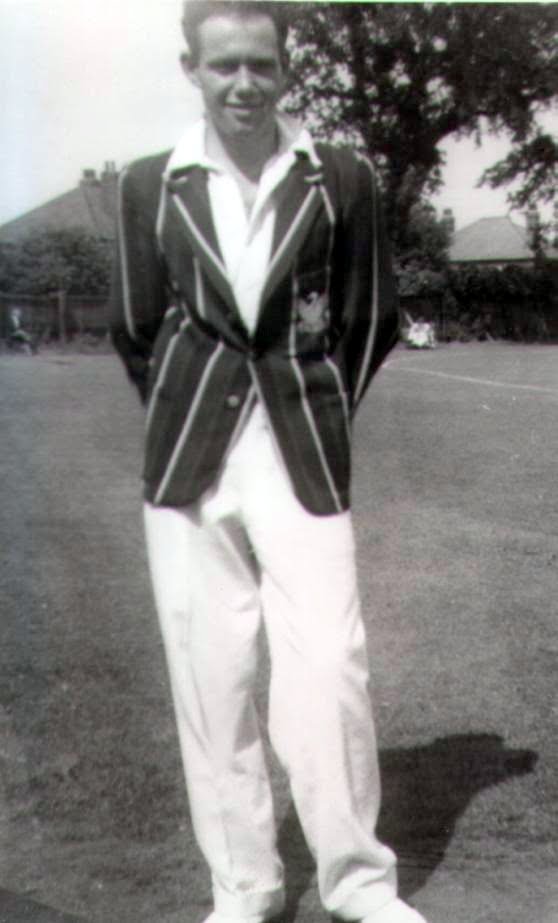
 Then there's a slightly older sporting single in this shot taken at Lincoln Lindum cricket ground in the 1950s.

Bob - Stamford School blazer
I still have the blazer but sad to say it no longer fits - it must have shrunk. Some time later I settled for more formal attire.

Single breasted - all dressed up - waiting to go.
I just wish I could remember just where I was meant to go!

Keeping it in the family I've saved a shot from my brother's war photos till last.

Unknown Naval Officer - c1940 - with his cats.

For more photos on the theme you need to visit the other single people at Carmi's Written Inc. TP191