Pages

Showing posts with label Wales. Show all posts

Wednesday, 4 April 2018

A-Z Challenge 2018 - British Rivers; 'D' Dee, Derwent

Why I chose the Dee and Derwent to write about I'm not sure. Now I find that there are four rivers for each of these names.

The Welsh Dee rises in Snowdonia and passes from North Wales into Cheshire, through the Roman town of Chester and enters the sea at the estuary between Wales and the Wirral.

In Scotland one River Dee is in Galloway, but it's the River Dee in Aberdeenshire with which I used to be familiar, driving up the A90 and over - 


Bridge of Dee
Uisge Dhè is its name in Gaelic; the Dee is one of the most famous salmon rivers in the world. In Royal Deesside it passes between Braemar and Banchory. It's this connection with the Royal Family, Queen Victoria and Balmoral that is known to so many visitors.

River Dee at Potarch (between Aboyne and Banchory)
The Cumbrian River Derwent runs through two of the district's major Lakes - Derwentwater and Bassenthwaite Lake. It empties into the Irish Sea.

The time I spent with British Rail at Derby in the 1990s gave me many closeups on Derbyshire's River Derwent. I missed out on its mainly rural route and its entry into the River Trent south of the city.

The River Derwent, River Gardens & The Council House, Derby
Despite my years in both Aberdeen and Derby I had no chance to take photos of the rivers. I regret that now - all work and no play!

Photo attributions:
  • Bridge of Dee: 19 April 2009, ex geograph.org.uk by Anne Burgess - CC BY-SA licence
  • River Dee at Potarch: April 1995, ex geograph.org.uk by Colin Smith - CC BY-SA 2.0
  • River Derwent etc, Derby: c2004 by Eamon Curry - CC BY 2.0 licence


Sunday, 14 January 2018

Sunday Stamps II A-Z 'W' - French West Africa, Wales

I really struggled with this letter so much so that I got quite wild. So it seemed natural to look for something different. Eventually I came up with not one but two - 


Wildebeest
Not being able to find stamps from the states of Wisconsin or Wyoming I settled for a President's wife.

Martha Washington
I did not think Senegal would come to my rescue until I realise it used to be one of the colonies making up -

French West Africa
I have got so used to looking at stamps from Great Britain I forgot that we have a 'W' on our doorstep.

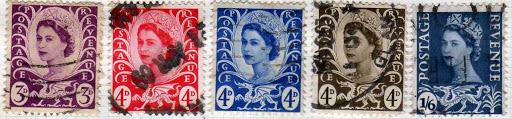
Wales - Wilding Definitive

And later from decimal currency - 


Which Welsh dragon do you prefer - Wilding or Machin?

Select your choice with an 'X' - sorry that's next week!

For more 'W' stamps cross over to Sunday-Stamps-II-161.


Wednesday, 18 April 2012

Powis Castle and the Spinning Spinster


A-Z Challenge 2012 - P
Powis Castle

Powis Castle, near Welshpool in Powys, Mid Wales was built in the 12th century as a stronghold for the Princes of Powys as a defence against English invaders. The castle sits on a rocky ridge with steep slopes to the south-east and north-west.

Powis Castle
During the latter half of the 13th century, Owain, the last Prince of Powis began a rebuilding programme most of which is still visible today. In 1578 the castle came into the hands of Sir Edward Herbert, in whose family it has remained. Extensive repairs and modernisation were carried out by the Herberts in the late 1500s. The family were staunch Royalists during the Civil War. Powis Castle was captured by the Parliamentarian forces in 1644, garrisoned by them during the remainder of the war and not returned to the family until the restoration of Charles II.

William, Lord Powis, inherited the castle on the death of his father in 1667. A State Apartment, the Blue Drawing Room, library and the State Bedroom were all additions by William.

In 1784 Lady Henrietta Herbert married the eldest son of Clive of India; Edward Clive later changed his name to Herbert. The Clive fortune paid for overdue repairs to the castle and funded improvements to the gardens and park. It was George Herbert, 4th Earl of Powis who bequeathed the castle and gardens to the National Trust on his death in 1952.

Powis Castle - from its gardens 2006
The most famous haunting associated with Powis Castle is that involving a devout spinster invited in 1780 to stay and do some spinning work for the Earl. Little did she know that she had been given a bedroom known to be haunted.

As she was sitting by the fire reading her bible, she heard the door open. A man dressed in gold lace entered the room, crossed to the window and stood there silently, before turning and leaving the room. Not a word was spoken.

The woman knelt to pray when the ghostly man reappeared and motioned to her to follow him. By the light of a candle he led her to another room and showed her a locked casket beneath a floorboard. The phantom told her to take the casket and its key and send it to the Earl in London, promising her he would leave the house in peace if she did what she had been told.

Apparently the Earl was so delighted that he mad provision for the spinster to live in comfort at the castle for the rest of her life.

The contents of the casket were never revealed. The ghost in the gold lace suit was never seen again.

Hilary Melton-Butcher's castle for O - Oystermouth Castle on the Gower.

Attributions
  • Powis Castle; author Val Vannet; Geograph project collection; Creative Commons Attribution-ShareAlike 2.0 license.
  • Powis Castle viewed from its gardens, 2006; author Phil Catterall; Creative Commons Attribution-ShareAlike 2.0 license.

Thursday, 12 April 2012

Kidwelly Castle and the Headless Princess


 A-Z Challenge 2012 - K
Kidwelly Castle

The Norman castle of Kidwelly overlooks the River Gwendraeth and the town of Kidwelly in Carmarthenshire, Wales. Developed over more than three centuries of warfare the castle’s outer half-moon, towered walls stand on the Norman earthwork. Inside is the first stone stronghold with four round towers at each corner with the great stone gatehouse in the south outer wall.

Kidwelly Castle - 2001
The original 12th century timber castle was defended on one side by the river and a deep crescent ditch to the landward. Its strategic position defended the road to west Wales. The castle fell to the Welsh several times during the 12th and 13th centuries. At the end of the 13th century Henry, Earl of Lancaster built the inner rectangular stronghold with its four round towers. The great gatehouse took over a century to complete and was unfinished when Owen Glyndwr’s Welsh troops attacked in 1403. King Henry V ensured that the damaged gatehouse was rebuilt. Its design is such that it could be defended even if the rest of the castle was taken.

The Great Gatehouse, Kidwelly Castle - 2008
The end of the 15th century saw the addition of a new great hall at the west of the outer ward and a connecting kitchen within the inner ward. Another building and a bakehouse were added, possibly by Rhys ap Thomas who had been granted the castle by King Henry VII. The castle played a minor role in the Civil War as it lay far way from the main areas of the struggle.

The formidable history of the castle and especially the gatehouse gives approaching visitors the feeling of being watched; they may even meet the glowering ghost of a medieval sentry its dark recesses.

It is even suggested that the headless spirit of brave Gwenllian, Wales' best-loved warrior princess, stalks the grounds of Kidwelly Castle and the bloody battlefield upon which she was killed in 1136.

Gwenllian is not the female to haunt the area. Spudder’s Bridge over the River Gwendraeth is known as the Bridge of the White Spirit. The Norman lover of Nest, the daughter of the castle’s owner, was killed and thrown into the river by an assassin. Nest jumped in as well and drowned. Her spirit is said to return to the scene of the tragedy.

Hilary Melton-Butcher's Castle yesterday was J - Johnstown Castle, Wexford, Eire

Attributions:
  • Image 1: Kidwelly Castle 2001; by John Atherton; Geograph Project Collection; Creative Commons Attribution-ShareAlike 2.0 license.
  • Image 2: The Great Gatehouse, Kidwelly Castle 2008; by Rose and Trevor Clough; Creative Commons Attribution-ShareAlike 2.0 license.

Thursday, 5 April 2012

Eerie Ewloe Castle

A-Z Challenge 2012 - E

Eerie Ewloe Castle

Ewloe Castle stands on a promontory in North-East Wales near the town of Harwarden, Flintshire. Its position near the English border gave it a strategic control of the road to Chester. Today its ruins are under the control of the Welsh heritage agency (Cadw – pronounced ‘kadu’.)

Ewloe Castle - 2008
The area had earned its place in history even before the castle was built as in 1157 Welshmen led by Owain Gwynedd, the then King of North Wales, nearly killed the English King Henry II at the battle of Ewloe.

Llywelyn the Last began the castle’s construction in 1257, adding to work undertaken by Owain Gwynedd and Llywelyn the Great.

At the outbreak of the Welsh Wars in 1277, Edward I left Chester and established a base at Flint. Although Ewloe may have been occupied by Edward, Flint and Rhuddlan castles were preferred; they could be restocked by sea and that’s why Ewloe went into decline.

Ewloe Castle - East Wing 2005
Stories of ghosts abound at Ewloe. A glowing spectre strolling the ramparts once so startled a dog that it never recovered from the shock and died two days later. Legends say that marching soldiers can be heard in the surrounding woodland. During thunderstorms the singing of a phantom crooner drifts down from the ramparts, loud enough to be audible above the storms.

Hilary Melton-Butchers Castle for D - Dover Castle

Image attribution:
  • Ewloe Castle – 2008; by Brian Jorgensen; Creative Commons Attribution-ShareAlike 2.0 license.
  • Ewloe Castle (east wing) – 2007; by Peter Craine; Creative Commons Attribution-ShareAlike 2.0 license.
  • Images from the Geograph project collection.

Sunday, 29 January 2012

Dragons - Sunday Stamps

Viridian has chosen to celebrate China and the year of the Dragon this week.

China’s first stamps appeared in 1878 and had dragons on them! They are known as “large dragon stamps” and are very rare. I wish I had one of them, but the nearest I can offer you is a an image of a stamp from 1897.


China - 1897, Dragon
In the year of the Dragon, many different countries issue dragon stamps. The year 2000 was a dragon year, and dragon stamps were issued in Macau, U.S.A, Canada, Christmas Islands, Hong Kong, Japan and China, of course. I'm told that the first Japanese stamps in 1871 also depicted dragons.

I looked hard for other dragon stamps and was disappointed to find I had very few. However I was pleased to find this dragon's head on a Norwegian stamp.

Norway - 1972
Viking longships had dragon heads like this on their prows. However I have not been able to confim whether these are dragons on these other stamps from Scandinavia. Perhaps someone can tell me whether they are.

Finland
I looked hard to find stamps with komodo dragons but had to give up as my stamps from Indonesia had pangolins.

I was on much safer ground closer to home as a dragon is always depicted on the regional issues from Wales.

Great Britain - Wales - pre 1971 - Wilding design
Wales - post 1971 - Machin design
1971 was the year Breat Britain changed from pounds, shillings and pence to decimal currency.

Wales - Commonwealth Games 1958
My favourite dragon stamp is one I don't possess - it's from the set of mythical creatures.

Great Britain


Thursday, 24 February 2011

Ghosts in March


Where you in Pembrokeshire on the nights before and after 1st March, St David’s Day? Perhaps if you visited St Bride’s Bay you may have heard ghostly singing from the ruined chapel overlooking the Bay.
No.

St David's Cathedral and the Bishop's Palace
© Copyright Martin Halley and licensed for reuse under this Creative Commons Licence
(Photo is copyrighted but also licensed for reuse)

 Then perhaps you heard the church bell stolen from the tower of St David’s Cathedral. The bell was lost together with the boat and crew that smuggled it into St Bride’s Bay. The boat sank in a storm. Seamen claim to hear the bell chiming on the seabed to warn them of an impending storm.

On 9th March in Cassiobury Park, Watford you may meet the ghost of Lord Arthur Capel.

1st Baron Capel and his family
(Portrait - source Norton Anthology; Author Cornelius Johnson)

Lord Capel defected from the Roundheads to support the King in the Civil War. Captured by Fairfax at Colchester, he even escaped from the Tower. Recaptured he eventually lost his head. 9th March is the anniversary of his death in 1649.

 Ferry Boat Inn
© David Bartlett - Licensed for reuse under CC-ASA 2.0 License

 The Ferry Boat Inn in Holywell claims to be the oldest inn in England. A slab in the floor covers the grave of 17 year-old Juliet Tewsley who hanged herself on 17th March 1050 as the resulted of unrequited love for a local woodcutter. Her ghost is said to appear each March on the anniversary of her suicide.