Pages

Thursday, 12 April 2012

Kidwelly Castle and the Headless Princess


 A-Z Challenge 2012 - K
Kidwelly Castle

The Norman castle of Kidwelly overlooks the River Gwendraeth and the town of Kidwelly in Carmarthenshire, Wales. Developed over more than three centuries of warfare the castle’s outer half-moon, towered walls stand on the Norman earthwork. Inside is the first stone stronghold with four round towers at each corner with the great stone gatehouse in the south outer wall.

Kidwelly Castle - 2001
The original 12th century timber castle was defended on one side by the river and a deep crescent ditch to the landward. Its strategic position defended the road to west Wales. The castle fell to the Welsh several times during the 12th and 13th centuries. At the end of the 13th century Henry, Earl of Lancaster built the inner rectangular stronghold with its four round towers. The great gatehouse took over a century to complete and was unfinished when Owen Glyndwr’s Welsh troops attacked in 1403. King Henry V ensured that the damaged gatehouse was rebuilt. Its design is such that it could be defended even if the rest of the castle was taken.

The Great Gatehouse, Kidwelly Castle - 2008
The end of the 15th century saw the addition of a new great hall at the west of the outer ward and a connecting kitchen within the inner ward. Another building and a bakehouse were added, possibly by Rhys ap Thomas who had been granted the castle by King Henry VII. The castle played a minor role in the Civil War as it lay far way from the main areas of the struggle.

The formidable history of the castle and especially the gatehouse gives approaching visitors the feeling of being watched; they may even meet the glowering ghost of a medieval sentry its dark recesses.

It is even suggested that the headless spirit of brave Gwenllian, Wales' best-loved warrior princess, stalks the grounds of Kidwelly Castle and the bloody battlefield upon which she was killed in 1136.

Gwenllian is not the female to haunt the area. Spudder’s Bridge over the River Gwendraeth is known as the Bridge of the White Spirit. The Norman lover of Nest, the daughter of the castle’s owner, was killed and thrown into the river by an assassin. Nest jumped in as well and drowned. Her spirit is said to return to the scene of the tragedy.

Hilary Melton-Butcher's Castle yesterday was J - Johnstown Castle, Wexford, Eire

Attributions:
  • Image 1: Kidwelly Castle 2001; by John Atherton; Geograph Project Collection; Creative Commons Attribution-ShareAlike 2.0 license.
  • Image 2: The Great Gatehouse, Kidwelly Castle 2008; by Rose and Trevor Clough; Creative Commons Attribution-ShareAlike 2.0 license.

Wednesday, 11 April 2012

Singles - Thematic Photography

When I saw this week's theme was 'single people' I wondered what to do. Then my grandson saved me.

Angus - Panama 2012
Angus is a member of the GB Squad for the World Junior Surfing Championship to be held in Panama starting on 14 April. You may see more 'single' surfers here.

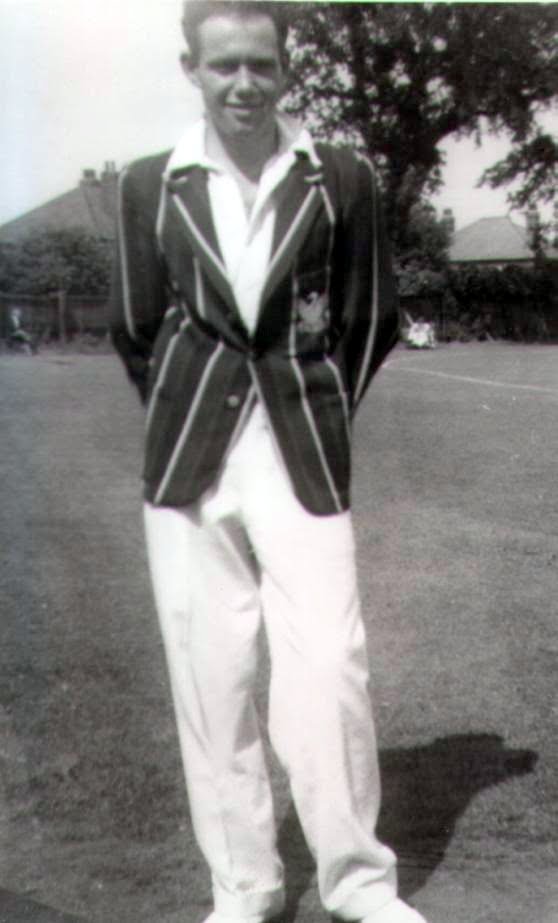
 Then there's a slightly older sporting single in this shot taken at Lincoln Lindum cricket ground in the 1950s.

Bob - Stamford School blazer
I still have the blazer but sad to say it no longer fits - it must have shrunk. Some time later I settled for more formal attire.

Single breasted - all dressed up - waiting to go.
I just wish I could remember just where I was meant to go!

Keeping it in the family I've saved a shot from my brother's war photos till last.

Unknown Naval Officer - c1940 - with his cats.

For more photos on the theme you need to visit the other single people at Carmi's Written Inc. TP191

Johnstone Castle, Renfrewshire


A-Z Challenge 2012 - J
Johnstone Castle

All that remains today of Johnstone Castle in Renfrewshire, Scotland is the protected Category B square central tower and a crow-stepped section of an older date. The original building dates back to the 16th century. Its L-shape consisted of three storeys and a wing remodelled as a Gothic tower.

Johnstone Castle - North west elevation 2009
The lands in Renfrewshire had passed to Sir Ludovic Houston in 1645; it was the fourth laird of Johnstone Castle, George Houston who in 1771 and 1812 had it extended in the castellated Gothic style.

Frederick Chopin, the Polish composer visited the castle in 1848. It’s said that a relationship existed between Chopin and Jane Stirling, the sister-in-law of the 5th laird. He became sick after a concert in Glasgow and was nursed by Jane and her sister for some weeks. A few months later Chopin died in Paris.

During World War II the MOD took over the castle and a POW camp was set up in the grounds. A Polish soldier who died at the castle is buried in the nearby woods. Supposedly Chopin’s music is sometime to be heard on moonlight nights between the castle and the woods.

Johnstone Castle - viewed from south 2009
Most of the house was demolished in 1950 and the land taken over by the local council. The remains of the castle are now surrounded by a housing estate.

Hilary Melton-Butcher's Scottish Castle yesterday was Inveraray Castle

Attributions:
  • Johnstone Castle, North West Elevation; by wfmillar; Creative Commons Attribution-Share Alike 2.0 Generic license.
  • Johnstone Castle; by wfmillar; Creative Commons Attribution-Share Alike 2.0 Generic license.

Tuesday, 10 April 2012

Inverness Castle


 A-Z Challenge 2012 - I
Inverness Castle

The red sandstone Inverness Castle on the cliff overlooking the River Ness in Scotland is a comparatively modern castle. Although a series of castles have stood on the site since the 11th century, the castle we see today was built as recently as 1836.

Inverness Castle - 2005
The 12th century earth and timber fortress was occupied by English troops under King Edward I; King Robert the Bruce took and destroyed the castle in 1310. A stone castle founded in the early 15th century by the Earl of Mar had a square stone tower added by George Gordon, Earl of Huntly in the 1548. Gordon was constable of the castle until 1562.

He was hanged by Mary Queen of Scots after the castle had been taken for the Queen by the Frasers and Munros. Earlier the Queen had found the gates of the castle shut against her.

The castle was defended against the Jacobites more that once. During the second major Jacobite rising in 1745 it fell to Bonnie Prince Charlie (Prince Charles Edward Stuart). It was blown up after the Battle of Culloden.

The castle now standing on the site was built to house the Sheriff Courthouse and County Hall. A deep well and part of a bastion wall are all that remain of the medieval castle.

Inverness Castle front - 2007
Hilary Melton-Butcher's Castle H - Herstmonceux Castle, East Sussex

Attribution
  • Inverness Castle, 2005, by Dave Connor, originally posted to Flickr; Creative Commons Attribution 2.0 Generic license.
  • Inverness Castle – Front, 2007, by Conor Power (Waterford, Ireland); Creative Commons Attribution 2.0 Generic license. 

Monday, 9 April 2012

Huntington Castle - The Wailing Wife and the Phantom Bishop

A-Z Challenge 2012 - H

Huntington Castle - The Wailing Wife and the Phantom Bishop

Huntington Castle stands in Clonegal, County Carlow, Ireland. During his conquest of Ireland Cromwell captured the castle in 1650.

Back in the 13th century there had been a Franciscan monastery on the site. The Jacobean castle built in 1625 by Sir Laurence Esmonde replaced an earlier stronghold on the site of the monastery.

Huntington Castle - 2008


Huntington is a site that abounds with ghosts. The original monks planted a yew tree walk which survives to this day. It is there that you might just come across their ghostly forms.

The marriage of the Protestant Sir Laurence and his Catholic wife, Ailish had its problems. It’s said that one night Ailish took her baby son and stole away to her Connaught family. Sir Laurence promptly took a new wife. Ailish’s wraithlike spirit sometimes stands in the garden combing her hair and wailing in anguish at the unfairness of it all.

The tale is also told of the ghosts of Barbara St Lege and her maidservant, Honor Byrne. They wander the corridors, keys jangling and Honor polishing door handles with her hair.

Should you hear a knock on the castle door it may turn out to be a spectral soldier from Cromwell’s time. Sent to gather information from the enemy his comrades did not recognise him when he returned, still in disguise. His ghostly face may be seen at the grille through which he was shot.

The Bishop of Limerick died at the castle in 1770. Occupants of the Four Poster Room in the bedroom wing have claimed to see his ghost standing at the foot of their bed. From time to time his friendly face is said to replace that of a Spanish flower girl in the portrait by Murillo above the fireplace.

At ground level stone steps lead down to the space which in 1640 Cromwell’s men used as a dungeon. In modern times (1976) Lawrence Durdin-Robertson, his wife and sister converted the cellars into the head-quarters of the Fellowship of Isis which now has a worldwide membership.

Hilary Melton-Butcher's Castle G - Grimsthorpe Castle, Lincolnshire

Attribution
  • Image - Huntington Castle 2008 by Liam Hughes, Milwaukee, WI, USA; the Creative Commons Attribution 2.0 Generic license.

Sunday, 8 April 2012

British Architecture - Sunday Stamps

I've had these stamps in mind for a long time, waiting for the right theme.

British Architecture - Cathedrals

These stamps were issued on 28 May 1969. The cathedrals are from the top:
  • Durham Cathedral  and York Minster
  • St Giles Edinburgh and Canterbury Cathedral
  • St Paul's Cathedral and Liverpool Metropolitan Cathedral
The colours have not scanned well and tend to be deeper and harsher than on the actual stamps.

For more architecture check the stamps posted by others at Viridian's Sunday Stamps 65

Saturday, 7 April 2012

Glenbuchat Castle


A-Z Challenge 2012 - G

Glenbuchat Castle

Glenbuchat Castle - 2007
 Glenbuchat Castle sits on a bluff above the River Don, near Kildrummy in Aberdeenshire. The Z-plan castle has a rectangular central tower with two square towers at diagonally opposing corners.

The castle was built in 1590 to mark the wedding of John Gordon of Cairnbarrow and his wife Helen. A later John Gordon, known as ‘Old Glenbucket’ (an older spelling) supported the Jacobite cause and became a hero of the Jacobite Risings.

So far my posts have managed to include ghostly hauntings. It was the infamy achieved by Old Glenbucket that supposedly haunted the dreams of King George III.

After the sale of the castle in 1738 the castle fell into disrepair. Purchased by James Barclay in 1901, it was handed to the state in 1946. The main spiral staircase to the castle’s upper levels has been restored.

Glenbuchat is usually unmanned and access to a viewing platform erected across the central area is restricted. Visitors may however explore the first floor and the vaulted ground-floor rooms.

However if you wanted to see Scotland’s most haunted castle then you should go to Glamis which I wrote about here in November 2010.

Hilary Melton-Butcher's Castle  for F - Framlingham Castle Suffolk

Attribution:
  • Glenbuchat Castle 2007; By Stanley Howe; Creative Commons Attribution-ShareAlike 2.0 license; Geograph Project collection.