Pages

Showing posts with label Norfolk. Show all posts

Saturday, 28 April 2018

A-Z Challenge 2018 - British Rivers: 'Y' Yare

In 1949 I was awarded a form prize at Stamford School. The book I chose was 'Coot Club' by Arthur Ransome. It is the story of Dick and Dorothea and their adventures in a yacht, the Titmouse, as they sailed down the River Yare in Norfolk.

The inside covers contain maps of the Norfolk Broads and the Northern and Southern Rivers which are navigable.


River Yare as it runs south from Norwich
You should be able to see the name Buckenham Ferry

Buckenham Ferry on the River Yare -
oil painting by Joseph Stannard (1797-1830)
River Yare by Buckenham Marshes
The Yare is a principal navigable waterway of the Norfolk Broads and flows into and out of Breydon Water.

The Yare's route to the from Reedham to Gorleston-on-Sea
View of Gorleston-on-Sea from South Denes
I've always been a little disappointed that this river which runs through Great Yarmouth is not called the River Yarm. (Yarm is the town on the North East River Tees -see my 'T' post) My visits to Yarmouth have either been on holiday or to catch a helicopter from North Denes heliport when going offshore.

Photo attributions:

  • Buckenham Ferry on the River Yare: Joseph Stannard 1826 painting - Yale Centre for British Art  - public domain
  • River Yare by Buckenham Marshes: 3 January 2009 ex geograph.org.uk by Hugh Venables - CC BY-SA 2.0 Licence
  • View of Gorleston-on-Sea across the River Yare: 13 February 2009  ex geograph.org.uk by Craig Tuck - CC BY-SA 2.0 Licence

Thursday, 26 April 2018

A-Z Challenge 2018 - British Rivers: 'W' Wye, Wear, Wensum.

It's at this stage in the A-Z when I wonder Wye I started and Wear (where) I've got to and Wensum one will comment.

I started with the Wye because apart from the River Severn it has the most westerly of sources in the UK. It rises on Plynlimon in mid Wales and forms part of the border between England and Wales. Its valley is an area of Outstanding Natural Beauty.


River Wye at Hay on Wye looking downstream towards Hereford
On a visit to Chepstow some years ago I took a photo of the Wye from the Castle walls but as I can no longer find it I have had to make do with this shot, at low tide, instead.

River Wye at Chepstow
The River Wear is one of the longest rivers in North East England. It rises in the Pennines, flows through County Durham, the city of Durham before reaching Sunderland and the North Sea.

I've seen it often from up high on - 

Croxdale railway viaduct carrying the East Coast mainline between London and Edinburgh near Durham
Having started in Wales it's time to finish in the east.

Swans on the River Wensum
The Wensum is another of those chalk rivers I've mention in earlier posts. 71 km of its length has been designated as a Site of Special Scientific Interest and a Special Area of Conservation. If you have Google Earth on your computer you may see all about the Wensum.

It's a tributary of the River Yare despite being the larger of the two and it flows through the city of Norwich.

Photo attributions:
  • River Wye at Hay on Wye: 29 August 2008 ex geograph.org.uk by OLU - CC BY-SA 2,0 Licence
  • River Wye at Chepstow: 3 September 2003 ex geograph.org.uk by Robin Somes - CC BY-SA 2,0 Licence
  • River Wear - Croxdale viaduct: 30 June 2007 by Peter G Hughes - CC BY-SA 3.0 Licence
  • Swans on River Wensum: 25 January 2008 ex geograph.org.uk by Evelyn Simak - CC BY-SA 2.0 Licence.


Wednesday, 22 April 2015

A - Z Challenge 2015 - Butterflies 'S'

S - Speckled Wood, Swallowtail

The Speckled Wood we see frequently in Yorkshire but the Swallowtail in the British Isles is confined to wetland areas of eastern England.

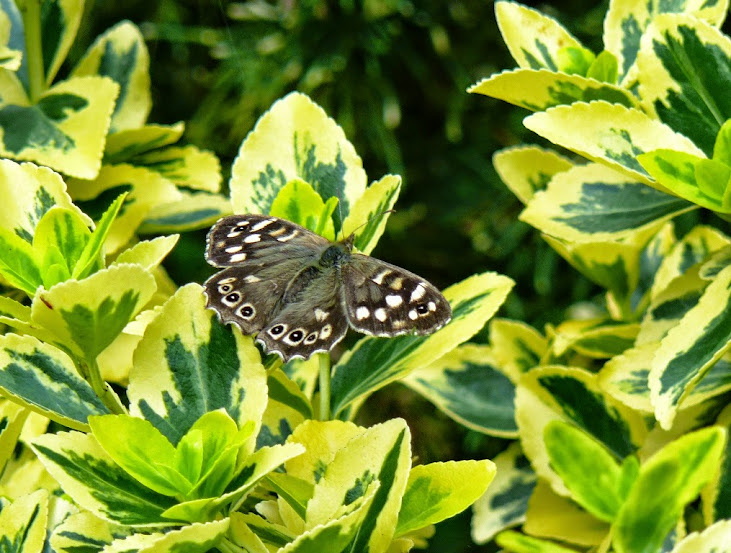
The Speckled Wood is another of those butterflies that visits our Butterfly Bush, As it always seems to be on the move its difficult to photograph, however I caught up with one elsewhere on a shrub in our garden.


Speckled Wood (Pararge segeria) on Euonymous bush

The Strumpshaw Fen nature reserve  in Norfolk managed by the RSPB is one of the few breeding sites for the Swallowtail.

Swallowtail (Papilio britannicus) at Strumpshaw
The Swallowtail is the largest resident British butterfly with a wingspan of 8 - 10cm.

I've yet to see one. Until yesterday at least; but the ones I saw at Butterfly World at Preston Park in Eaglescliffe where tropical Swallowtails.


Love is like a butterfly
As soft and gentle as a sigh
The multicolored moods of love are like its satin wings
Love makes your heart feel strange inside
It flutters like soft wings in flight
Love is like a butterfly, a rare and gentle thing

I feel it when you're with me
It happens when you kiss me
That rare and gentle feeling that I feel inside
Your touch is soft and gentle
Your kiss is warm and tender
Whenever I am with you I think of butterflies

Love is like a butterfly
The multicolored moods of love are like its satin wings
Love makes your heart feel strange inside
It flutters like soft wings in flight
Love is like a butterfly, a rare and gentle thing

Your laughter brings me sunshine
Every day is spring time

Photo attribution:
  • Swallowtail: RSPB Strumpshaw Fen, geograph.or.uk, 11 June 2007, by Janet Richardson - CC BY-SA 2.0

Friday, 21 June 2013

Milking Time - Sepia Saturday

In the days before milking machines there were many tasks to be performed, even as we can see from this week's prompt a churn being delivered by a man on horseback.

During World War I milk was delivered to your door from churns sometimes carried by women.
A woman at work - 1917
(Imperial War Museum collections)
If you look closely you can see the hooves of the horse pulling the cart.

This practice continued between the wars; in our village deliveries were made by Mr Capendale, a local farmer. You had to go out to his cart for milk to be ladled into your own container. My elder brother got into trouble for filling one of his churns with stones when he wasn't looking.

Of course before you could use a churn it had to be cleaned as can be seen at a farm in Norfolk during WWII.
Steam cleaning a churn - 1944(Imperial War Museum collections)
Prior to the war in Holland Jewish immigrants were trained to become farmers as you can see on this short video form August 1937..
(Nederlands Instituut voor Beeid en Geluid - CC BY-SA 3.0 NL)

There was no steam cleaning here, just women cleaning milk churns by hand.

For other related posts you need to cross over to Sepia-saturday-182 and follow the links.

Thursday, 16 February 2012

Pairs - Thematic Photography

OH dear where to start when totally devoid of ideas and no chance to find pairs outside! What better place than this:

Hydroxide Lone Pair
(By Benjah-bmm 27)

For those who wonder what it is, in chemistry this represents the hydroxide ion (I think).

My next pair or two were right before my eyes.

Spectacles and scissors.
Here's a well thumbed pair that have seen better days.

Two pairs
Someone must have bet more than their shirt on those to end up like this.

Too shy to model pants, socks and gloves
Look what happened to his shoes.

Spare pair of shoes up street lamp in Norwich, Norfolk
(by Keith Evans -- CC A-SA 2.0 license)

I just hope that he didn't finance his gambling habit by pawning these.

Earings - three pairs.
Well I guess it's time to stop monkeying around.

Add caption
and for you to pair off at Carmi's Written Inc 183