Pages

Showing posts with label Billingham. Show all posts

Thursday, 20 February 2014

Men in Suits - Sepia Saturday

This days wearing a suit makes me itch. Perhaps that's why I found myself at the local flea market earlier today and found some men in suits. Just don't ask who these four are/were.


However these two were named.


According to the back of the photo they were called Ben & Ern who had sent the photo to someone unknown in 1939, "With Best Wishes."


Our prompt for this week shows three men in suits. Well if you average the number of men in my two flea market photos you also come up with three.

However I can do better that that with this 'formal' shot.

Lord Nelson hands over the winner's cheque
Lincolnshire Iron & Steel Institute Dinner  1962
The man in the middle was C G Davies, President of The Lincolnshire Iron & Steel Institute and MD of Richard Thomas and Baldwins, Redbourn Works, Scunthorpe. My winning young members' paper that I had presented at a meeting earlier in the year was entitled "Experience with the Rotor Process at Redbourn Works, with special reference to lance control."

The plant at Redbourn was the only oxygen steelmaking Rotor process ever installed in the UK although there had been other plants in Germany, where the process was developed, and in South Africa.

Rotor Steelmaking Vessel
The vessel is in the blowing position with lance, which you can just see, on the right. The rotating vessel can be rotated through 360 degrees in the horizontal plane. It can also be be tilted; and tilted vertically when empty for the vessel to be removed for relining while another takes its place.

Rotor cross-section showing oxygen blowing in progress
Oxygen is blown through a lance (3) into the metal (1). The lance at Redbourn was different to this with the tip turned down. Impurities removed from the metal form a slag (2) with added lime.. Gases formed are extracted (5) to a gas cleaning plant..At the end of the process the metal can be decanted via a tap hole into a ladle (not shown) by tilting the vessel. The vessel produced about 100 tons of steel at a time.

Before I left Scunthorpe at the end of 1969 the steel industry had been nationalised. In 1971 I became Works Manager of a foundry and engineering shop in Billingham on Teesside and there were more men in suits.

Sir Monty Finniston visits APV Paramount
From right to left they are J F B Jackson, MD: Sir Monty Finniston - Chairman of British Steel, behind him Bill Cockburn, General Manager: Leslie Halling, Sales Director; A n other; and me complete with orange ear muffs..

The tubes that they were examining where intended for the British Steel Direct Reduction plant at Hunterston, Scotland. That plant never operated and was it was eventually moved to the USA.

So you can see that my early career was heavily involved with steel which brings me to men in suits in a drawing on my study wall.

Demonstration of an early steel rolling process
I must say one man is trying a hard sell; others look more sceptical.

For more suited gentry roll over to Sepia-Saturday-216.


Monday, 15 April 2013

A-Z Challenge 2013 - 'M'


My A-Z posts this year are based on my garden – flowers, animals, the birds and the bees, butterflies - with a bit of poetry thrown in. For some letters I am expecting to cheat somewhat – a sort of wish they were here.

M – Mahonia, Michaelmas Daisy, Magpie, Mallard, Moorhen

The mahonia bush we inherited in the front garden when we moved into our house over 20 years ago stands about three feet tall. At this time of year it shows a flower head like this:


Mahonia
Those buds develop into berries later in the year. Which bird takes a liking to them we do not know; something must because a second shrub has appeared in the garden at the back of the house.

Later in the year some daisies grow,

Michaelmas Daisies
Lilac and blue, the daisies nurse now
Quiet suns in a centre of petals.

You always know when there is mischief afoot when you hear these birds; their raucous noise sounds just like the House of Commons at PM’s Question Time – no wonder the collective name for a group of them is a parliament. We see a pair regularly now but it has not reached the stage when they are mobbed by other birds frightened for their young.


Magpie
One for sorrow,
Two for mirth,
Three for a wedding,
And four for death

This rhyme, first recorded around 1780, has its origins in superstitions connected with magpies. The magpie was considered a bird of ill omen in some cultures, and in Britain, at least as far back as the early sixteenth century

A bird that overflies us often is the  mallard. We even see them in the corner of a waterlogged field


Mallard Ducks
It does not cluck.
A cluck it lacks.
It quacks.
It is specially fond
Of a puddle or pond.
When it dines it sups,
It bottoms ups.

Mallards occur on my golf course at Billingham. There is a pond on the 11th hole to which this verse could well apply:

In Spring in pond in grove by the old streamlet amongst the reeds the moorhen built her nest
A bulky mass just above the water level of flags and long dried grass the material she liked best

Moorhen
 But when it comes to dogs some take exception to being given a bath after rolling in deer droppings. Just to show who is in charge she dries off in the dirtiest spot she can find.


Maxie sulking

Poems:
  • The Moorhen Pond – Francis Dugan
  • Michaelmas Daisies – Ronald ‘Chalky’ White
  • Mallard Duck – Albert Aunchman

Thursday, 12 January 2012

Hold On To Your Hats - Sepia Saturday

I have never understood why so many ladies are fascinated by them - but now I've discover that 'facination' is a collective noun for hats. It must be due to displays like this:

Many Hats - by Quadell
(Released under GNU Free Documentation Licence - CC-BY-SA 3.0)

But even I can see the attraction of hats like these:

Two Girls in Hats
Create by L Prang & Co (publisher) 1881-1897
(Boston Public Library - ex flickr - CC-BY 2.0)

In my experience hats take different forms and are there for a practical purpose even if the lady is only checking out whether there is garlic in the dishes prepared for a meal.

Chef in Cyprus
For many years in industry it was hard hats for all.

JFB Jackson and Sir Monty Finniston (centre) at APV Paramount, Billingham
My sideburns have just got in on the act!

On a less serious note some horns get in on the hat.

Not JR
And here's a hat once worn for a wedding, but the wearer is shy so you will have to make do with just the hat.

Wedding Hat
Fortunately Sally and Sam are not so shy.

Sally & Sam Scarecrow
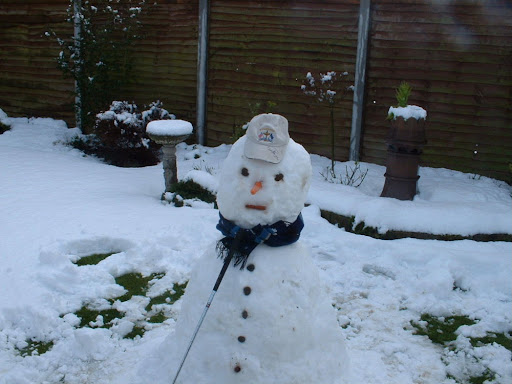
These days I wear a cap to keep the sun out of my eyes or a bobble hat to keep my head warm when I am playing golf. There must be something wrong with this golfer however:

Ryder Cup Cap (2004) ; St Andrews Undergraduate Scarf (1950s)
Now it's time to take your hat off to the 'mad hatters' at Sepia Saturday