Joseph Lister was a pioneer of antiseptic surgery who promoted the idea of sterile surgery while working at the Glasgow Royal Infirmary. Lister successfully introduced carbolic acid to sterilise surgical instruments and to clean wounds, which led to a reduction in post-operative infections and made surgery safer for patients.
Lister tested the results of spraying instruments, the
surgical incisions, and dressings with a solution of carbolic acid. Lister found
that the solution swabbed on wounds remarkably reduced the incidence of
gangrene. In August 1865, Lister applied a piece of lint dipped in
carbolic acid solution onto the wound of an eleven year old boy at
Glasgow Infirmary, who had sustained a compound fracture after a cart
wheel had passed over his leg. After four days, he renewed the pad and
discovered that no infection had developed, and after a total of six
weeks he was amazed to discover that the boy's bones had fused back
together, without the danger of suppuration.
 |
| Great Britain - Centenary of Joseph Lister discovering |
. Antiseptic Surgery - (issued 1 September 1965)
The stamp has not scanned well; its catalogue description says it is indigo, black and grey. The tube snaking down the centre of the stamp should be indigo (red).
Carbolic acid and related phenols can be derived from coal tar - this reminded me of this set of stamps issued on 25 Jan 1978.
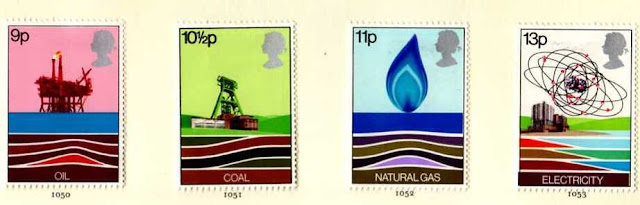 |
| Great Britain - Energy Resources |
I believe I have shown the 'coal' stamp in an earlier Sunday Stamps post.
To see what other useful/practical items have been chosen for this week please visit Viridian at
Sunday-stamps-85


